Human Nutrition Unit, Department of Oncology & Metabolism, The Medical School, University of Sheffield, Sheffield, S10 2RX, UK.
Corporate Information & Computing Service, University of Sheffield, Sheffield, S10 2GU, UK.
Nutr J. 2018 Oct 5;17(1):90. doi: 10.1186/s12937-018-0398-y.
University represents a key transition into adulthood for many adolescents but there are associated concerns about health and behaviours. One important aspect relates to diet and there is emerging evidence that university students may consume poor quality diets, with potential implications for body weight and long-term health. This research aimed to characterise dietary patterns of university students in the UK and their sociodemographic and lifestyle antecedents.
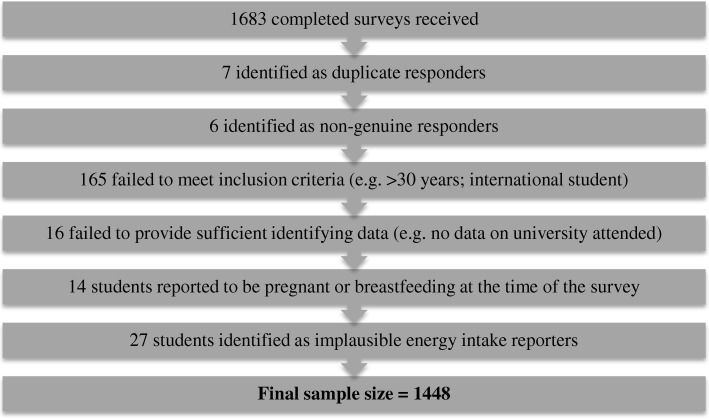
An online, cross-sectional survey was undertaken with a convenience sample of 1448 university students from five UK universities (King's College London, Universities of St Andrews, Southampton and Sheffield, and Ulster University). The survey comprised a validated food frequency questionnaire alongside lifestyle and sociodemographic questions. Dietary patterns were generated from food frequency intake data using principal components analysis. Nutrient intakes were estimated to characterise the nutrient profile of each dietary pattern. Associations with sociodemographic variables were assessed through general linear modelling.
Dietary analyses revealed four major dietary patterns: 'vegetarian'; 'snacking'; 'health-conscious'; and 'convenience, red meat & alcohol'. The 'health-conscious' pattern had the most favourable micronutrient profile. Students' gender, age, year of study, geographical location and cooking ability were associated with differences in pattern behaviour. Female students favoured the 'vegetarian' pattern, whilst male students preferred the 'convenience, red meat & alcohol' pattern. Less healthful dietary patterns were positively associated with lifestyle risk factors such as smoking, low physical activity and take-away consumption. The health-conscious pattern had greatest nutrient density. The 'convenience, red meat & alcohol' pattern was associated with higher weekly food spending; this pattern was also identified most consistently across universities. Students reporting greater cooking ability tended towards the 'vegetarian' and 'health-conscious' patterns.
Food intake varied amongst university students. A substantial proportion of students followed health-promoting diets, which had good nutrient profiles obviating a need for dietary intervention. However, some students consumed poor diets, incurred greater food costs and practised unfavourable lifestyle behaviours, which may have long-term health effects. University policy to improve students' diets should incorporate efforts to promote student engagement in cooking and food preparation, and increased availability of low cost healthier food items.
对许多青少年来说,大学代表着向成年期的关键过渡,但健康和行为方面存在相关问题。一个重要方面与饮食有关,有新的证据表明,大学生可能饮食质量较差,这可能对体重和长期健康产生影响。本研究旨在描述英国大学生的饮食模式及其社会人口学和生活方式的前因。
采用横断面调查,在英国五所大学(伦敦国王学院、圣安德鲁斯大学、南安普顿大学、谢菲尔德大学和阿尔斯特大学)的便利样本中对 1448 名大学生进行了在线调查。该调查包括经过验证的食物频率问卷以及生活方式和社会人口学问题。使用主成分分析从食物频率摄入数据中生成饮食模式。估计营养素摄入量以描述每种饮食模式的营养状况。通过一般线性模型评估与社会人口学变量的关联。
饮食分析揭示了四种主要的饮食模式:“素食”、“零食”、“注重健康”和“方便、红肉和酒精”。“注重健康”的模式具有最有利的微量营养素特征。学生的性别、年龄、学习年限、地理位置和烹饪能力与模式行为的差异有关。女学生倾向于“素食”模式,而男学生则更喜欢“方便、红肉和酒精”模式。不太健康的饮食模式与吸烟、低体力活动和外卖消费等生活方式风险因素呈正相关。“注重健康”的模式具有最大的营养密度。“方便、红肉和酒精”模式与每周食品支出较高有关;该模式在各大学也最一致。报告烹饪能力较高的学生倾向于“素食”和“注重健康”的模式。
大学生的食物摄入量各不相同。相当一部分学生遵循促进健康的饮食,这些饮食具有良好的营养状况,无需进行饮食干预。然而,一些学生饮食较差,食物支出较高,且生活方式不佳,这可能对长期健康产生影响。改善学生饮食的大学政策应包括努力促进学生参与烹饪和食品准备,以及增加低成本更健康食品的供应。
