Peters Robert Mattson, Lui Matt, Patel Kunjan, Tian Lewis, Javaherian Kavon, Sink Eric, Xu Ran, Xu Zhuchen, Aung Wint, Zhou Li, Huynh Justin, Polites Gregory, Blanchard Melvin, Som Avik, Ross Will, Bernal-Mizrachi Carlos
Washington University in St. Louis School of Medicine, St. Louis, MO, United States.
Saint Louis University School of Medicine, St. Louis, MO, United States.
JMIR Diabetes. 2017 Jul 25;2(2):e15. doi: 10.2196/diabetes.7910.
Type II diabetes mellitus (T2DM) presents a major disease burden in the United States. Outpatient glycemic control among patients with T2DM remains difficult. Telemedicine shows great potential as an adjunct therapy to aid in glycemic control in real-world settings.
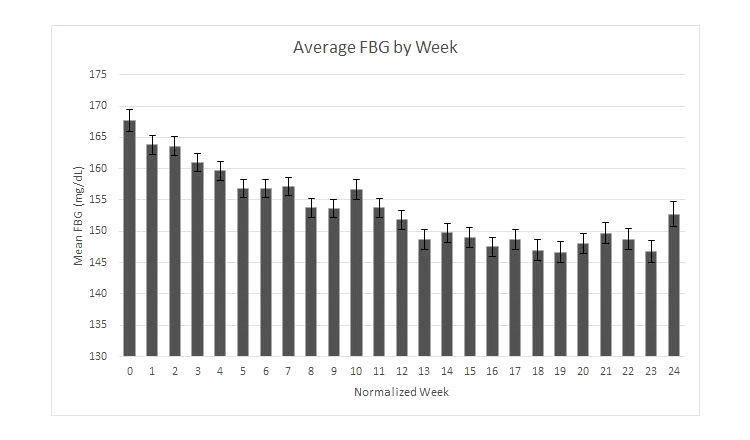
We aimed to explore the effectiveness of EpxDiabetes, a novel digital health intervention, in improving hemoglobin A1c (HbA1c) and fasting blood glucose (FBG) among patients with uncontrolled diabetes.
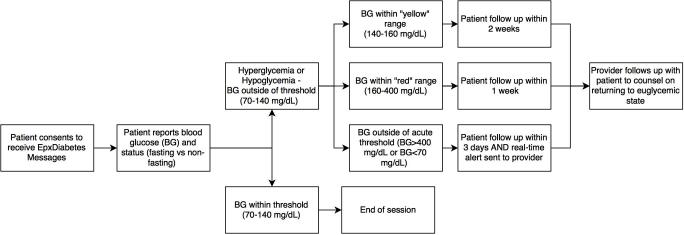
We recruited 396 patients from a community clinic in St. Louis, Missouri, from a database of patients diagnosed with T2DM and with a most recent HbA1c >7% as part of a quality improvement project. An automated call or text-messaging system was used to monitor patient-reported FBG. If determined to be elevated, care managers were notified by email, text, or electronic medical record alert. Participants self-reported their FBG data by replying to EpxDiabetes automated phone calls or text messages. Data were subsequently analyzed, triaged, and shared with providers to enable appropriate follow-up and care plan adjustments. Absolute HbA1c reduction, patient engagement, and absolute patient-reported FBG reduction were examined at approximately 6 months post implementation.
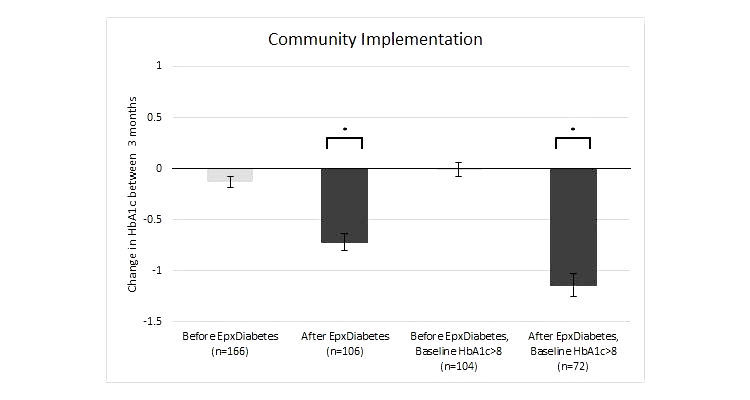
EpxDiabetes had an average 95.6% patient response rate to messages at least once per month and an average 71.1% response rate to messages at least once per week. Subsequent HbA1c drop with EpxDiabetes use over 4 months was -1.15% (95% CI -1.58 to -0.71) for patients with HbA1c >8% at baseline compared to the change in HbA1c over 4 months prior to the implementation of EpxDiabetes of only -0.005 points (95% CI -0.28 to 0.27), P=.0018.
EpxDiabetes may help reduce HbA1c in patients with high HbA1c baselines (>8%). The intervention demonstrates high patient engagement sustainable for at least 6 months.
2型糖尿病(T2DM)在美国是一项主要的疾病负担。T2DM患者的门诊血糖控制仍然困难。远程医疗作为一种辅助疗法,在现实环境中帮助血糖控制方面显示出巨大潜力。
我们旨在探讨新型数字健康干预措施EpxDiabetes在改善未控制糖尿病患者的糖化血红蛋白(HbA1c)和空腹血糖(FBG)方面的有效性。
作为质量改进项目的一部分,我们从密苏里州圣路易斯的一家社区诊所的数据库中招募了396名被诊断为T2DM且最近HbA1c>7%的患者。使用自动呼叫或短信系统监测患者报告的FBG。如果确定FBG升高,通过电子邮件、短信或电子病历警报通知护理经理。参与者通过回复EpxDiabetes自动电话或短信自行报告他们的FBG数据。随后对数据进行分析、分类,并与提供者共享,以便进行适当的随访和护理计划调整。在实施后约6个月时检查HbA1c的绝对降低、患者参与度以及患者报告的FBG的绝对降低。
EpxDiabetes对每月至少一次的消息的患者平均响应率为95.6%,对每周至少一次的消息的平均响应率为71.1%。与实施EpxDiabetes前4个月HbA1c仅变化-0.005个百分点(95%CI -0.28至0.27)相比,基线HbA1c> 8%的患者在使用EpxDiabetes超过4个月后HbA1c下降了-1.15%(95%CI -1.58至-0.71),P = 0.0018。
EpxDiabetes可能有助于降低基线HbA1c较高(>8%)的患者的HbA1c。该干预措施显示出至少可持续6个月的高患者参与度。