Program in Computational Biology, Fred Hutchinson Cancer Research Center, Seattle, Washington.
Centre for Tumour Biology, Barts Cancer Institute, London, United Kingdom.
Cancer Res. 2019 Feb 1;79(3):495-504. doi: 10.1158/0008-5472.CAN-18-1682. Epub 2018 Oct 5.
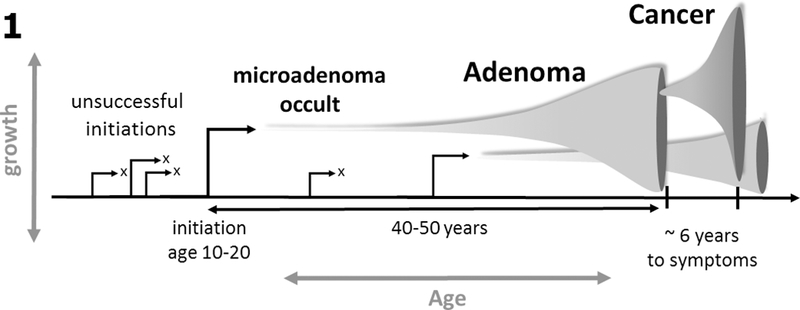
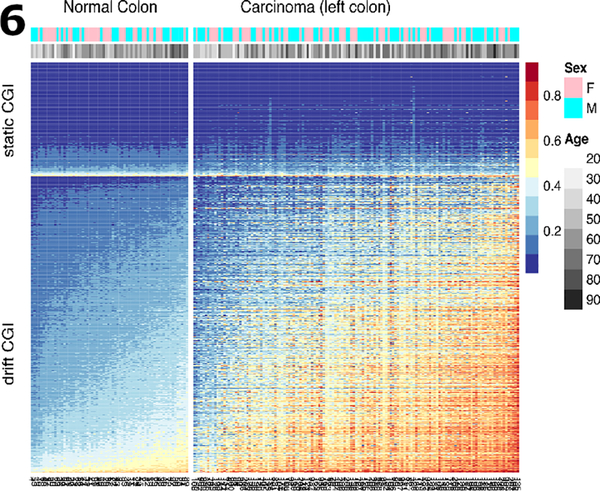
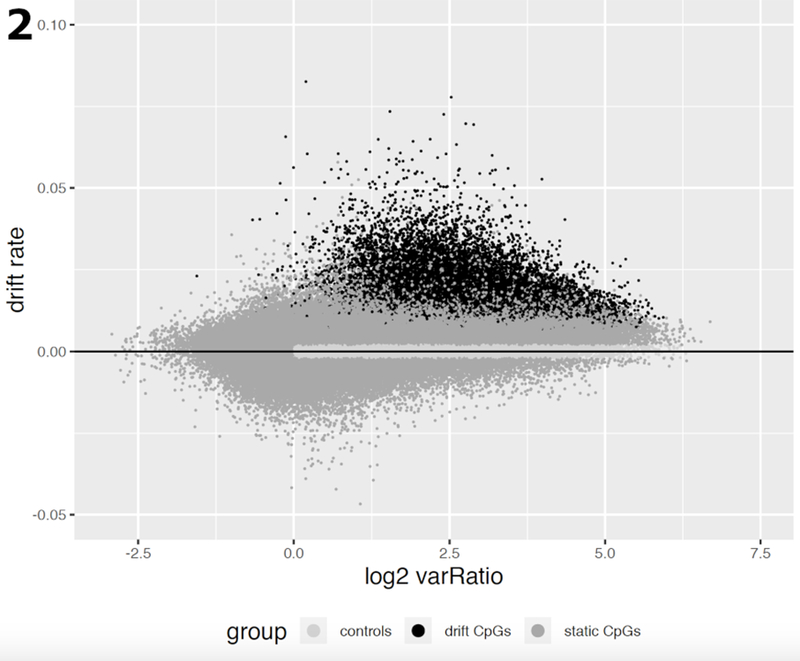
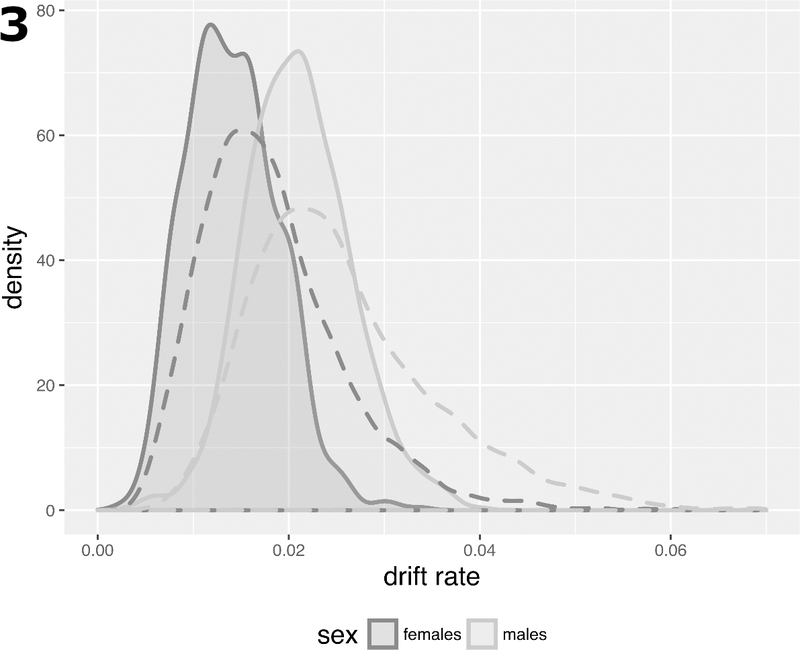
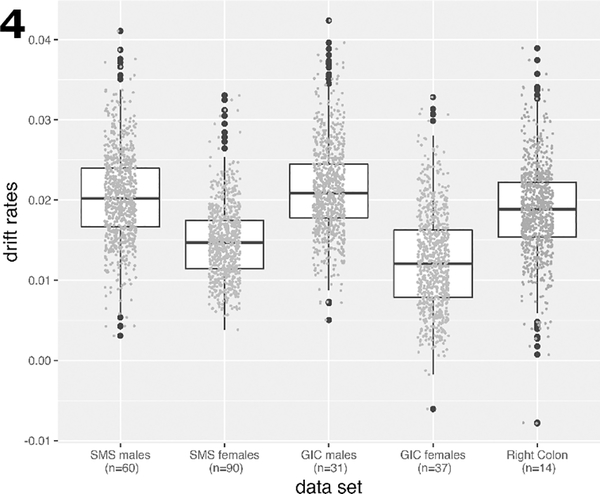
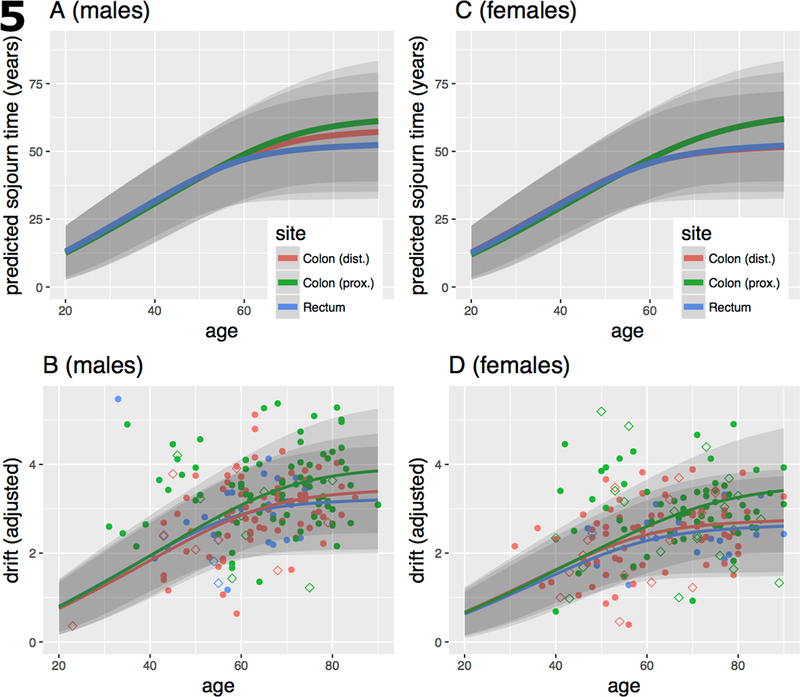
Many normal tissues undergo age-related drift in DNA methylation, providing a quantitative measure of tissue age. Here, we identify and validate 781 CpG islands (CGI) that undergo significant methylomic drift in 232 normal colorectal tissues and show that these CGI continue to drift in neoplasia while retaining significant correlations across samples. However, compared with normal colon, this drift advanced (∼3-4-fold) faster in neoplasia, consistent with increased cell proliferation during neoplastic progression. The observed drift patterns were broadly consistent with modeled adenoma-to-carcinoma sojourn time distributions from colorectal cancer incidence data. These results support the hypothesis that, beginning with the founder premalignant cell, cancer precursors frequently sojourn for decades before turning into cancer, implying that the founder cell typically arises early in life. At least 77% to 89% of the observed drift variance in distal and rectal tumors was explained by stochastic variability associated with neoplastic progression, whereas only 55% of the variance was explained for proximal tumors. However, gene-CGI pairs in the proximal colon that underwent drift were significantly and primarily negatively correlated with cancer gene expression, suggesting that methylomic drift participates in the clonal evolution of colorectal cancer. Methylomic drift advanced in colorectal neoplasia, consistent with extended sojourn time distributions, which accounts for a significant fraction of epigenetic heterogeneity in colorectal cancer. Importantly, these estimated long-duration premalignant sojourn times suggest that early dietary and lifestyle interventions may be more effective than later changes in reducing colorectal cancer incidence. SIGNIFICANCE: These findings present age-related methylomic drift in colorectal neoplasia as evidence that premalignant cells can persist for decades before becoming cancerous..
许多正常组织的 DNA 甲基化会随着年龄的增长而发生漂移,为组织年龄提供了一种定量的衡量标准。在这里,我们鉴定和验证了 232 个正常结直肠组织中发生显著甲基组漂移的 781 个 CpG 岛(CGI),并表明这些 CGI 在肿瘤发生过程中仍会继续漂移,同时在样本之间保持显著相关性。然而,与正常结肠相比,这种漂移在肿瘤中进展得更快(约 3-4 倍),这与肿瘤进展过程中细胞增殖增加一致。观察到的漂移模式与从结直肠癌发病率数据中模拟的腺瘤-癌转变时间分布广泛一致。这些结果支持这样的假设,即从创始性癌前细胞开始,癌症前体在变成癌症之前通常会停留数十年,这意味着创始细胞通常在生命早期出现。远端和直肠肿瘤中观察到的漂移变异的至少 77%到 89%可以用与肿瘤进展相关的随机变异性来解释,而近端肿瘤只有 55%的变异可以用这种方法来解释。然而,发生漂移的近端结肠中的基因-CGI 对与癌症基因表达呈显著负相关,表明甲基组漂移参与了结直肠癌的克隆进化。结直肠肿瘤中的甲基组漂移与扩展的滞留时间分布一致,这解释了结直肠癌中相当一部分的表观遗传异质性。重要的是,这些估计的长持续时间的癌前滞留时间表明,早期的饮食和生活方式干预可能比后期的改变更能有效降低结直肠癌的发病率。意义:这些发现为结直肠肿瘤中的年龄相关甲基组漂移提供了证据,表明癌前细胞可以在癌变前持续数十年。