Department of Ecology and Evolution, University of Lausanne, CH-1015, Lausanne, Switzerland.
Arizona Game and Fish Department, 5000 W. Carefree Highway, Phoenix, AZ, 85086, USA.
Nat Commun. 2018 Oct 5;9(1):4088. doi: 10.1038/s41467-018-06517-2.
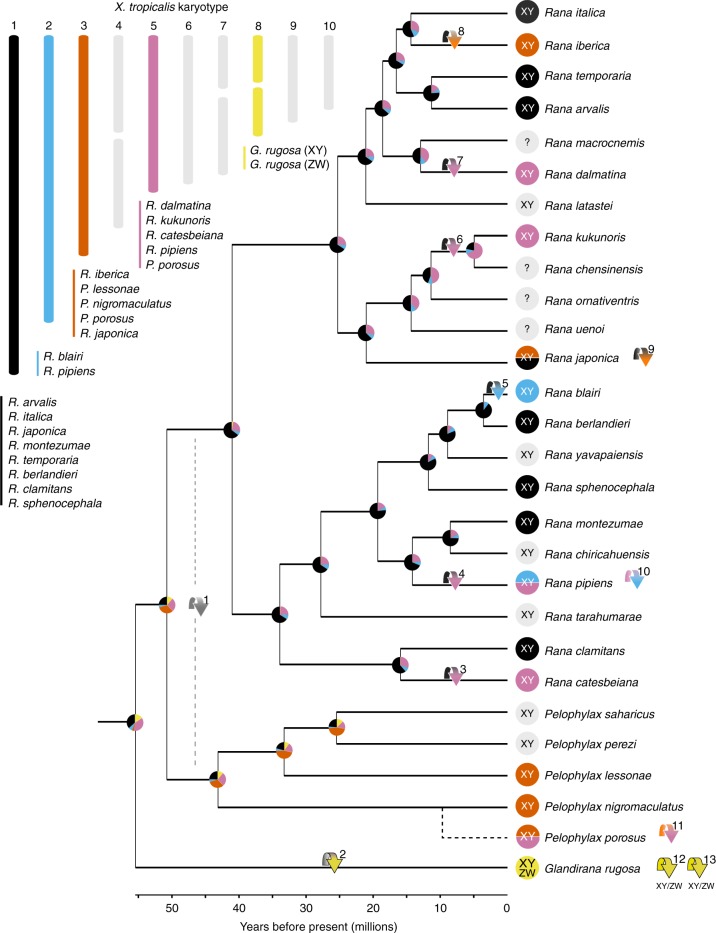
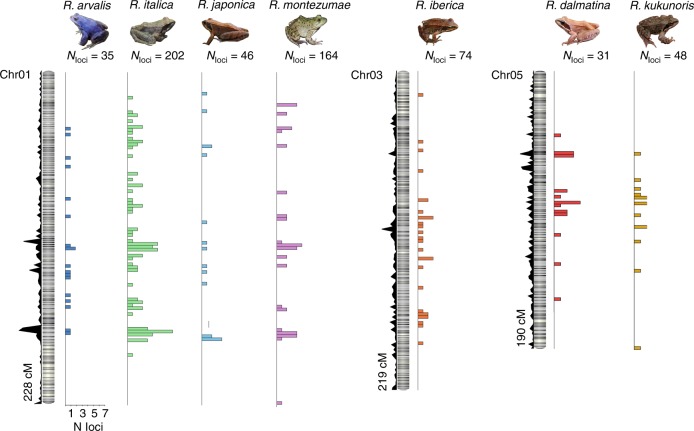
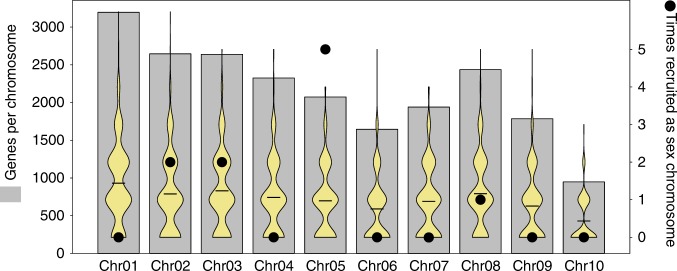
The canonical model of sex-chromosome evolution predicts that, as recombination is suppressed along sex chromosomes, gametologs will progressively differentiate, eventually becoming heteromorphic. However, there are numerous examples of homomorphic sex chromosomes across the tree of life. This homomorphy has been suggested to result from frequent sex-chromosome turnovers, yet we know little about which forces drive them. Here, we describe an extremely fast rate of turnover among 28 species of Ranidae. Transitions are not random, but converge on several chromosomes, potentially due to genes they harbour. Transitions also preserve the ancestral pattern of male heterogamety, in line with the 'hot-potato' model of sex-chromosome transitions, suggesting a key role for mutation-load accumulation in non-recombining genomic regions. The importance of mutation-load selection in frogs might result from the extreme heterochiasmy they exhibit, making frog sex chromosomes differentiate immediately from emergence and across their entire length.
性染色体进化的规范模型预测,随着重组在性染色体上受到抑制,配子体将逐渐分化,最终变得异型。然而,在生命之树的众多例子中存在着同型性染色体。这种同型性被认为是由于频繁的性染色体倒位造成的,但我们对驱动它们的力量知之甚少。在这里,我们描述了 28 种 Ranidae 物种中极其快速的倒位率。转变不是随机的,而是集中在几条染色体上,这可能是由于它们所携带的基因。转变也保留了祖先的雄性异型配子体模式,符合性染色体转变的“热土豆”模型,这表明非重组基因组区域中突变负荷积累起着关键作用。在青蛙中,突变负荷选择的重要性可能源于它们表现出的极端异质型,使得青蛙的性染色体从出现时就开始分化,并在整个长度上分化。