Division of Psychiatry and Applied Psychology, School of Medicine, CANDAL (Centre for ADHD and Neurodevelopmental Disorders across the Lifespan), Institute of Mental Health, University of Nottingham, Nottingham, UK.
Eur Child Adolesc Psychiatry. 2019 Nov;28(11):1417-1429. doi: 10.1007/s00787-018-1229-6. Epub 2018 Oct 6.
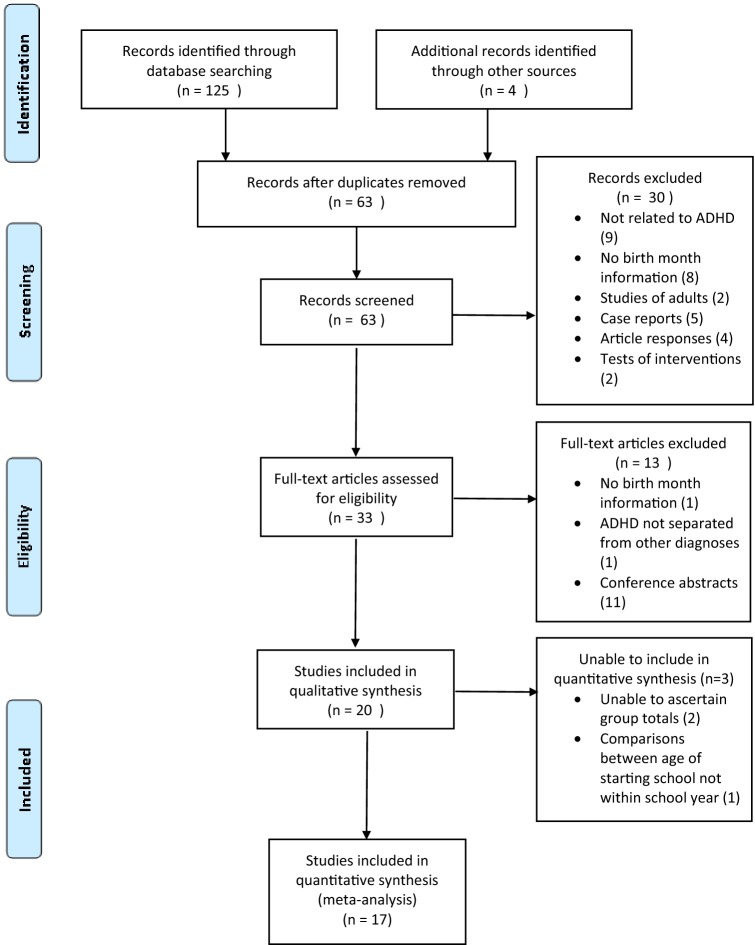
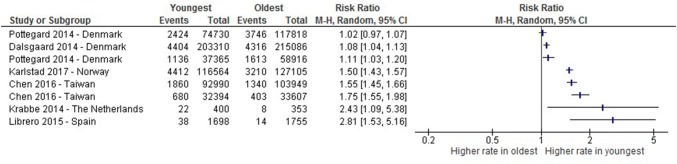
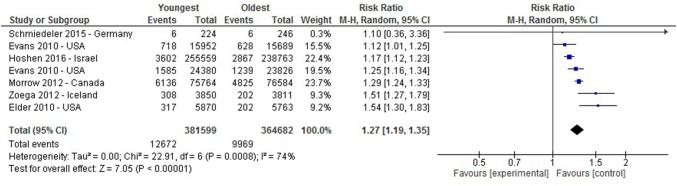
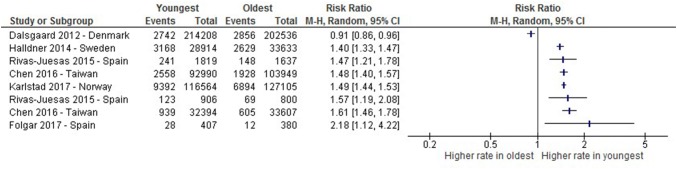
There is a growing international literature investigating the relationship between attention-deficit/hyperactivity disorder (ADHD) and younger relative age within the school year, but results have been mixed. There are no published systematic reviews on this topic. This study aimed to systematically review the published studies on the relative age effect in ADHD. Systematic database searches of: Medline, Embase, PsycINFO, Web of Science, ERIC, Psychology and Behavioral Sciences Collection and The Cochrane Library were conducted. Studies were selected which investigated the relative age effect in ADHD in children and adolescents. Twenty papers were included in the review. Sixteen (of 20) papers reported a significantly higher proportion of relatively younger children being diagnosed with ADHD and/or receiving medication for this. Meta-analyses involving 17 of these 20 papers revealed a modest relative age effect in countries with higher prescribing rates, risk ratio = 1.27 (95% CI 1.19-1.35) for receipt of medication. The relative age effect is well demonstrated in countries with known higher prescribing rates. Amongst other countries, there is also increasing evidence for the relative age effect, however, there is high heterogeneity amongst studies. Further research is needed to understand the possible reasons under-pinning the relative age effect and to inform attempts to reduce it.
目前,国际上有越来越多的文献研究注意力缺陷多动障碍(ADHD)与学年内年龄较小的相关性,但结果不一。针对这一主题,目前尚无已发表的系统评价。本研究旨在系统地回顾 ADHD 中相对年龄效应的已发表研究。对 Medline、Embase、PsycINFO、Web of Science、ERIC、心理学和行为科学收藏以及 Cochrane 图书馆进行了系统的数据库检索。研究选择了调查儿童和青少年 ADHD 中相对年龄效应的研究。共有 20 篇论文纳入了综述。16 篇(20 篇中的 16 篇)论文报告称,相对年龄较小的儿童被诊断为 ADHD 的比例以及为此接受药物治疗的比例明显更高。对其中 17 篇论文进行的荟萃分析表明,在药物处方率较高的国家中,相对年龄效应适中,药物治疗的风险比为 1.27(95%置信区间 1.19-1.35)。在已知药物处方率较高的国家中,相对年龄效应得到了很好的证明。在其他国家,也有越来越多的证据表明存在相对年龄效应,但研究之间存在很大的异质性。需要进一步的研究来了解相对年龄效应的可能原因,并为试图减少这种效应提供信息。