Rabesandratana Oriane, Goureau Olivier, Orieux Gaël
Sorbonne Université, INSERM, CNRS, Institut de la Vision, Paris, France.
Front Neurosci. 2018 Sep 20;12:651. doi: 10.3389/fnins.2018.00651. eCollection 2018.
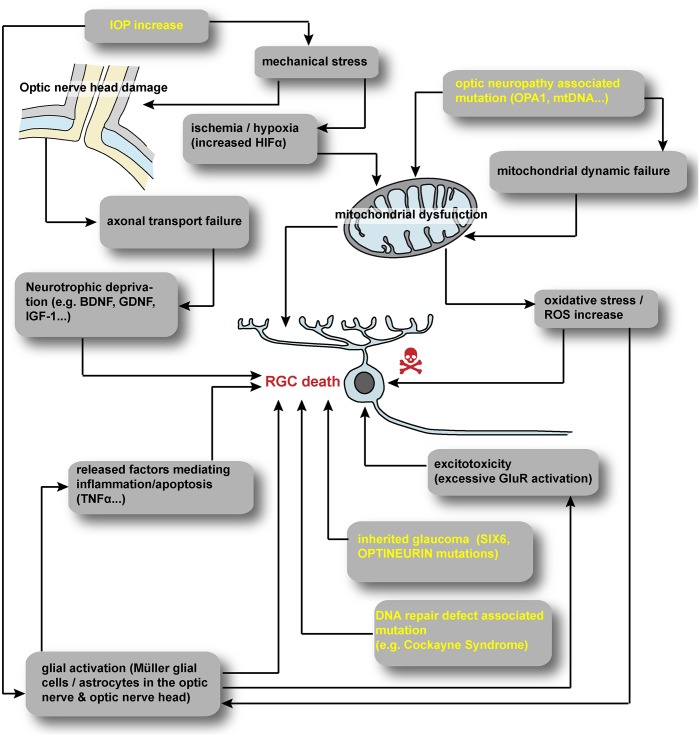
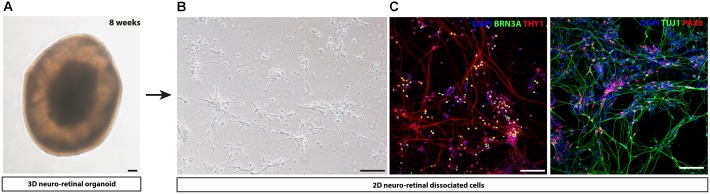
Sight is a major sense for human and visual impairment profoundly affects quality of life, especially retinal degenerative diseases which are the leading cause of irreversible blindness worldwide. As for other neurodegenerative disorders, almost all retinal dystrophies are characterized by the specific loss of one or two cell types, such as retinal ganglion cells, photoreceptor cells, or retinal pigmented epithelial cells. This feature is a critical point when dealing with cell replacement strategies considering that the preservation of other cell types and retinal circuitry is a prerequisite. Retinal ganglion cells are particularly vulnerable to degenerative process and glaucoma, the most common optic neuropathy, is a frequent retinal dystrophy. Cell replacement has been proposed as a potential approach to take on the challenge of visual restoration, but its application to optic neuropathies is particularly challenging. Many obstacles need to be overcome before any clinical application. Beyond their survival and differentiation, engrafted cells have to reconnect with both upstream synaptic retinal cell partners and specific targets in the brain. To date, reconnection of retinal ganglion cells with distal central targets appears unrealistic since central nervous system is refractory to regenerative processes. Significant progress on the understanding of molecular mechanisms that prevent central nervous system regeneration offer hope to overcome this obstacle in the future. At the same time, emergence of reprogramming of human somatic cells into pluripotent stem cells has facilitated both the generation of new source of cells with therapeutic potential and the development of innovative methods for the generation of transplantable cells. In this review, we discuss the feasibility of stem cell-based strategies applied to retinal ganglion cells and optic nerve impairment. We present the different strategies for the generation, characterization and the delivery of transplantable retinal ganglion cells derived from pluripotent stem cells. The relevance of pluripotent stem cell-derived retinal organoid and retinal ganglion cells for disease modeling or drug screening will be also introduced in the context of optic neuropathies.
视觉是人类的一种主要感官,视力障碍会严重影响生活质量,尤其是视网膜退行性疾病,它是全球不可逆失明的主要原因。与其他神经退行性疾病一样,几乎所有视网膜营养不良的特征都是一种或两种细胞类型的特异性丧失,如视网膜神经节细胞、光感受器细胞或视网膜色素上皮细胞。考虑到保留其他细胞类型和视网膜神经回路是一个先决条件,这一特征在处理细胞替代策略时是一个关键点。视网膜神经节细胞特别容易受到退行性病变的影响,而青光眼是最常见的视神经病变,也是一种常见的视网膜营养不良。细胞替代已被提出作为应对视觉恢复挑战的一种潜在方法,但其应用于视神经病变尤其具有挑战性。在任何临床应用之前,都需要克服许多障碍。除了它们的存活和分化,植入的细胞必须与上游的视网膜突触细胞伙伴和大脑中的特定靶点重新连接。迄今为止,视网膜神经节细胞与中枢远端靶点的重新连接似乎不切实际,因为中枢神经系统对再生过程具有抗性。在理解阻止中枢神经系统再生的分子机制方面取得的重大进展为未来克服这一障碍带来了希望。与此同时,人类体细胞重编程为多能干细胞的出现,既促进了具有治疗潜力的新细胞来源的产生,也推动了可移植细胞生成的创新方法的发展。在这篇综述中,我们讨论了基于干细胞的策略应用于视网膜神经节细胞和视神经损伤的可行性。我们介绍了从多能干细胞衍生的可移植视网膜神经节细胞的生成、表征和递送的不同策略。在视神经病变的背景下,还将介绍多能干细胞衍生的视网膜类器官和视网膜神经节细胞在疾病建模或药物筛选中的相关性。