Division of Biostatistics, Tohoku University Graduate School of Medicine, Sendai, Japan.
Medical Affairs Division, CAC Croit Corporation, Chuo-ku, Tokyo, Japan.
PLoS One. 2018 Oct 8;13(10):e0205146. doi: 10.1371/journal.pone.0205146. eCollection 2018.
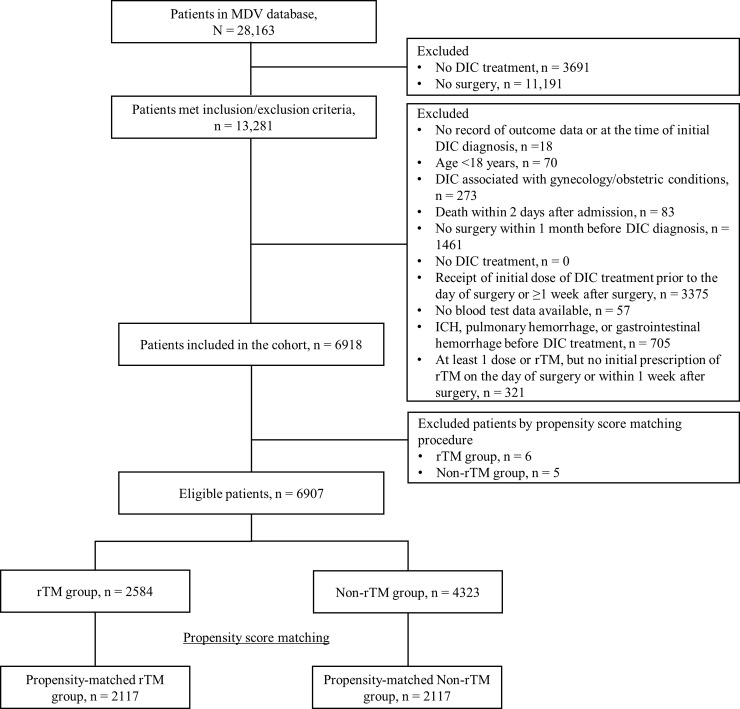
We aimed to investigate the incidence of bleeding-related adverse events (AEs) among patients with disseminated intravascular coagulation (DIC) receiving recombinant thrombomodulin (rTM) and those receiving other DIC treatments, the incidence by type of surgery, and the incidence when either blood transfusion or a hemostatic procedure was administered to treat DIC. In this cohort study, data were obtained from a large medical database (22 centers in Japan). The primary endpoint was the incidence rate of bleeding-related AEs by type of surgery. The secondary endpoint was the incidence rate of bleeding-related AEs based on whether blood transfusion or a hemostatic procedure was administered after the day of DIC treatment. In total, 4234 propensity score-matched patients were included in the main analysis (2117 patients each in the rTM and non-rTM groups). In the rTM and non-rTM groups, respectively, the incidence of bleeding-related AEs was 18.8% and 24.8% (p <0.001; risk ratio [RR] 0.757, 95% confidence interval [CI] 0.674-0.849), among patients requiring any type of surgery; 15.0% and 19.5% (p = 0.0001; RR 0.769, 95% CI 0.673-0.879) in patients requiring blood transfusion or a hemostatic procedure after the day of DIC treatment; 10.2% and 11.6% (p = 0.4470; RR 0.879, 95% CI 0.630-1.226) in patients undergoing hepatic, biliary, or pancreatic surgery; 24.3% and 25.4% (p = 0.6439; RR 0.955, 95% CI 0.786-1.160) in patients undergoing gastrointestinal surgeries; and 18.5% and 30.1% (p = 0.0001; RR 0.614, 95% CI 0.481-0.782) in patients undergoing cardiac or cardiovascular surgery. Our findings suggest that rTM treatment for Japanese postsurgical patients who develop DIC was associated with significantly fewer bleeding-related AEs compared with those receiving other DIC treatments.
我们旨在研究接受重组血栓调节蛋白(rTM)治疗和接受其他弥散性血管内凝血(DIC)治疗的弥散性血管内凝血(DIC)患者出血相关不良事件(AE)的发生率、不同类型手术的发生率,以及当输血或止血程序用于治疗 DIC 时的发生率。在这项队列研究中,数据来自一个大型医疗数据库(日本 22 个中心)。主要终点是根据手术类型确定的出血相关 AE 发生率。次要终点是根据 DIC 治疗后是否输血或止血程序确定的出血相关 AE 发生率。总共纳入了 4234 名倾向评分匹配的患者进行主要分析(rTM 和非-rTM 组各 2117 名患者)。rTM 和非-rTM 组分别有 18.8%和 24.8%(p<0.001;风险比 [RR]0.757,95%置信区间 [CI]0.674-0.849)的患者发生出血相关 AE;需要输血或止血程序的患者分别有 15.0%和 19.5%(p=0.0001;RR0.769,95%CI0.673-0.879);行肝、胆或胰腺手术的患者分别有 10.2%和 11.6%(p=0.4470;RR0.879,95%CI0.630-1.226);行胃肠手术的患者分别有 24.3%和 25.4%(p=0.6439;RR0.955,95%CI0.786-1.160);行心脏或心血管手术的患者分别有 18.5%和 30.1%(p=0.0001;RR0.614,95%CI0.481-0.782)。我们的研究结果表明,与接受其他 DIC 治疗的患者相比,rTM 治疗日本术后发生 DIC 的患者与出血相关 AE 显著减少相关。