Baker Cameron K, Flannery John G
Department of Molecular and Cell Biology, University of California, Berkeley, Berkeley, CA, United States.
School of Optometry, University of California, Berkeley, Berkeley, CA, United States.
Front Cell Neurosci. 2018 Sep 21;12:316. doi: 10.3389/fncel.2018.00316. eCollection 2018.
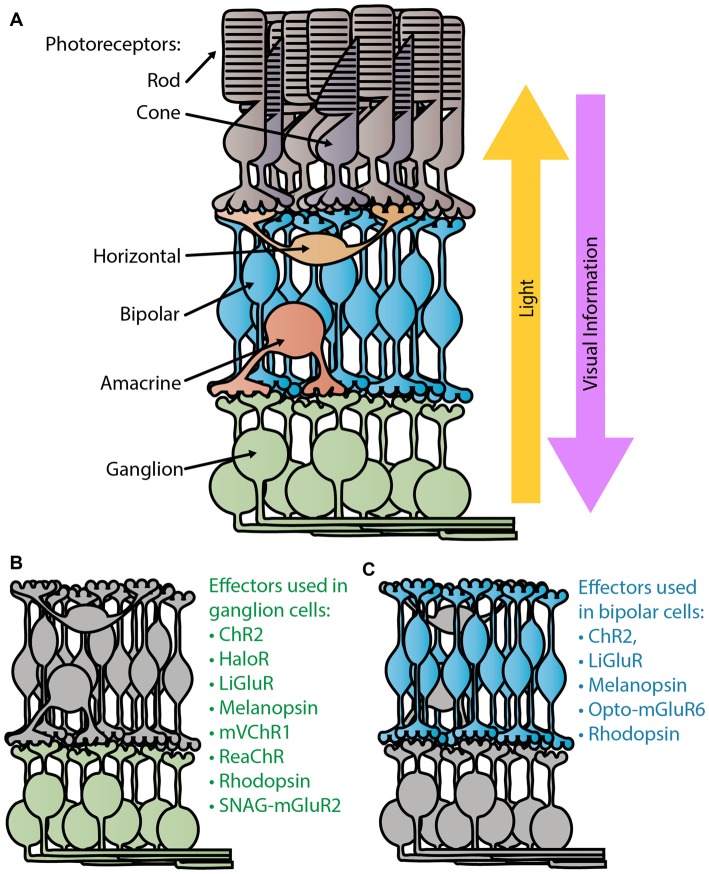
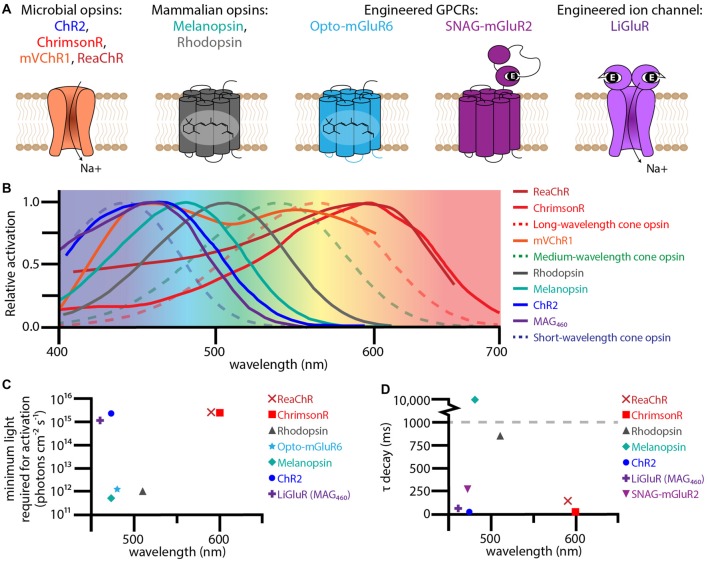
The advent of optogenetics has ushered in a new era in neuroscience where spatiotemporal control of neurons is possible through light application. These tools used to study neural circuits can also be used therapeutically to restore vision. In order to recapitulate the broad spectral and light sensitivities along with high temporal sensitivity found in human vision, researchers have identified and developed new optogenetic tools. There are two major kinds of optogenetic effectors employed in vision restoration: ion channels and G-protein coupled receptors (GPCRs). Ion channel based optogenetic therapies require high intensity light that can be unsafe at lower wavelengths, so work has been done to expand and red-shift the excitation spectra of these channels. Light activatable GPCRs are much more sensitive to light than their ion channel counterparts but are slower kinetically in terms of both activation and inactivation. This review article examines the latest optogenetic ion channel and GPCR candidates for vision restoration based on light and temporal sensitivity.
光遗传学的出现开创了神经科学的新纪元,通过施加光可以对神经元进行时空控制。这些用于研究神经回路的工具也可用于治疗性恢复视力。为了重现人类视觉中广泛的光谱和光敏感性以及高时间敏感性,研究人员已经鉴定并开发了新的光遗传学工具。用于视力恢复的光遗传学效应器主要有两种:离子通道和G蛋白偶联受体(GPCR)。基于离子通道的光遗传学疗法需要高强度的光,而在较低波长下这种光可能不安全,因此人们已经开展工作来扩展这些通道的激发光谱并使其红移。光激活的GPCR比其离子通道对应物对光更敏感,但在激活和失活方面的动力学较慢。这篇综述文章基于光和时间敏感性,研究了用于视力恢复的最新光遗传学离子通道和GPCR候选物。