Faculty of Medicine, University of Tsukuba, Tsukuba, Japan.
International Integrative Institute for Sleep medicine (WPI-IIIS), University of Tsukuba, Tsukuba, Japan.
Cell Rep Methods. 2022 Nov 14;2(11):100336. doi: 10.1016/j.crmeth.2022.100336. eCollection 2022 Nov 21.
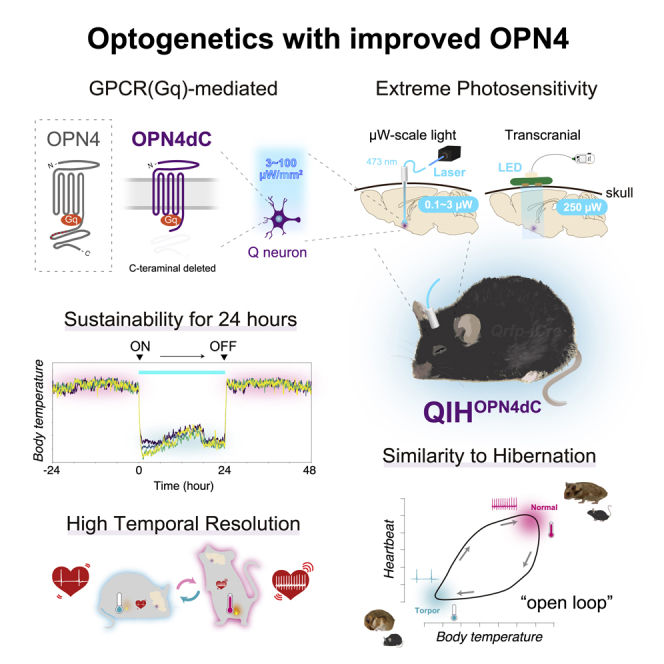
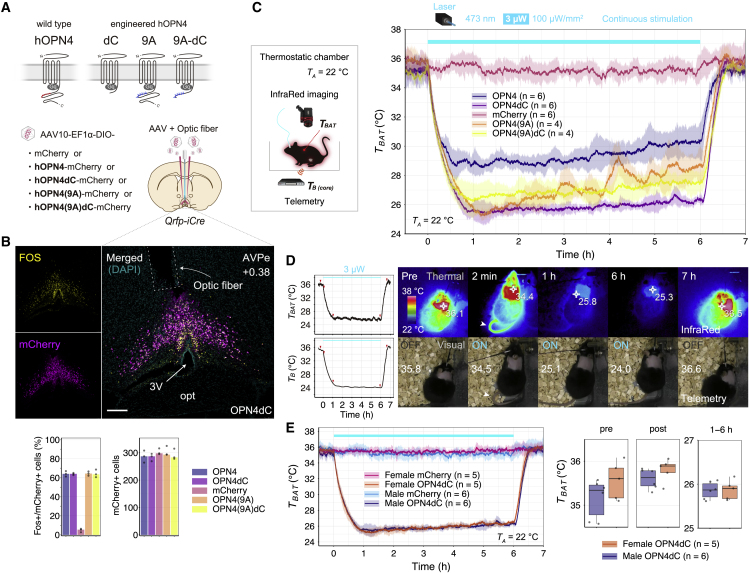
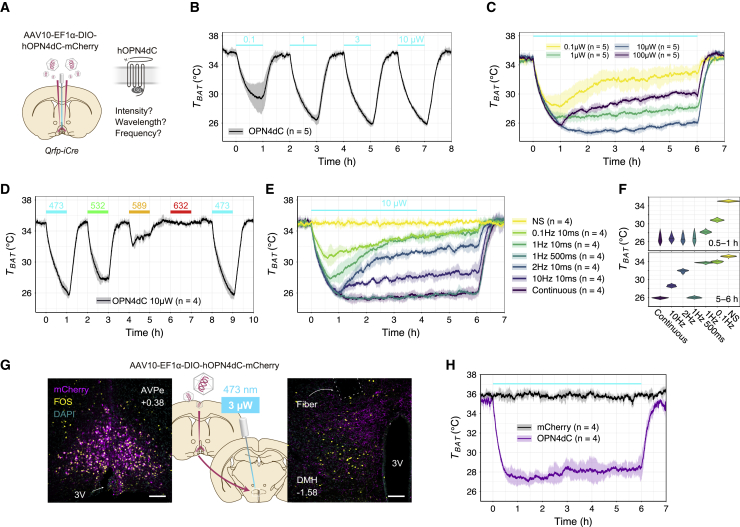
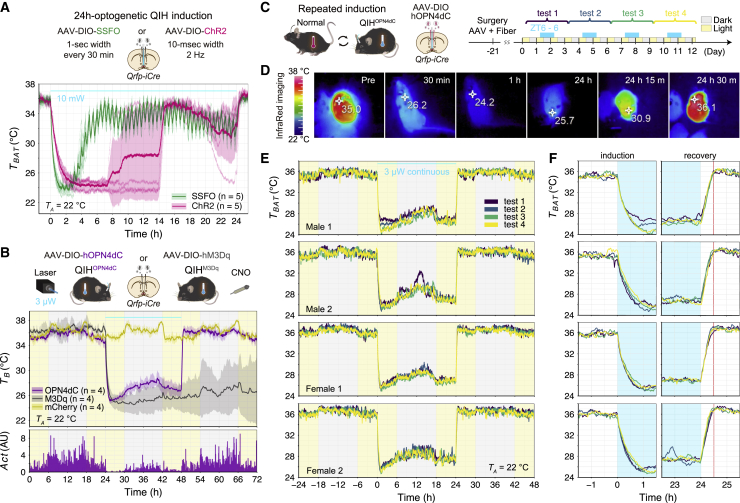
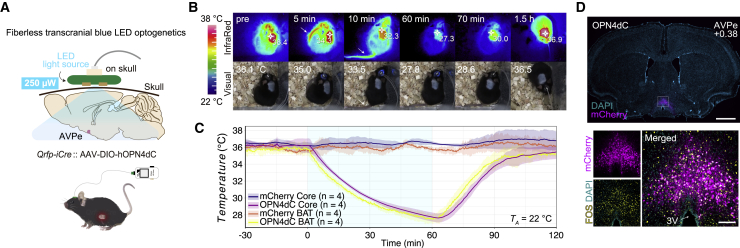
We recently determined that the excitatory manipulation of -expressing neurons in the preoptic area of the hypothalamus (quiescence-inducing neurons [Q neurons]) induced a hibernation-like hypothermic/hypometabolic state (QIH) in mice. To control the QIH with a higher time resolution, we develop an optogenetic method using modified human opsin4 (OPN4; also known as melanopsin), a G protein-coupled-receptor-type blue-light photoreceptor. C-terminally truncated OPN4 (OPN4dC) stably and reproducibly induces QIH for at least 24 h by illumination with low-power light (3 μW, 473 nm laser) with high temporal resolution. The high sensitivity of OPN4dC allows us to transcranially stimulate Q neurons with blue-light-emitting diodes and non-invasively induce the QIH. OPN4dC-mediated QIH recapitulates the kinetics of the physiological changes observed in natural hibernation, revealing that Q neurons concurrently contribute to thermoregulation and cardiovascular function. This optogenetic method may facilitate identification of the neural mechanisms underlying long-term dormancy states such as sleep, daily torpor, and hibernation.
我们最近发现,兴奋下丘脑视前区表达-的神经元(安静诱导神经元[Q 神经元])可诱导小鼠类似冬眠的低温/低代谢状态(QIH)。为了更精确地控制 QIH,我们开发了一种使用改良的人视蛋白 4(OPN4;也称为黑视蛋白)的光遗传学方法,OPN4 是一种 G 蛋白偶联受体型蓝光光感受器。C 端截断的 OPN4(OPN4dC)通过低功率光(3μW,473nm 激光)稳定且可重复地诱导 QIH,持续至少 24 小时,具有高时间分辨率。OPN4dC 的高灵敏度使我们能够用蓝光发光二极管经颅刺激 Q 神经元,并非侵入性地诱导 QIH。OPN4dC 介导的 QIH 再现了在自然冬眠中观察到的生理变化的动力学,表明 Q 神经元同时有助于体温调节和心血管功能。这种光遗传学方法可能有助于确定睡眠、日常蛰伏和冬眠等长期休眠状态的神经机制。