Leiden University Medical Center, Leiden, The Netherlands.
Radboud University Medical Center Nijmegen, The Netherlands, and Wellcome Trust Centre for Human Genetics, Oxford, UK.
Arthritis Rheumatol. 2019 Apr;71(4):561-570. doi: 10.1002/art.40748. Epub 2019 Feb 23.
Multiple single-nucleotide polymorphisms (SNPs) conferring susceptibility to osteoarthritis (OA) mark imbalanced expression of positional genes in articular cartilage, reflected by unequally expressed alleles among heterozygotes (allelic imbalance [AI]). We undertook this study to explore the articular cartilage transcriptome from OA patients for AI events to identify putative disease-driving genetic variation.
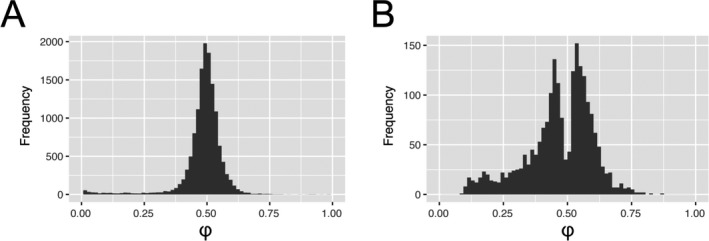
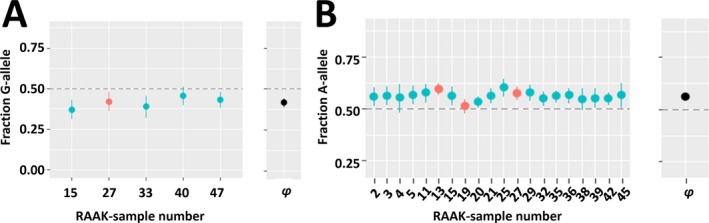
AI was assessed in 42 preserved and 5 lesioned OA cartilage samples (from the Research Arthritis and Articular Cartilage study) for which RNA sequencing data were available. The count fraction of the alternative alleles among the alternative and reference alleles together (φ) was determined for heterozygous individuals. A meta-analysis was performed to generate a meta-φ and P value for each SNP with a false discovery rate (FDR) correction for multiple comparisons. To further validate AI events, we explored them as a function of multiple additional OA features.
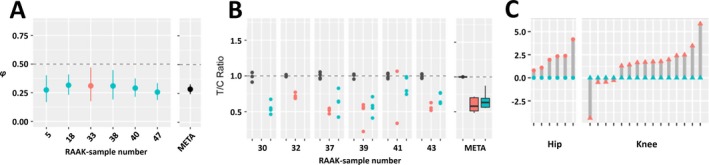
We observed a total of 2,070 SNPs that consistently marked AI of 1,031 unique genes in articular cartilage. Of these genes, 49 were found to be significantly differentially expressed (fold change <0.5 or >2, FDR <0.05) between preserved and paired lesioned cartilage, and 18 had previously been reported to confer susceptibility to OA and/or related phenotypes. Moreover, we identified notable highly significant AI SNPs in the CRLF1, WWP2, and RPS3 genes that were related to multiple OA features.
We present a framework and resulting data set for researchers in the OA research field to probe for disease-relevant genetic variation that affects gene expression in pivotal disease-affected tissue. This likely includes putative novel compelling OA risk genes such as CRLF1, WWP2, and RPS3.
多个单核苷酸多态性(SNP)赋予骨关节炎(OA)易感性,这标志着关节软骨中位置基因表达失衡,杂合子中表现出等位基因不等表达(等位基因不平衡[AI])。我们进行这项研究,以探索 OA 患者的关节软骨转录组中的 AI 事件,以确定潜在的疾病驱动遗传变异。
对 42 个保存完好和 5 个病变 OA 软骨样本(来自研究关节炎和关节软骨研究)进行 AI 评估,这些样本具有 RNA 测序数据。对于杂合子个体,确定替代等位基因与参考等位基因之和的替代等位基因计数分数(φ)。进行荟萃分析,为每个 SNP 生成荟萃φ和 P 值,并对多个比较进行错误发现率(FDR)校正。为了进一步验证 AI 事件,我们将其作为多个额外 OA 特征的函数进行探索。
我们总共观察到 2070 个 SNP,这些 SNP 一致地标识了关节软骨中 1031 个独特基因的 AI。在这些基因中,有 49 个基因在保存完好和配对病变软骨之间的表达存在显著差异(倍数变化<0.5 或>2,FDR<0.05),其中 18 个基因先前被报道与 OA 和/或相关表型易感性有关。此外,我们在 CRLF1、WWP2 和 RPS3 基因中鉴定了一些显著的高度显著的 AI SNP,这些基因与多种 OA 特征有关。
我们提出了一个框架和相关数据集,供 OA 研究领域的研究人员探索影响关键疾病相关组织中基因表达的疾病相关遗传变异。这可能包括潜在的新型引人注目的 OA 风险基因,如 CRLF1、WWP2 和 RPS3。