Department of Epidemiology, Johns Hopkins University Bloomberg School of Public Health, Baltimore, MD.
Department of Medicine, Kidney Health Research Collaborative, San Francisco VA Medical Center, University of California, San Francisco, San Francisco, CA.
J Acquir Immune Defic Syndr. 2019 Jan 1;80(1):118-125. doi: 10.1097/QAI.0000000000001868.
In the Multicenter AIDS Cohort Study, we examined whether fibroblast growth factor-23 (FGF-23), a bone-derived phosphaturic hormone involved in bone metabolism, is associated with incident frailty. Furthermore, we examined whether this association differs by HIV serostatus and race.
Of 715 men assessed for frailty and selected for FGF-23 measurements using stored blood samples (2007-2011), 512 men were nonfrail at/before the baseline visit. Frailty was defined by the presence of ≥3 of the following on 2 consecutive 6-month visits within 1 year: unintentional weight loss ≥10 pounds, weakness, slowness, low energy, and low physical activity. We determined the association of FGF-23 levels with incident frailty using proportional hazards models adjusting for sociodemographics, comorbidities, and kidney function.
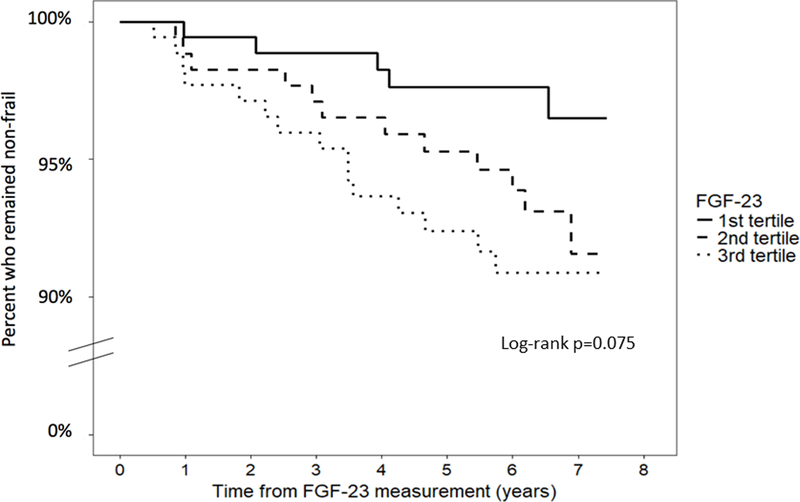
Sixty-five percent were HIV-infected; 29% were black. Median baseline FGF-23 levels were lower in HIV-infected vs. HIV-uninfected men (33.7 vs. 39.9 rU/mL, P = 0.006) but similar by race. During a median follow-up of 6.6 years, 32 men developed frailty; they had higher baseline FGF-23 levels vs. men who remained nonfrail (45 vs. 36 rU/mL, P = 0.02). FGF-23 (per doubling) was associated with a 1.63-fold risk of frailty [95% confidence interval (CI): 1.19 to 2.23]; results did not differ by HIV serostatus. Conversely, FGF-23 was associated with a 2.72-fold risk of frailty among blacks (95% CI: 1.51 to 4.91) but had minimal association among nonblacks (hazard ratio = 1.26, 95% CI: 0.77 to 2.05; p-interaction = 0.024).
Among men with or at-risk of HIV infection, higher FGF-23 was associated with greater risk of frailty, particularly in blacks. The mechanisms by which FGF-23 may contribute to frailty warrant further study.
在多中心艾滋病队列研究中,我们研究了成纤维细胞生长因子 23(FGF-23)——一种参与骨代谢的骨源性磷酸盐激素——是否与虚弱的发生有关。此外,我们还研究了这种关联是否因 HIV 感染状态和种族而不同。
在使用储存的血液样本评估虚弱并选择进行 FGF-23 测量的 715 名男性中,有 512 名男性在基线检查前/时没有虚弱。通过在一年内的 2 次连续 6 个月访视中存在以下 3 项或以上情况定义虚弱:非故意体重减轻≥10 磅、虚弱、缓慢、低能量和低体力活动。我们使用比例风险模型,根据社会人口统计学、合并症和肾功能调整 FGF-23 水平与虚弱发生的关联。
65%的人感染了 HIV;29%是黑人。与未感染 HIV 的男性相比,感染 HIV 的男性的中位基线 FGF-23 水平较低(33.7 与 39.9 rU/mL,P=0.006),但按种族划分则相似。在中位随访 6.6 年后,有 32 名男性出现虚弱;与未发生虚弱的男性相比,他们的基线 FGF-23 水平更高(45 与 36 rU/mL,P=0.02)。FGF-23(每翻倍)与虚弱的风险增加 1.63 倍相关[95%置信区间(CI):1.19 至 2.23];结果不因 HIV 感染状态而异。相反,FGF-23 与黑人虚弱的风险增加 2.72 倍相关(95%CI:1.51 至 4.91),但在非黑人中关联较小(风险比=1.26,95%CI:0.77 至 2.05;p 交互=0.024)。
在感染或有感染 HIV 风险的男性中,较高的 FGF-23 与虚弱的风险增加相关,尤其是在黑人中。FGF-23 可能导致虚弱的机制值得进一步研究。