Department of Molecular Neuropharmacology, Institute of Pharmacology of the Polish Academy of Sciences, 31-343, Krakow, Poland.
Department of Psychology, Seoul National University, Seoul 08826, Korea.
eNeuro. 2018 Oct 5;5(4). doi: 10.1523/ENEURO.0331-18.2018. eCollection 2018 Jul-Aug.
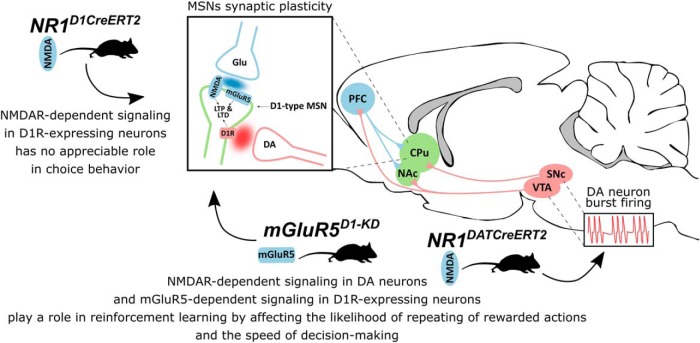
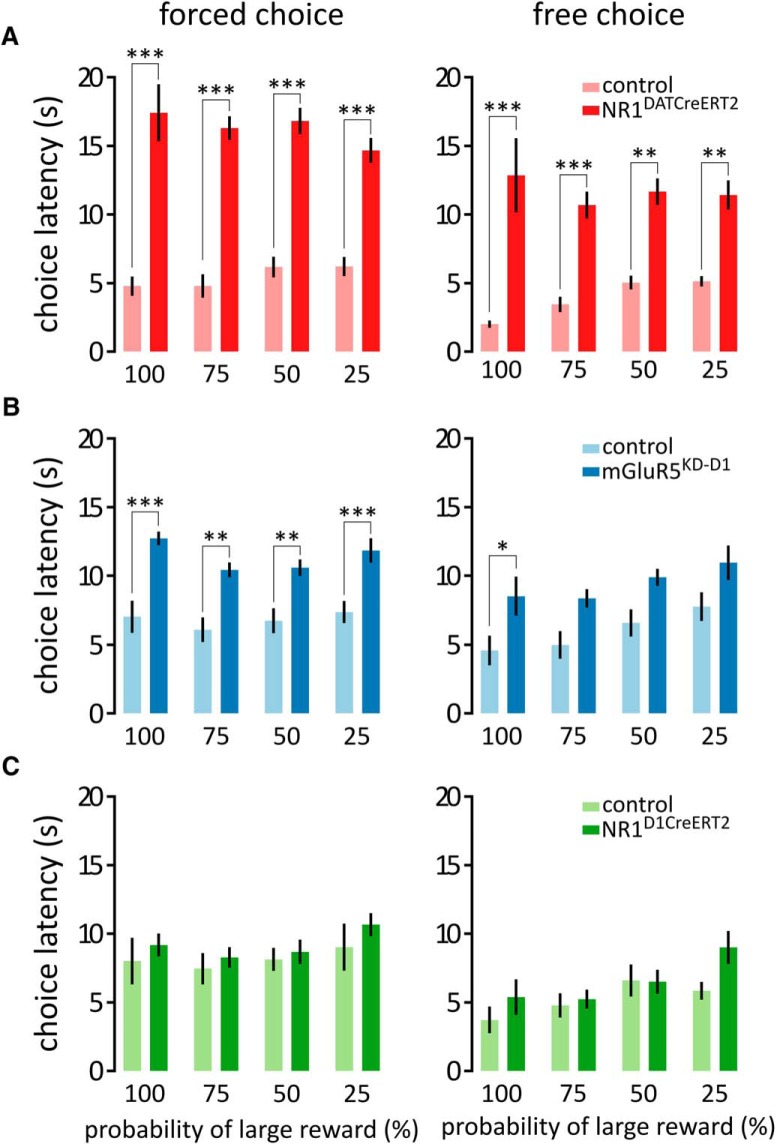
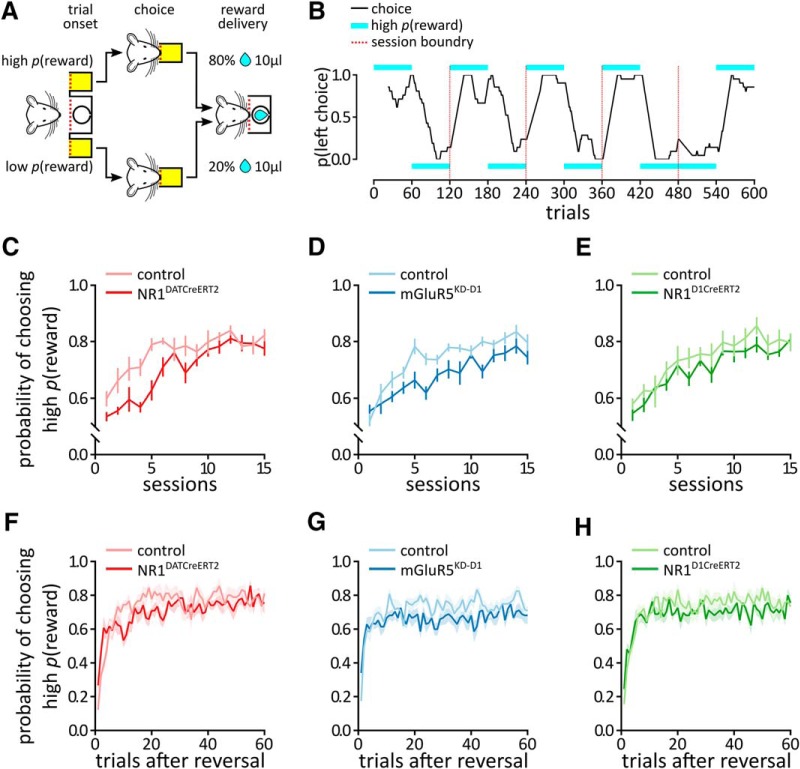
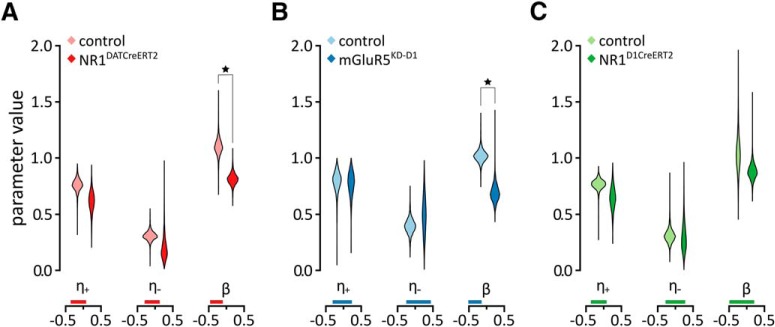
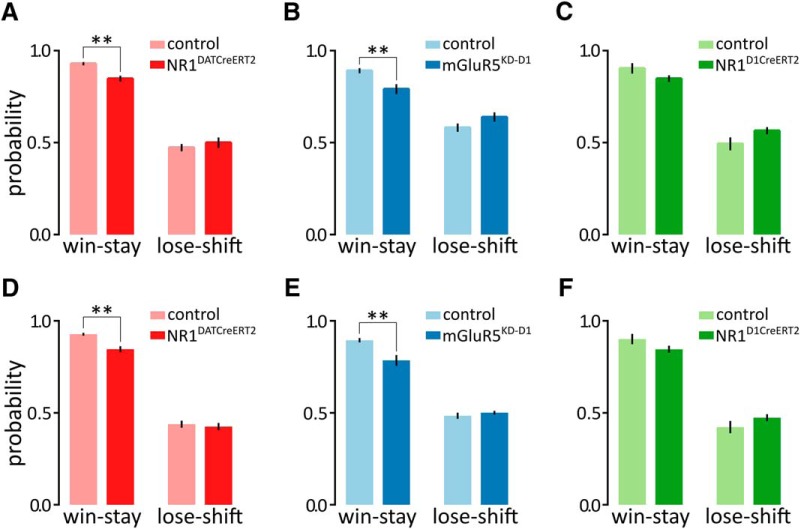
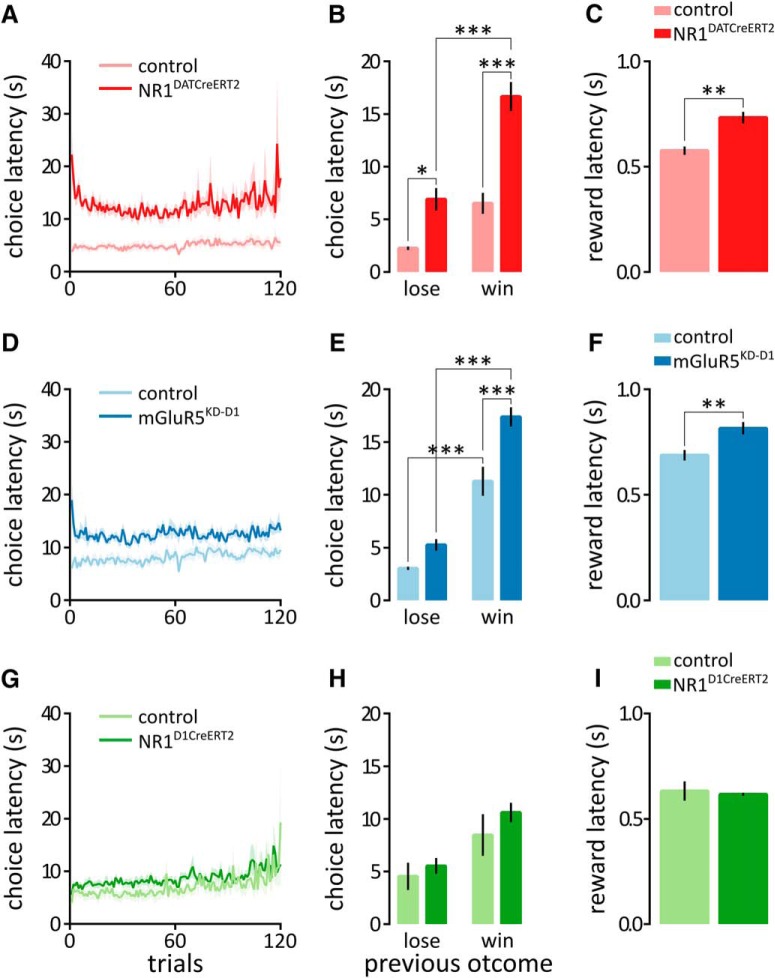
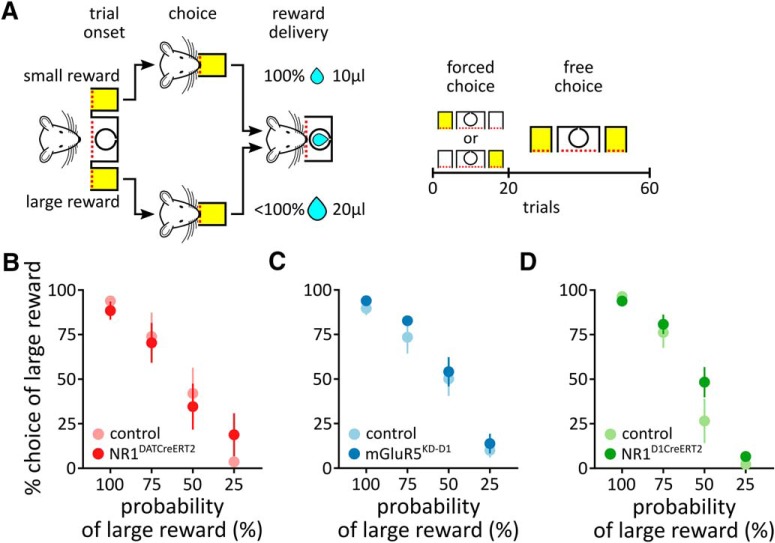
Selecting the most advantageous actions in a changing environment is a central feature of adaptive behavior. The midbrain dopamine (DA) neurons along with the major targets of their projections, including dopaminoceptive neurons in the frontal cortex and basal ganglia, play a key role in this process. Here, we investigate the consequences of a selective genetic disruption of NMDA receptor and metabotropic glutamate receptor 5 (mGluR5) in the DA system on adaptive choice behavior in mice. We tested the effects of the mutation on performance in the probabilistic reinforcement learning and probability-discounting tasks. In case of the probabilistic choice, both the loss of NMDA receptors in dopaminergic neurons or the loss mGluR5 receptors in D receptor-expressing dopaminoceptive neurons reduced the probability of selecting the more rewarded alternative and lowered the likelihood of returning to the previously rewarded alternative (win-stay). When observed behavior was fitted to reinforcement learning models, we found that these two mutations were associated with a reduced effect of the expected outcome on choice (i.e., more random choices). None of the mutations affected probability discounting, which indicates that all animals had a normal ability to assess probability. However, in both behavioral tasks animals with targeted loss of NMDA receptors in dopaminergic neurons or mGluR5 receptors in D neurons were significantly slower to perform choices. In conclusion, these results show that glutamate receptor-dependent signaling in the DA system is essential for the speed and accuracy of choices, but at the same time probably is not critical for correct estimation of probable outcomes.
在不断变化的环境中选择最有利的行动是适应行为的一个核心特征。中脑多巴胺 (DA) 神经元及其主要投射靶点,包括前额叶皮层和基底神经节中的多巴胺能神经元,在这个过程中发挥着关键作用。在这里,我们研究了选择性破坏 NMDA 受体和代谢型谷氨酸受体 5 (mGluR5) 在 DA 系统中对小鼠适应性选择行为的影响。我们测试了该突变对概率强化学习和概率折扣任务中表现的影响。在概率选择的情况下,多巴胺能神经元中 NMDA 受体的丧失或 D 受体表达的多巴胺能神经元中 mGluR5 受体的丧失均降低了选择更受奖励的替代方案的概率,并降低了返回先前受奖励的替代方案的可能性(赢留)。当观察到的行为被拟合到强化学习模型中时,我们发现这两种突变与预期结果对选择的影响降低有关(即更多的随机选择)。这些突变都没有影响概率折扣,这表明所有动物都有正常的能力来评估概率。然而,在这两种行为任务中,多巴胺能神经元中靶向 NMDA 受体丧失或 D 神经元中 mGluR5 受体丧失的动物在进行选择时明显较慢。总之,这些结果表明,DA 系统中谷氨酸受体依赖性信号对于选择的速度和准确性是必不可少的,但同时对于正确估计可能的结果可能不是关键的。