Kinney Brian M, Lozanova Paula
University of Southern California Division of Plastic Surgery, Beverly Hills, California.
Paula Fines Center, Sofia BG, Europe.
Lasers Surg Med. 2019 Jan;51(1):40-46. doi: 10.1002/lsm.23024. Epub 2018 Oct 10.
This study introduces an initial evaluation of a novel High-Intensity Focused Electromagnetic (HIFEM) technology. The primary goal is to quantify any effects the treatments may have on abdominal tissues, as well as to establish hypotheses for future research of this technology.
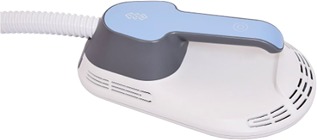
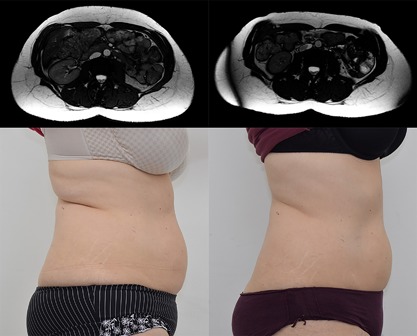
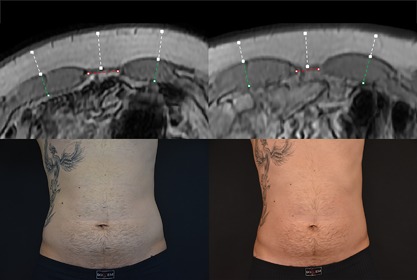
Twenty-two patients received four abdominal treatments using the EMSCULPT device (BTL Industries Inc., Boston, MA). Anthropometric evaluations were recorded and digital photographs were taken at baseline, at 2 months, and at 6 months post-treatments. The MRI without contrast determined by vertertebras T12 and S1 (FIESTA and FSPRG sequences) was used to measure dimensions in coronal cross-sectional images of abdominal muscle and fatty tissues, in order to assess any anatomical changes induced by the application.
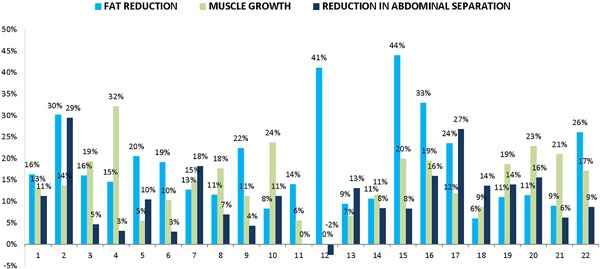
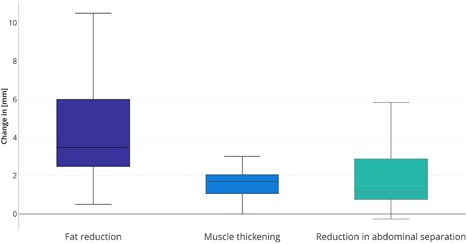
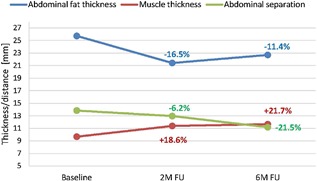
Analysis of the same MRI slices verified by tissue artefacts showed a statistically significant (all P < 0.0001) average 18.6% reduction of adipose tissue thickness, 15.4% increase in rectus abdominis muscle thickness, and 10.4% reduction in rectus abdominus separation (diastasis recti) as measured from the medial border of the muscle 2 months post-treatment. More significant improvements were observed in patients with BMI 18.5-24.9 (classified as "normal"). MRI data from 6-month follow-up suggest the changes can be preserved in longer term. Tape measurements showed on average 3.8 cm subumbilical circumference reduction. The weight of the subjects did not change significantly (average -0.5 lb; P > 0.05). No adverse events were reported.
MRI, considered as a highly precise diagnostic method, revealed simultaneous muscle growth, fat reduction and reduced abdominal separation at 2 months and at 6 months post treatments, unrelated with dieting. Further research should investigate the exact physiological processes which stand behind the tissue changes observed in this study. Lasers Surg. Med. 51:40-46, 2019. © 2018 The Authors. Lasers in Surgery and Medicine Published by Wiley Periodicals, Inc.
本研究对一种新型高强度聚焦电磁(HIFEM)技术进行了初步评估。主要目标是量化该治疗对腹部组织可能产生的任何影响,并为该技术的未来研究建立假设。
22名患者使用EMSCULPT设备(BTL Industries Inc.,波士顿,马萨诸塞州)接受了四次腹部治疗。记录人体测量评估数据,并在基线、治疗后2个月和6个月时拍摄数码照片。使用由T12和S1椎体确定的无对比剂MRI(FIESTA和FSPRG序列)来测量腹部肌肉和脂肪组织冠状面图像的尺寸,以评估该应用引起的任何解剖学变化。
经组织伪影验证的相同MRI切片分析显示,治疗后2个月,从肌肉内侧边缘测量,脂肪组织厚度平均减少18.6%,腹直肌厚度增加15.4%,腹直肌分离(腹直肌分离症)减少10.4%,差异均具有统计学意义(所有P < 0.0001)。在体重指数(BMI)为18.5 - 24.9(分类为“正常”)的患者中观察到更显著的改善。6个月随访的MRI数据表明,这些变化可以长期保持。卷尺测量显示脐下平均周长减少3.8厘米。受试者的体重没有显著变化(平均减少0.5磅;P > 0.05)。未报告不良事件。
MRI作为一种高度精确的诊断方法,显示在治疗后2个月和6个月时,肌肉生长、脂肪减少和腹部间距减小同时出现,且与节食无关。进一步的研究应调查本研究中观察到的组织变化背后的确切生理过程。《激光外科与医学》51:40 - 46,2019年。© 2018作者。《激光外科与医学》由威利期刊公司出版。