Department of Colorectal Surgery, Huzhou Central Hospital, Zhejiang, China.
Central Laboratory, Huzhou Central Hospital, Zhejiang, China.
Cancer Med. 2018 Nov;7(11):5327-5338. doi: 10.1002/cam4.1814. Epub 2018 Oct 9.
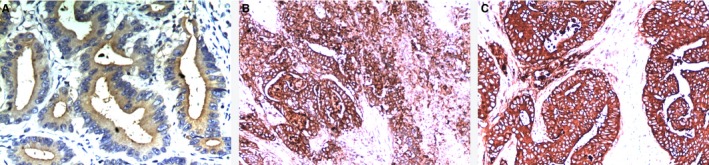
Tissue carcinoembryonic antigen (t-CEA) and serum carcinoembryonic antigen (s-CEA) expression profiles are the most useful tumor markers for the diagnosis and evaluation of colorectal cancer (CRC) worldwide; however, their roles in CRC progression remain controversial. This study aimed to compare the prognostic values of both s-CEA and t-CEA in CRC.
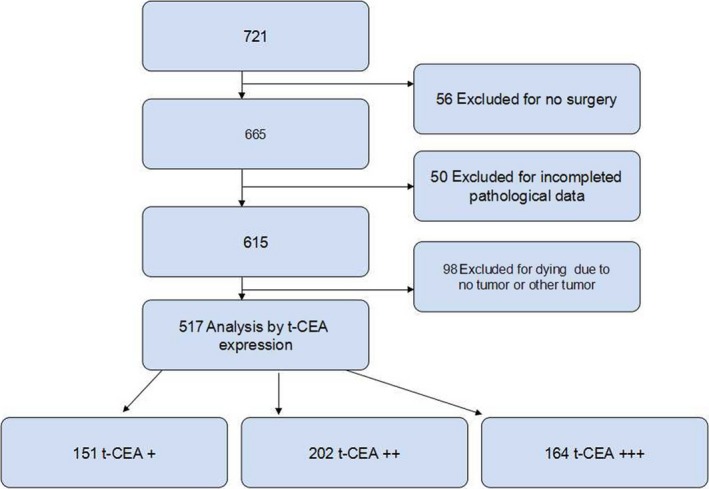
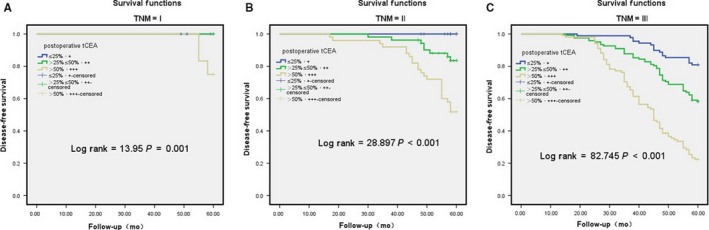
A total of 517 patients from January 2006 to December 2010 with stages I-III CRC were retrospectively examined, with 5-year postoperative follow-up and death as end-points. T-CEA expression, s-CEA expression, and clinical pathological parameters were inputted into the SPSS 21.0 software. The Kaplan-Meier method was used to analyze the 5-year disease-free survival (DFS) rate of patients in different tumor node metastasis (TNM) stages based on t-CEA and s-CEA expression.
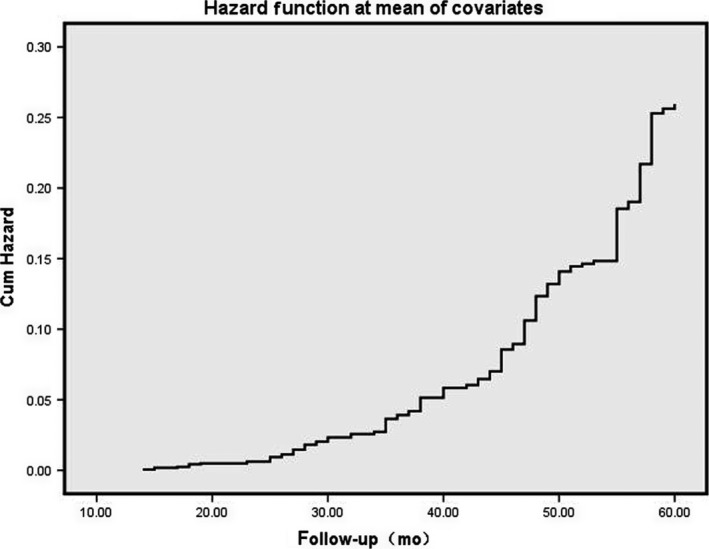
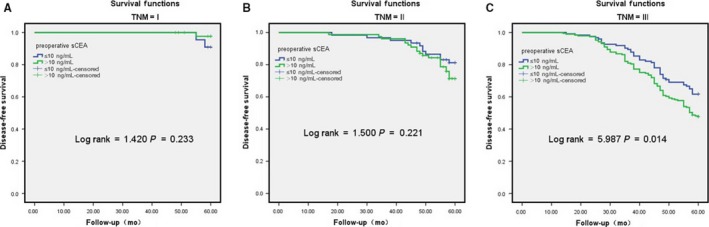
Tumor differentiation and the number of positive lymph node harvests were significantly different among the t-CEA groups (P < 0.001, P = 0.002); however, clinicopathological features showed no significant difference. The groups with high s-CEA and t-CEA expression had a significantly poorer prognosis than those with low s-CEA (P = 0.021) and t-CEA (P < 0.01) expression, respectively. The multivariate analysis demonstrated that t-CEA was an independent prognostic factor in CRC (P < 0.001), but s-CEA was not (P = 0.339). The 5-year disease-free survival rates among the t-CEA groups were significantly different in stages I, II, and III of CRC (P = 0.001, P < 0.001, P < 0.001), whereas in the s-CEA groups, this difference was observed only in stage III (P = 0.014).
This study shows that postoperative t-CEA expression is an independent factor associated with poorer CRC prognosis and has a higher prognostic value than that of preoperative s-CEA expression.
组织癌胚抗原(t-CEA)和血清癌胚抗原(s-CEA)的表达谱是全球诊断和评估结直肠癌(CRC)最有用的肿瘤标志物;然而,它们在 CRC 进展中的作用仍存在争议。本研究旨在比较 s-CEA 和 t-CEA 在 CRC 中的预后价值。
回顾性分析 2006 年 1 月至 2010 年 12 月期间 I-III 期 CRC 患者 517 例,术后随访 5 年,以死亡为终点。将 t-CEA 表达、s-CEA 表达和临床病理参数输入 SPSS 21.0 软件。采用 Kaplan-Meier 法分析不同 t-CEA 和 s-CEA 表达的肿瘤淋巴结转移(TNM)分期患者的 5 年无病生存率(DFS)。
t-CEA 组肿瘤分化和阳性淋巴结检出数差异有统计学意义(P<0.001,P=0.002);而临床病理特征无显著性差异。高 s-CEA 和 t-CEA 表达组的预后明显差于低 s-CEA(P=0.021)和 t-CEA(P<0.01)表达组。多因素分析表明,t-CEA 是 CRC 的独立预后因素(P<0.001),而 s-CEA 不是(P=0.339)。t-CEA 组在 CRC 的 I、II 和 III 期的 5 年无病生存率差异有统计学意义(P=0.001,P<0.001,P<0.001),而 s-CEA 组仅在 III 期有差异(P=0.014)。
本研究表明,术后 t-CEA 表达是 CRC 预后不良的独立因素,其预后价值高于术前 s-CEA 表达。