Yang Yeoree, Lee Eun Young, Cho Jae Hyoung, Park Yong Moon, Ko Seung Hyun, Yoon Kun Ho, Kang Moo Il, Cha Bong Yun, Lee Seung Hwan
Division of Endocrinology and Metabolism, Department of Internal Medicine, Seoul St. Mary's Hospital, College of Medicine, The Catholic University of Korea, Seoul, Korea.
Epidemiology Branch, National Institute of Environmental Health Sciences, National Institutes of Health, Research Triangle Park, NC, USA.
Diabetes Metab J. 2018 Dec;42(6):496-512. doi: 10.4093/dmj.2018.0026. Epub 2018 Sep 28.
This study aimed to investigate the association between the presence and severity of cardiovascular autonomic neuropathy (CAN) and development of long-term glucose fluctuation in subjects with type 2 diabetes mellitus.
In this retrospective cohort study, subjects with type 2 diabetes mellitus who received cardiovascular autonomic reflex tests (CARTs) at baseline and at least 4-year of follow-up with ≥6 measures of glycosylated hemoglobin (HbA1c) were included. The severity of CAN was categorized as normal, early, or severe CAN according to the CARTs score. HbA1c variability was measured as the standard deviation (SD), coefficient of variation, and adjusted SD of serial HbA1c measurements.
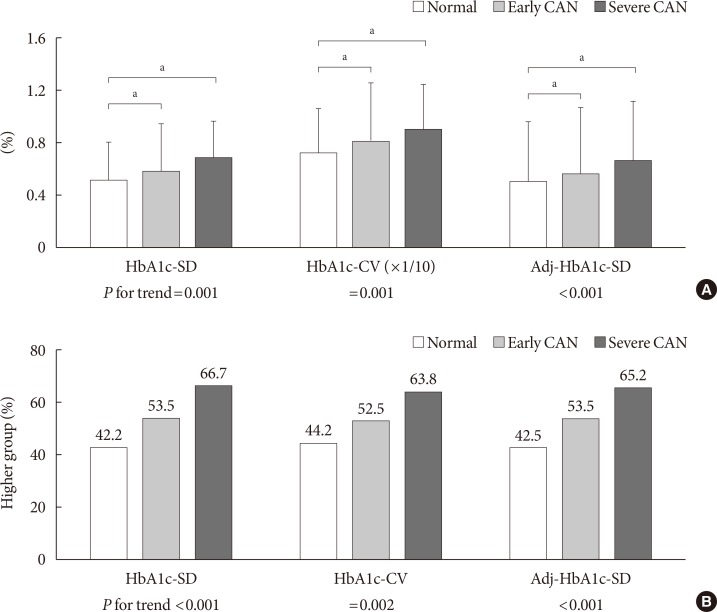
A total of 681 subjects were analyzed (294 normal, 318 early, and 69 severe CAN). The HbA1c variability index values showed a positive relationship with the severity of CAN. Multivariable logistic regression analysis showed that CAN was significantly associated with the risk of developing higher HbA1c variability (SD) after adjusting for age, sex, body mass index, diabetes duration, mean HbA1c, heart rate, glomerular filtration rate, diabetic retinopathy, coronary artery disease, insulin use, and anti-hypertensive medication (early CAN: odds ratio [OR], 1.65; 95% confidence interval [CI], 1.12 to 2.43) (severe CAN: OR, 2.86; 95% CI, 1.47 to 5.56). This association was more prominent in subjects who had a longer duration of diabetes (>10 years) and lower mean HbA1c (<7%).
CAN is an independent risk factor for future higher HbA1c variability in subjects with type 2 diabetes mellitus. Tailored therapy for stabilizing glucose fluctuation should be emphasized in subjects with CAN.
本研究旨在探讨2型糖尿病患者心血管自主神经病变(CAN)的存在及严重程度与长期血糖波动发展之间的关联。
在这项回顾性队列研究中,纳入了在基线时接受心血管自主神经反射测试(CARTs)且至少随访4年并有≥6次糖化血红蛋白(HbA1c)测量值的2型糖尿病患者。根据CARTs评分,将CAN的严重程度分为正常、早期或严重CAN。HbA1c变异性通过连续HbA1c测量值的标准差(SD)、变异系数和调整后的SD来衡量。
共分析了681名受试者(294名正常、318名早期和69名严重CAN)。HbA1c变异性指数值与CAN的严重程度呈正相关。多变量逻辑回归分析显示,在调整年龄、性别、体重指数、糖尿病病程、平均HbA1c、心率、肾小球滤过率、糖尿病视网膜病变、冠状动脉疾病、胰岛素使用和抗高血压药物后,CAN与发生更高HbA1c变异性(SD)的风险显著相关(早期CAN:比值比[OR],1.65;95%置信区间[CI],1.12至2.43)(严重CAN:OR,2.86;95%CI, 1.47至5.56)。这种关联在糖尿病病程较长(>10年)且平均HbA1c较低(<7%)的受试者中更为突出。
CAN是2型糖尿病患者未来发生更高HbA1c变异性的独立危险因素。对于CAN患者,应强调采取针对性治疗以稳定血糖波动。