Almeida Anderson Barbosa de, Leite Isabel Cristina Gonçalves, Silva Girlene Alves da
Universidade Federal de Juiz de Fora, Faculdade de Medicina, Departamento de Saúde Coletiva, Programa de Pós-graduação em Saúde, ênfase em Saúde Brasileira (Juiz de Fora/MG, Brazil).
Universidade Federal de Juiz de Fora, Faculdade de Medicina, Departamento de Saúde Coletiva (Juiz de Fora/MG, Brazil).
Dental Press J Orthod. 2018 Aug 1;23(4):64-71. doi: 10.1590/2177-6709.23.4.064-071.oar.
Research in Orthodontics has historically followed the positivist model based on the direct relationship of cause and effect between diseases and their specific etiological factors. Despite the objectivity and the great potential of statistical procedures, quantitative methods have progressively been sharing space with other models that can encompass the multiplicity of factors that affect the health-disease process, which until such time was reduced to its biological dimension.
This study aims, through an integrative review, to identify orthodontics articles published over a 10-year period that have used, exclusively or not, some method of qualitative research, and analyze the main aspects of their content.
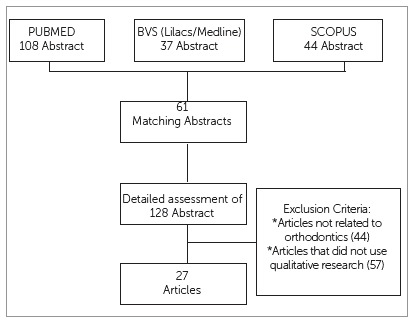
A survey was performed on Pubmed, Medline, Scopus, and Lilacs databases from 2007 to 2016 with a focus on the applicability of the qualitative methodology in orthodontic research.
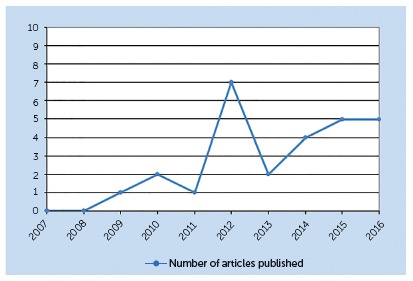
The 27 articles selected showed a trend to increase in publications, with the most recent four years concentrating almost 60% of them. Most studies were from Europe, particularly the UK, and the more frequent study objectives were related to the perception of people about the reasons for orthodontic treatment, about the aesthetic and psychosocial impact of malocclusion or orthodontic treatment, and the implications of these factors for their quality of life.
Because of its potential to explore behaviours and socio-cultural attitudes sustained in subjectivity, qualitative research offers new possibilities for orthodontic studies and can be used in an exclusive or complementary way in relation to quantitative methods.
正畸学研究历来遵循实证主义模式,该模式基于疾病与其特定病因之间的直接因果关系。尽管统计程序具有客观性和巨大潜力,但定量方法已逐渐与其他模式共同发展,这些模式能够涵盖影响健康 - 疾病过程的多种因素,而在此之前该过程仅被归结为生物学层面。
本研究旨在通过综合回顾,识别在十年期间发表的正畸学文章,这些文章是否专门或非专门地使用了某种定性研究方法,并分析其内容的主要方面。
对2007年至2016年期间的Pubmed、Medline、Scopus和Lilacs数据库进行了调查,重点关注定性方法在正畸研究中的适用性。
所选的27篇文章显示出发表数量增加的趋势,最近四年的文章数量几乎占总数的60%。大多数研究来自欧洲,特别是英国,最常见的研究目标与人们对正畸治疗原因的看法、错牙合或正畸治疗的美学和心理社会影响,以及这些因素对其生活质量的影响有关。
由于定性研究具有探索主观行为和社会文化态度的潜力,它为正畸研究提供了新的可能性,并且可以与定量方法以单独或互补的方式使用。