Kodama Yuya, Furumatsu Takayuki, Hino Tomohito, Kamatsuki Yusuke, Okazaki Yoshiki, Masuda Shin, Okazaki Yuki, Ozaki Toshifumi
Department of Orthopaedic Surgery, Okayama University Graduate School of Medicine, Dentistry, and Pharmaceutical Sciences, 2-5-1 Shikatacho, Kitaku, Okayama, 700-8558, Japan.
BMC Musculoskelet Disord. 2018 Oct 12;19(1):367. doi: 10.1186/s12891-018-2286-1.
Cyclops nodule formation is a serious complication after anterior cruciate ligament (ACL) reconstruction. The purpose of our study was to investigate whether an increase in thymol turbidity test (TTT) values is involved in the development of cyclops nodule formation or cyclopoid scar formation following ACL reconstruction.
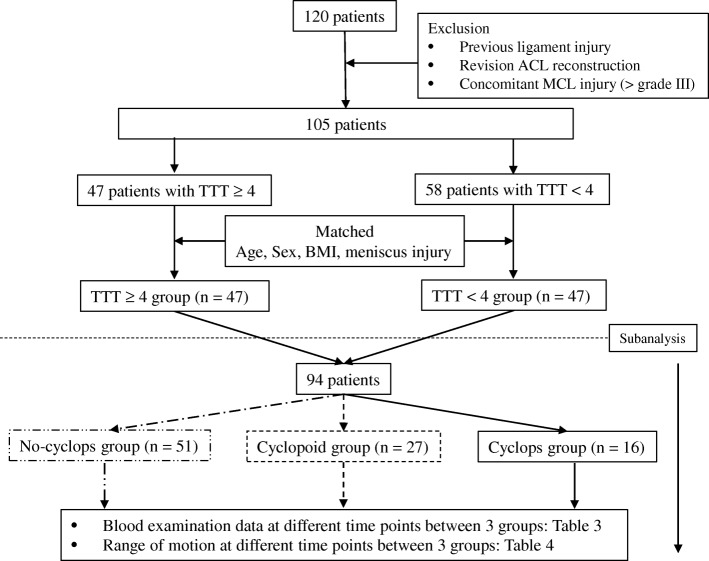
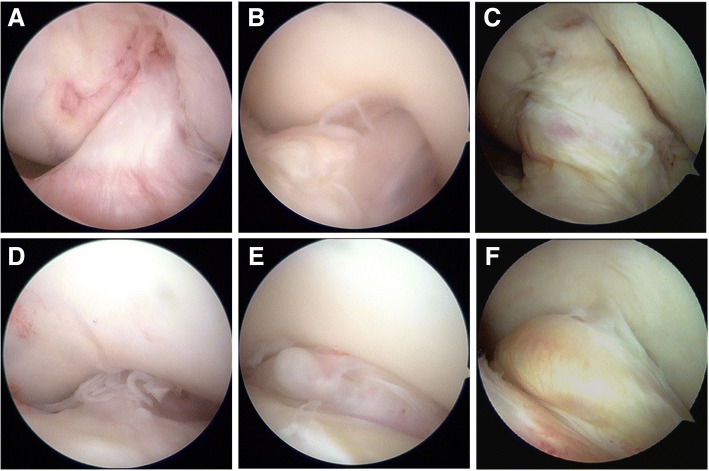
Between 2011 and 2014, 120 cases underwent outside-in ACL reconstruction. Forty-seven patients who had high TTT values were individually matched for age, sex, body mass index, and meniscus injury to a low TTT value group of 47 patients. The primary outcome was the occurrence of cyclops nodule formation or cyclopoid scar formation. All 94 patients were divided into 3 groups using surgical records and intra-operative video to enable a sub-analysis. The groups were a no-cyclops group, a cyclopoid group, and a cyclops group. Blood examinations, including TTT, and knee range of motion evaluations were performed before surgery, 3 months after surgery, and 1 year after surgery.
There were no differences in preoperative demographic data between the two groups. TTT values did not significantly influence cyclopoid scar formation (OR, 1.67; 95% CI, 0.62 to 4.66; p = 0.362). However, patients with cyclops nodule formation showed significantly higher TTT values than the control patients. (OR, 9.34; 95% CI, 1.94 to 90.3; p = 0.002). Knee extension loss was observed in the cyclopoid and cyclops groups 3 months after reconstruction. In the cyclops group, arthroscopic resection of the cyclops nodule was performed 3 months after reconstruction. Eventually, almost full range of motion was restored in all patients.
High TTT values before ACL reconstruction were an indicator of cyclops nodule formation. Furthermore, cyclopoid scar formations may not be the result of an individual's immune reaction but that of extension loss in the early post-reconstruction phase.
“独眼巨人”结节形成是前交叉韧带(ACL)重建术后的一种严重并发症。我们研究的目的是调查麝香草酚浊度试验(TTT)值升高是否与ACL重建术后“独眼巨人”结节形成或类“独眼巨人”瘢痕形成有关。
2011年至2014年期间,120例患者接受了由外向内的ACL重建术。将47例TTT值高的患者按照年龄、性别、体重指数和半月板损伤情况与47例TTT值低的患者进行个体匹配。主要结局是“独眼巨人”结节形成或类“独眼巨人”瘢痕形成的发生情况。利用手术记录和术中视频将所有94例患者分为3组以进行亚分析。这3组分别是无“独眼巨人”组、类“独眼巨人”组和“独眼巨人”组。在手术前、术后3个月和术后1年进行包括TTT在内的血液检查以及膝关节活动度评估。
两组术前人口统计学数据无差异。TTT值对类“独眼巨人”瘢痕形成无显著影响(比值比[OR],1.67;95%置信区间[CI],0.62至4.66;p = 0.362)。然而,有“独眼巨人”结节形成的患者TTT值显著高于对照患者(OR,9.34;95% CI,1.94至90.3;p = 0.002)。重建术后3个月,在类“独眼巨人”组和“独眼巨人”组观察到膝关节伸展受限。在“独眼巨人”组,重建术后3个月进行了关节镜下“独眼巨人”结节切除术。最终,所有患者的膝关节活动度几乎完全恢复。
ACL重建术前TTT值高是“独眼巨人”结节形成的一个指标。此外,类“独眼巨人”瘢痕形成可能不是个体免疫反应的结果,而是重建后早期伸展受限的结果。