Department of Biology, Johns Hopkins University, 3400 N. Charles Street, Baltimore, MD 21218, USA.
Wilmer Eye Institute, Johns Hopkins University School of Medicine, Baltimore, MD 21287, USA.
Science. 2018 Oct 12;362(6411). doi: 10.1126/science.aau6348.
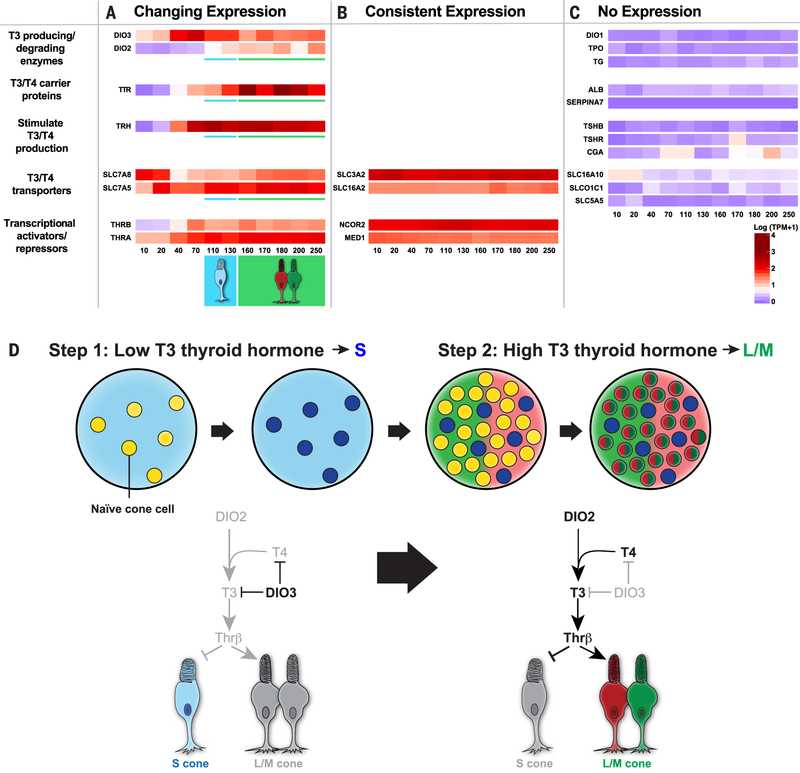
The mechanisms underlying specification of neuronal subtypes within the human nervous system are largely unknown. The blue (S), green (M), and red (L) cones of the retina enable high-acuity daytime and color vision. To determine the mechanism that controls S versus L/M fates, we studied the differentiation of human retinal organoids. Organoids and retinas have similar distributions, expression profiles, and morphologies of cone subtypes. S cones are specified first, followed by L/M cones, and thyroid hormone signaling controls this temporal switch. Dynamic expression of thyroid hormone-degrading and -activating proteins within the retina ensures low signaling early to specify S cones and high signaling late to produce L/M cones. This work establishes organoids as a model for determining mechanisms of human development with promising utility for therapeutics and vision repair.
人类神经系统中神经元亚型特化的机制在很大程度上是未知的。视网膜的蓝色(S)、绿色(M)和红色(L)锥体使我们具有高分辨率的日间视觉和色觉。为了确定控制 S 与 L/M 命运的机制,我们研究了人类视网膜类器官的分化。类器官和视网膜具有相似的锥体亚型分布、表达谱和形态。S 锥体首先被特化,然后是 L/M 锥体,甲状腺激素信号控制着这种时间转换。甲状腺激素降解和激活蛋白在视网膜内的动态表达确保了早期低信号以特化 S 锥体,后期高信号以产生 L/M 锥体。这项工作确立了类器官作为确定人类发育机制的模型,具有治疗和视觉修复的广阔应用前景。