Bons Eva, Bertels Frederic, Regoes Roland R
Department of Environmental Systems Science, Institute of Integrative Biology, ETH Zurich, Universitätstrasse 16, Zurich, Switzerland.
Department for Evolutionary Theory, Max Planck Institute for Evolutionary Biology, August-Thienemann-Str. 2, Plön, Germany.
Virus Evol. 2018 Oct 4;4(2):vey029. doi: 10.1093/ve/vey029. eCollection 2018 Jul.
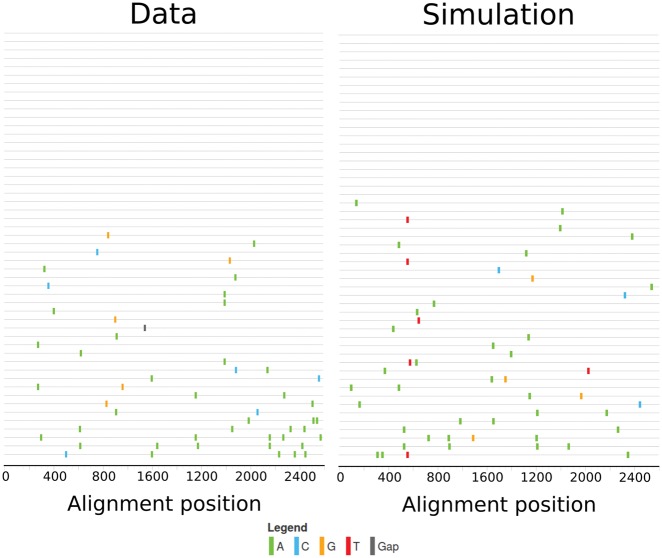
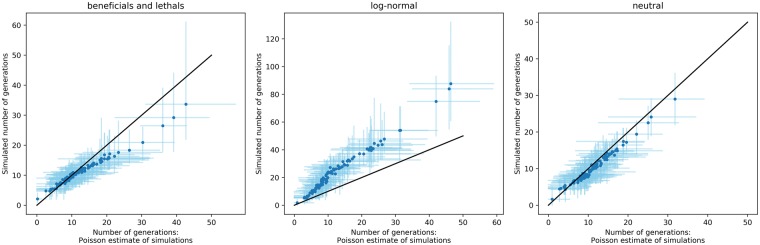
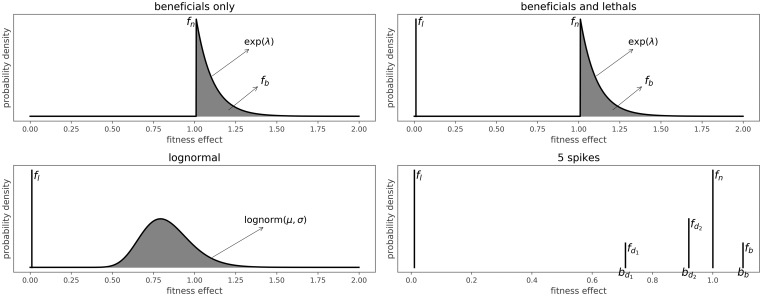
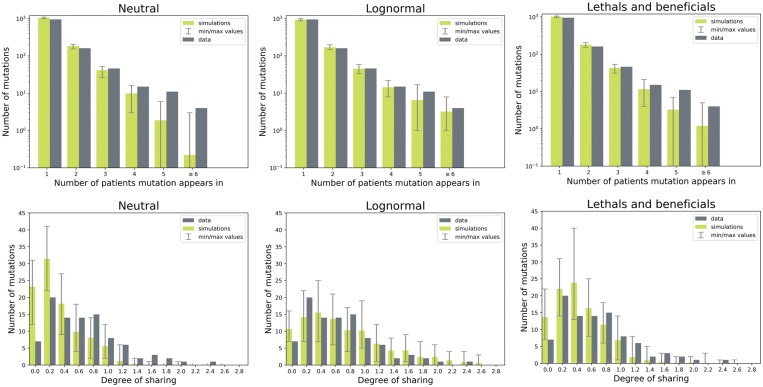
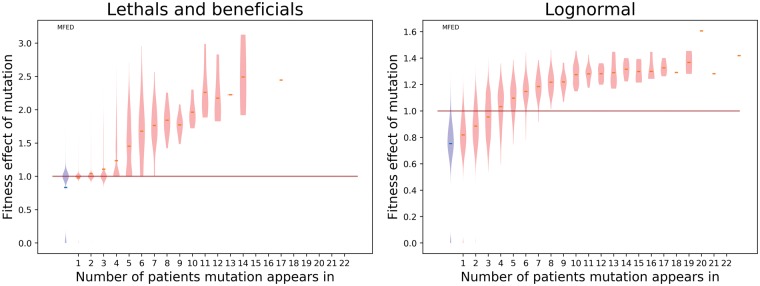
The evolution of HIV during acute infection is often considered a neutral process. Recent analysis of sequencing data from this stage of infection, however, showed high levels of shared mutations between independent viral populations. This suggests that selection might play a role in the early stages of HIV infection. We adapted an existing model for random evolution during acute HIV-infection to include selection. Simulations of this model were used to fit a global mutational fitness effects distribution to previously published sequencing data of the gene of individuals with acute HIV infection. Measures of sharing between viral populations were used as summary statistics to compare the data to the simulations. We confirm that evolution during acute infection is significantly different from neutral. The distribution of mutational fitness effects is best fit by a distribution with a low, but significant fraction of beneficial mutations and a high fraction of deleterious mutations. While most mutations are neutral or deleterious in this model, about 5% of mutations are beneficial. These beneficial mutations will, on average, result in a small but significant increase in fitness. When assuming no epistasis, this indicates that, at the moment of transmission, HIV is near, but not on the fitness peak for early infection.
在急性感染期间,HIV的进化通常被认为是一个中性过程。然而,最近对该感染阶段测序数据的分析显示,独立病毒群体之间存在高水平的共享突变。这表明选择可能在HIV感染的早期阶段发挥作用。我们对现有的急性HIV感染期间随机进化模型进行了调整,以纳入选择因素。该模型的模拟用于将全局突变适应度效应分布拟合到先前发表的急性HIV感染个体基因的测序数据。病毒群体之间的共享度量被用作汇总统计量,以将数据与模拟进行比较。我们证实,急性感染期间的进化与中性进化显著不同。突变适应度效应的分布最适合于一种分布,即有益突变的比例较低但显著,有害突变的比例较高。在该模型中,虽然大多数突变是中性或有害的,但约5%的突变是有益的。这些有益突变平均会导致适应度有小幅但显著的增加。在假设没有上位性的情况下,这表明在传播时,HIV接近但未处于早期感染的适应度峰值。