Department of Psychiatry, Perelman School of Medicine, University of Pennsylvania, Philadelphia, Pennsylvania.
Department of Psychiatry, Perelman School of Medicine, University of Pennsylvania, Philadelphia, Pennsylvania.
Biol Psychiatry. 2019 Jan 15;85(2):97-106. doi: 10.1016/j.biopsych.2018.08.018. Epub 2018 Sep 5.
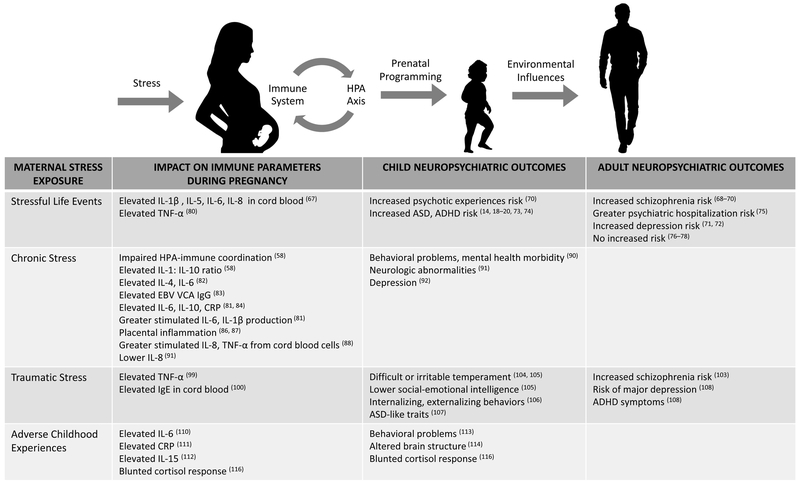
During pregnancy, programming of the fetal central nervous system establishes vulnerabilities for emergence of neuropsychiatric phenotypes later in life. Psychosocial influences during pregnancy, such as stressful life events and chronic stress, correlate with offspring neuropsychiatric disorders and inflammation, respectively. Stress promotes inflammation, but the role of inflammation as a mediator between maternal psychosocial stress and offspring neuropsychiatric outcomes has not been extensively studied in humans. This review summarizes clinical evidence linking specific types of stress to maternal inflammatory load during pregnancy. We propose that inflammation is a mediator in the relationship between psychosocial stress and offspring neuropsychiatric outcomes, potentially influenced by poor maternal glucocorticoid-immune coordination. We present relevant experimental animal research supporting this hypothesis. We conclude that clinical and preclinical research supports the premise that stress-induced maternal immune activation contributes in part to prenatal programming of risk. Programming of risk is likely due to a combination of vulnerabilities, including multiple or repeated inflammatory events; timing of such events; poor maternal regulation of inflammation; genetic vulnerability; and lifestyle contributors.
在妊娠期间,胎儿中枢神经系统的编程为生命后期出现神经精神表型奠定了基础。妊娠期间的心理社会影响,如生活应激事件和慢性应激,分别与后代的神经精神障碍和炎症相关。应激会促进炎症,但炎症作为母体心理社会应激与后代神经精神结局之间的中介物的作用在人类中尚未得到广泛研究。这篇综述总结了将特定类型的应激与妊娠期间母体炎症负荷联系起来的临床证据。我们提出,炎症是心理社会应激与后代神经精神结局之间关系的中介物,可能受到糖皮质激素-免疫协调不良的影响。我们介绍了支持这一假设的相关实验动物研究。我们的结论是,临床和临床前研究支持了应激诱导的母体免疫激活部分导致产前风险编程的前提。风险编程可能是由于多种或反复的炎症事件、这些事件的时间安排、母体对炎症的调节不良、遗传易感性和生活方式因素等综合作用所致。