Department of Medicine, Sungkyunkwan University School of Medicine, Seoul, Korea.
Department of Internal Medicine, Seoul National University Hospital, Seoul, Korea.
Korean J Intern Med. 2019 Sep;34(5):1030-1039. doi: 10.3904/kjim.2018.009. Epub 2018 Oct 16.
BACKGROUND/AIMS: It is unknown whether different β-blockers (BBs) have variable effects on long-term survival of patients with heart failure with reduced ejection fraction (HFrEF). This study compares the effects of two BBs, carvedilol and bisoprolol, on survival in patients with HFrEF.
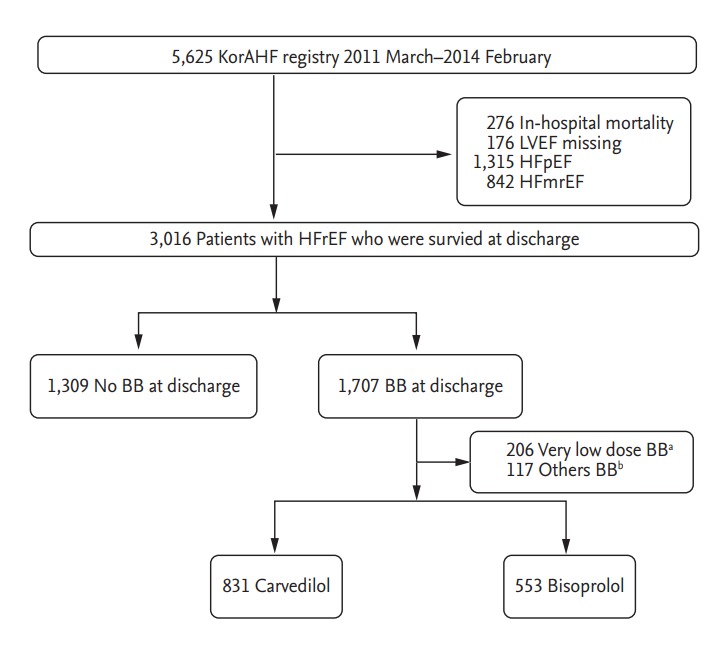
The Korean Acute Heart Failure (KorAHF) registry is a prospective multicenter cohort that includes 5,625 patients who were hospitalized for acute heart failure (AHF). We selected 3,016 patients with HFrEF and divided this study population into two groups: BB at discharge (n = 1,707) or no BB at discharge (n = 1,309). Among patients with BB at discharge, subgroups were formed based on carvedilol prescription (n = 831), or bisoprolol prescription (n = 553). Propensity score matching analysis was performed.
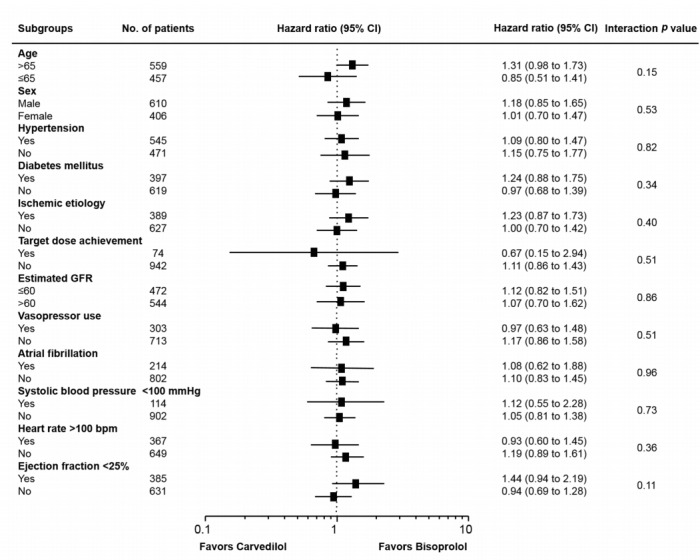
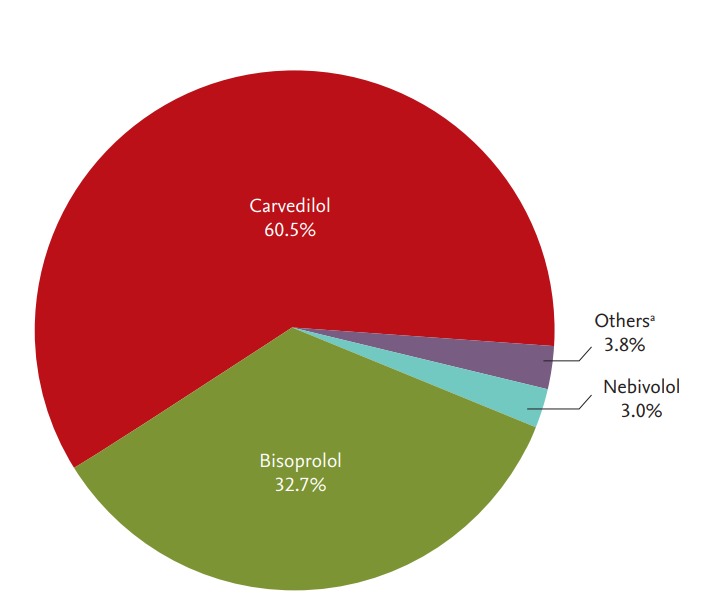
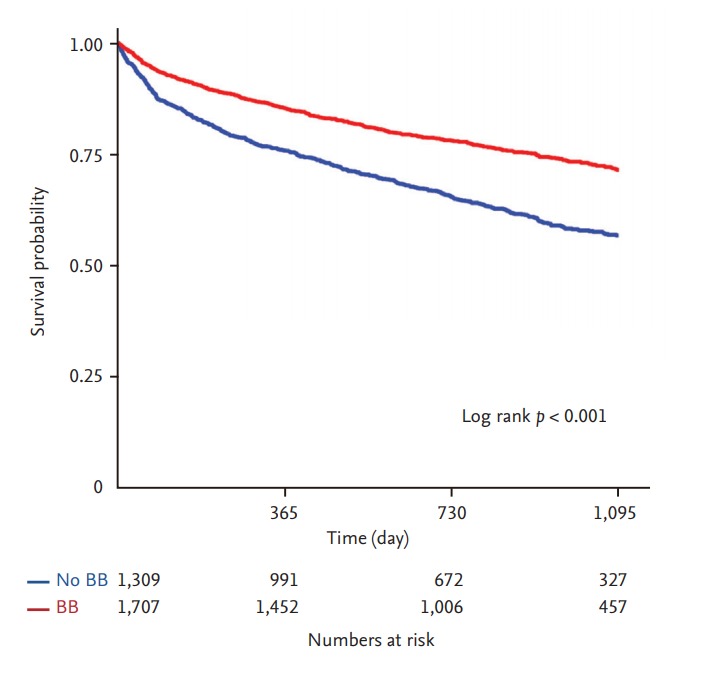
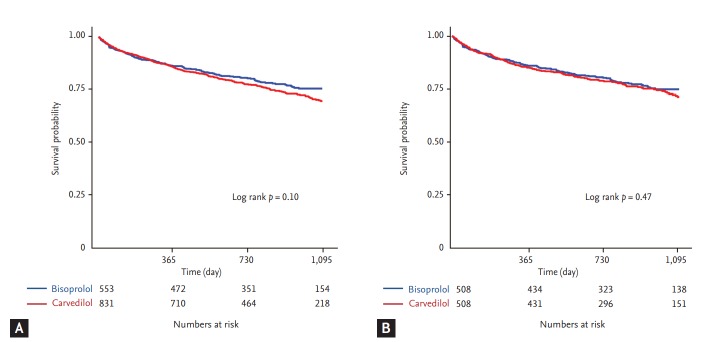
Among patients who were prescribed a BB at discharge, 60.5% received carvedilol and 32.7% received bisoprolol. There was a significant reduction in allcause mortality in those patients with HFrEF prescribed a BB at discharge compared to those who were not (BB vs. no BB, 26.1% vs. 40.8%; hazard ratio [HR], 0.59; 95% confidence interval [CI], 0.52 to 0.67; p < 0.001). However, there was no significant difference in the rate of all-cause mortality between those receiving different types of BB (carvedilol vs. bisoprolol, 27.5% vs. 23.5%; HR, 1.21; 95% CI, 0.99 to 1.47; p = 0.07). Similar results were observed after propensity score matching analysis (508 pairs, 26.2% vs. 23.8%; HR, 1.10; 95% CI, 0.86 to 1.40; p = 0.47).
In the treatment of AHF with reduced EF after hospitalization, mortality benefits of carvedilol and bisoprolol were comparable.
背景/目的:尚不清楚不同的β受体阻滞剂(BBs)是否对射血分数降低的心力衰竭(HFrEF)患者的长期生存有不同影响。本研究比较了两种 BB,卡维地洛和比索洛尔,对 HFrEF 患者生存的影响。
韩国急性心力衰竭(KorAHF)登记处是一项前瞻性多中心队列研究,包括 5625 名因急性心力衰竭(AHF)住院的患者。我们选择了 3016 名 HFrEF 患者,并将该研究人群分为两组:出院时使用 BB(n = 1707)或出院时未使用 BB(n = 1309)。在出院时使用 BB 的患者中,根据卡维地洛处方(n = 831)或比索洛尔处方(n = 553)形成亚组。进行倾向评分匹配分析。
在出院时开具 BB 的患者中,60.5%接受了卡维地洛,32.7%接受了比索洛尔。与未开具 BB 的患者相比,出院时开具 BB 的 HFrEF 患者的全因死亡率显著降低(BB 与无 BB,26.1% vs. 40.8%;风险比 [HR],0.59;95%置信区间 [CI],0.52 至 0.67;p < 0.001)。然而,接受不同类型 BB 的患者的全因死亡率之间没有显著差异(卡维地洛与比索洛尔,27.5% vs. 23.5%;HR,1.21;95%CI,0.99 至 1.47;p = 0.07)。在倾向评分匹配分析后也观察到了类似的结果(508 对,26.2% vs. 23.8%;HR,1.10;95%CI,0.86 至 1.40;p = 0.47)。
在住院后射血分数降低的 AHF 治疗中,卡维地洛和比索洛尔的死亡率获益相当。