Department of Surgery, Medical School, University of Thessaly, Larissa, Greece.
Tissue Analysis Core, Immunology Laboratory, Vaccine Research Center, NIAID, NIH, Bethesda, MD, United States.
Front Immunol. 2018 Sep 27;9:2233. doi: 10.3389/fimmu.2018.02233. eCollection 2018.
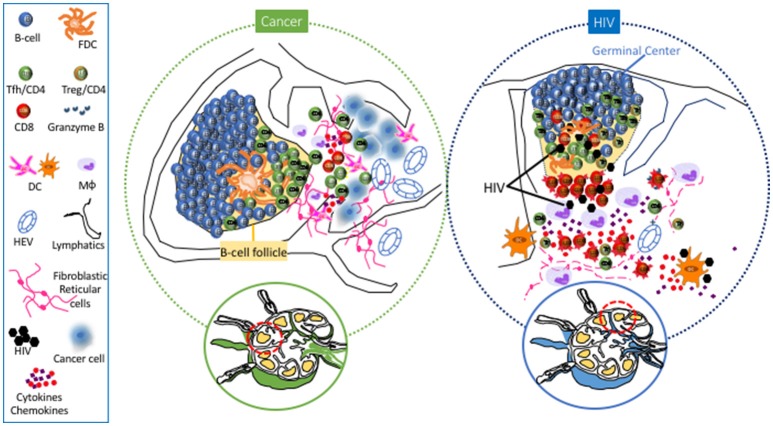
Lymph nodes (LNs) are central in the generation of adaptive immune responses. Follicular helper CD4 T (Tfh) cells, a highly differentiated CD4 population, provide critical help for the development of antigen-specific B cell responses within the germinal center. Throughout the past decade, numerous studies have revealed the important role of Tfh cells in Human Immunodeficiency Virus (HIV) pathogenesis as well as in the development of neutralizing antibodies post-infection and post-vaccination. It has also been established that tumors influence various immune cell subsets not only in their proximity, but also in draining lymph nodes. The role of local or tumor associated lymph node Tfh cells in disease progression is emerging. Comparative studies of Tfh cells in chronic infections and cancer could therefore provide novel information with regards to their differentiation plasticity and to the mechanisms regulating their development.
淋巴结(LNs)是适应性免疫反应产生的核心。滤泡辅助性 CD4 T(Tfh)细胞是一种高度分化的 CD4 细胞群,在生发中心内为抗原特异性 B 细胞反应的发展提供关键帮助。在过去的十年中,大量研究揭示了 Tfh 细胞在人类免疫缺陷病毒(HIV)发病机制以及感染和接种疫苗后中和抗体的发展中的重要作用。已经确定肿瘤不仅在其附近,而且在引流淋巴结中影响各种免疫细胞亚群。局部或与肿瘤相关的淋巴结 Tfh 细胞在疾病进展中的作用正在出现。因此,慢性感染和癌症中 Tfh 细胞的比较研究可以提供关于其分化可塑性和调节其发展的机制的新信息。