Wang Zhiqiang, Fan Zhexuan, Zhao Qi, Wang Mingcheng, Ran Jinzhi, Huang Heng, Niklas Karl J
The Institute for Advanced Study, Chengdu University, Chengdu, China.
State Key Laboratory of Biocontrol, School of Life Sciences, Sun Yat-sen University, Guangzhou, China.
Front Plant Sci. 2018 Sep 26;9:1431. doi: 10.3389/fpls.2018.01431. eCollection 2018.
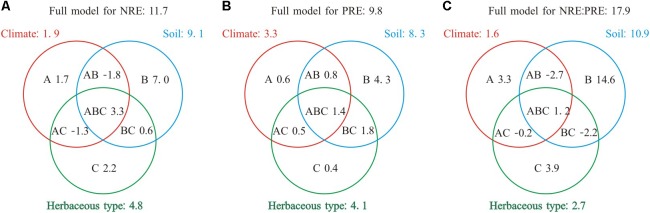
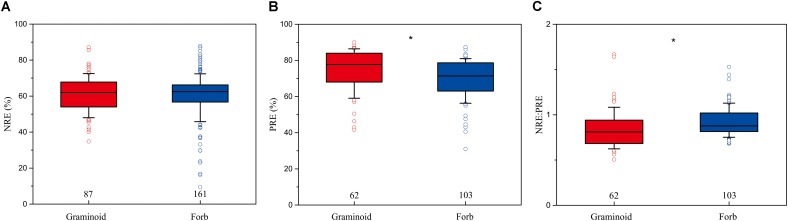
Nutrient resorption plays an important role in ecology because it has a profound effect on subsequent plant growth. However, our current knowledge about patterns of nutrient resorption, particularly among herbaceous species, at a global scale is still inadequate. Here, we present a meta-analysis using a global dataset of nitrogen (N) and phosphorus (P) resorption efficiency encompassing 227 perennial herbaceous species. This analysis shows that the N and P resorption efficiency (NRE and PRE, respectively), and N:P resorption ratios (NRE:PRE) across all herbaceous plant groups are 59.4, 67.5, and 0.89%, respectively. Across all species, NRE, PRE, and NRE:PRE, exhibited different patterns along climatic and soil nutrient gradients, i.e., NRE decreases with increasing mean annual precipitation (MAP) and soil N, PRE increases with aridity index (AI) but decreases with MAP and soil P, and NRE:PRE decreases with increasing potential evapotranspiration (PET), AI, and soil N:P. NRE, PRE, and NRE:PRE also differed in functional species group (graminoids vs. forbs). Soil nutrient level was the largest contributor to the total variations in NRE, PRE, and NRE:PRE, while climate and herbaceous types had relatively smaller effects on NRE, PRE, and NRE:PRE. Collectively, these trends can inform attempts to model biogeochemical cycling at a global scale.
养分再吸收在生态学中起着重要作用,因为它对后续植物生长有着深远影响。然而,我们目前关于全球范围内养分再吸收模式的知识,尤其是草本植物中的模式,仍然不足。在此,我们使用一个包含227种多年生草本植物的全球氮(N)和磷(P)再吸收效率数据集进行了一项荟萃分析。该分析表明,所有草本植物组的氮和磷再吸收效率(分别为NRE和PRE)以及氮磷再吸收比率(NRE:PRE)分别为59.4%、67.5%和0.89%。在所有物种中,NRE、PRE和NRE:PRE沿气候和土壤养分梯度呈现出不同模式,即NRE随年平均降水量(MAP)和土壤氮含量的增加而降低,PRE随干旱指数(AI)增加但随MAP和土壤磷含量降低,NRE:PRE随潜在蒸散量(PET)、AI和土壤氮磷比的增加而降低。NRE、PRE和NRE:PRE在功能物种组(禾本科植物与双子叶植物)中也存在差异。土壤养分水平是NRE、PRE和NRE:PRE总变异的最大贡献因素,而气候和草本植物类型对NRE、PRE和NRE:PRE的影响相对较小。总体而言,这些趋势可为全球尺度上生物地球化学循环的建模尝试提供参考。