Wang Yi-Jun, Fletcher Rochelle, Yu Jian, Zhang Lin
UPMC Hillman Cancer Center, Pittsburgh, PA, 15213, USA.
Department of Pharmacology and Chemical Biology, University of Pittsburgh School of Medicine, Pittsburgh, PA, 15213, USA.
Genes Dis. 2018 May 17;5(3):194-203. doi: 10.1016/j.gendis.2018.05.003. eCollection 2018 Sep.
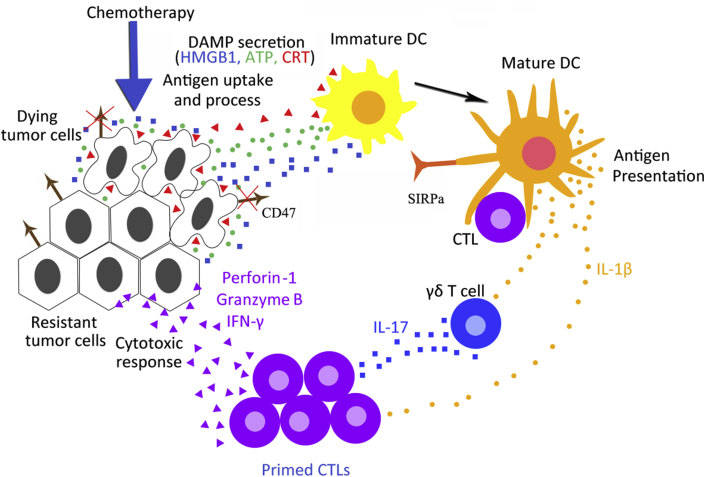
Emerging evidence suggests that the clinical success of conventional chemotherapy is not solely attributed to tumor cell toxicity, but also results from the restoration of immunosurveillance, which has been largely neglected in the past preclinical and clinical research. Antitumor immune response can be primed by immunogenic cell death (ICD), a type of cell death characterized by cell-surface translocation of calreticulin (CRT), extracellular release of ATP and high mobility group box 1 (HMGB1), and stimulation of type I interferon (IFN) responses. Here we summarize recent studies showing conventional chemotherapeutics as ICD inducers, which are capable of modulating tumor infiltrating lymphocytes (TILs) and reactivating antitumor immunity within an immuno-suppressive microenvironment. Such immunological effects of conventional chemotherapy are likely critical for better prognosis of cancer patients. Furthermore, combination of ICD-inducing chemotherapeutics with immunotherapy is a promising approach for improving the clinical outcomes of cancer patients.
新出现的证据表明,传统化疗的临床成功不仅归因于肿瘤细胞毒性,还源于免疫监视的恢复,而这在过去的临床前和临床研究中很大程度上被忽视了。抗肿瘤免疫反应可由免疫原性细胞死亡(ICD)引发,这是一种细胞死亡类型,其特征为钙网蛋白(CRT)的细胞表面易位、ATP和高迁移率族蛋白B1(HMGB1)的细胞外释放,以及I型干扰素(IFN)反应的刺激。在此,我们总结了近期的研究,这些研究表明传统化疗药物可作为ICD诱导剂,能够在免疫抑制微环境中调节肿瘤浸润淋巴细胞(TILs)并重新激活抗肿瘤免疫。传统化疗的这种免疫效应可能对癌症患者的更好预后至关重要。此外,将诱导ICD的化疗药物与免疫疗法联合使用是改善癌症患者临床结局的一种有前景的方法。