Perry Luba, Landau Shira, Flugelman Moshe Y, Levenberg Shulamit
Biomedical Engineering Department, Technion-Israel Institute of Technology, Haifa, 32000, Israel.
Inter-departmental Program in Biotechnology, Technion-Israel Institute of Technology, Haifa, 32000, Israel.
Commun Biol. 2018 Oct 4;1:161. doi: 10.1038/s42003-018-0161-0. eCollection 2018.
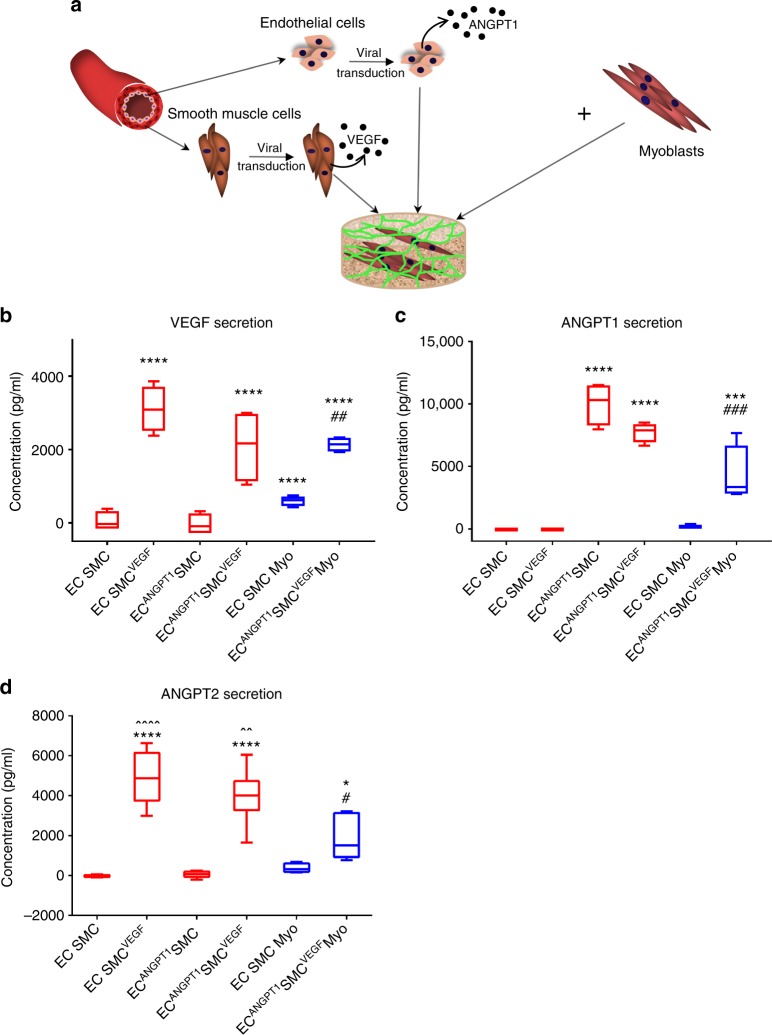
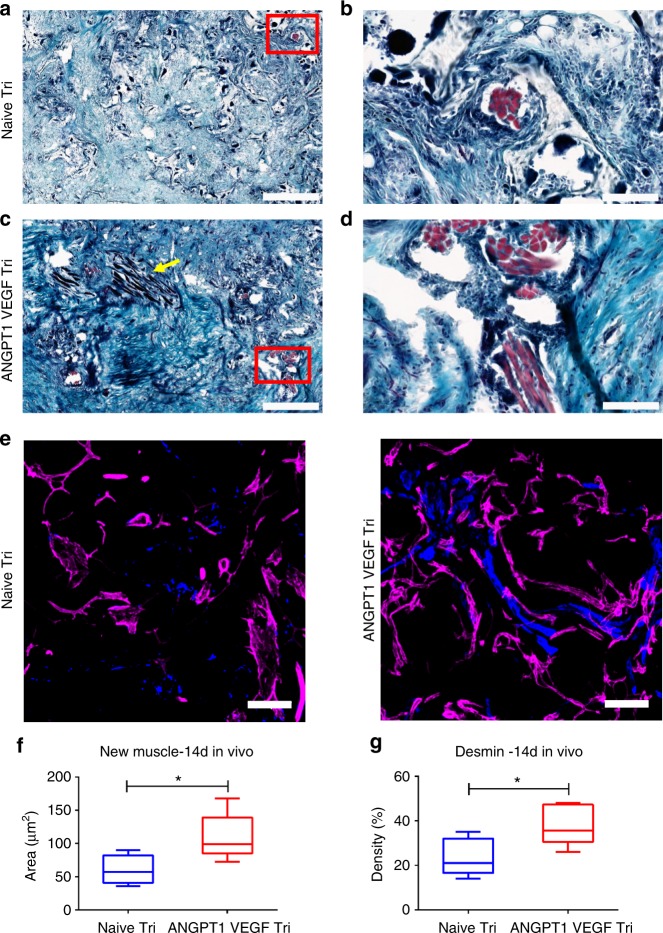
Engineered tissues are a promising tool for addressing the growing need for tissues and organs in surgical reconstructions. Prevascularization of implanted tissues is expected to enhance survival prospects post transplantation and minimize deficiencies and/or hypoxia deeper in the tissue. Here, we fabricate a three-dimensional, prevascularized engineered muscle containing human myoblasts, genetically modified endothelial cells secreting angiopoietin 1 (ANGPT1) and genetically modified smooth muscle cells secreting vascular endothelial growth factor (VEGF). The genetically engineered human muscle shows enhanced host neovascularization and myogenesis following transplantation into a mouse host, compared to the non-secreting control. The vascular, genetically modified cells have been cleared for clinical trials and can be used to construct autologous vascularized tissues. Therefore, the described genetically engineered vascularized muscle has the potential to be fully translated to the clinical setting to overcome autologous tissue shortage and to accelerate host neovascularization and integration of engineered grafts following transplantation.
工程组织是满足外科重建中对组织和器官日益增长需求的一种有前景的工具。植入组织的预血管化有望提高移植后的存活前景,并将组织深处的缺陷和/或缺氧降至最低。在此,我们构建了一种三维预血管化工程肌肉,其包含人类成肌细胞、分泌血管生成素1(ANGPT1)的基因修饰内皮细胞以及分泌血管内皮生长因子(VEGF)的基因修饰平滑肌细胞。与非分泌对照相比,这种基因工程化的人类肌肉在移植到小鼠宿主后显示出增强的宿主新血管形成和肌生成。经基因修饰的血管细胞已获批用于临床试验,可用于构建自体血管化组织。因此,所述的基因工程化血管化肌肉有潜力完全转化至临床应用,以克服自体组织短缺问题,并加速移植后宿主新血管形成和工程移植物的整合。