Laiva Ashang L, O'Brien Fergal J, Keogh Michael B
Tissue Engineering Research Group-Bahrain, Royal College of Surgeons in Ireland, Adliya, Manama P.O. Box 15503, Bahrain.
Tissue Engineering Research Group, Department of Anatomy and Regenerative Medicine, Royal College of Surgeons in Ireland, 123 St. Stephen's Green, D02 YN77 Dublin, Ireland.
Pharmaceuticals (Basel). 2021 Nov 17;14(11):1168. doi: 10.3390/ph14111168.
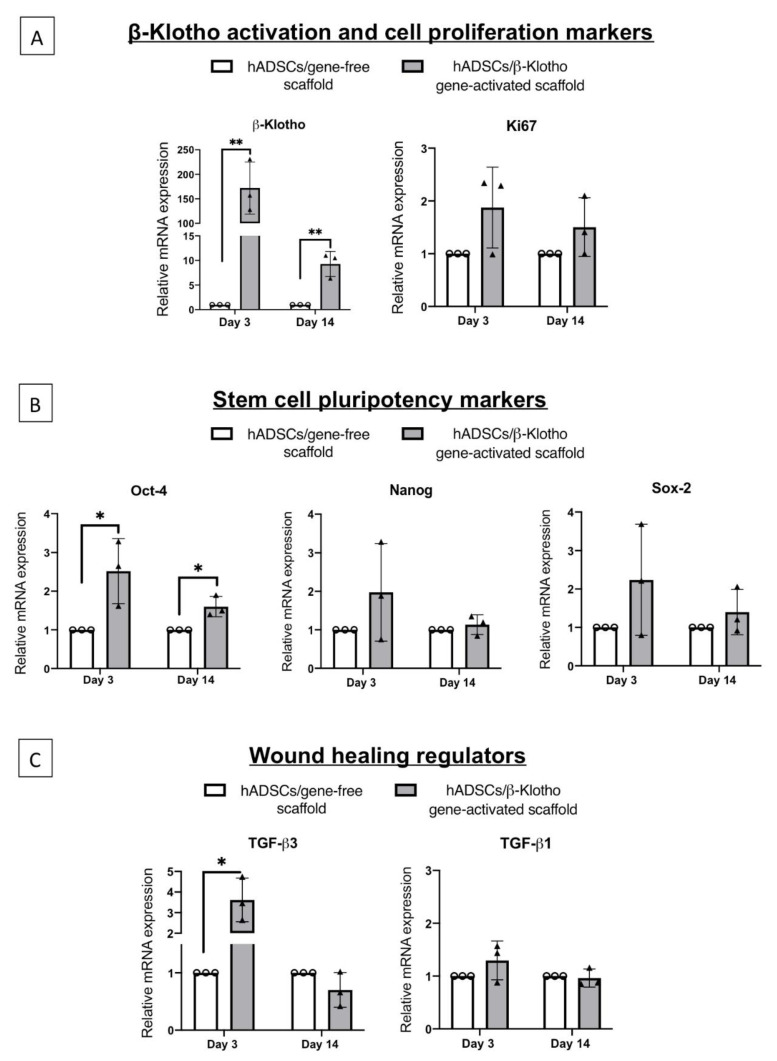
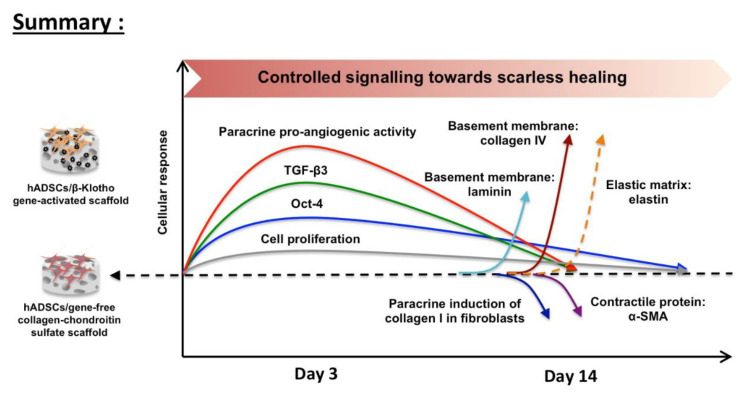
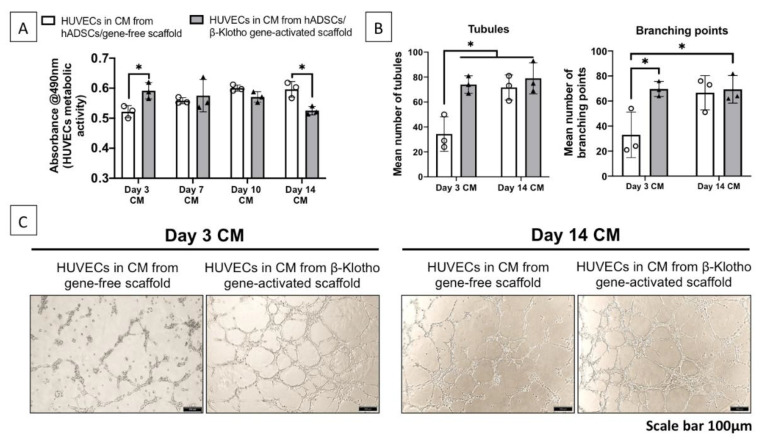
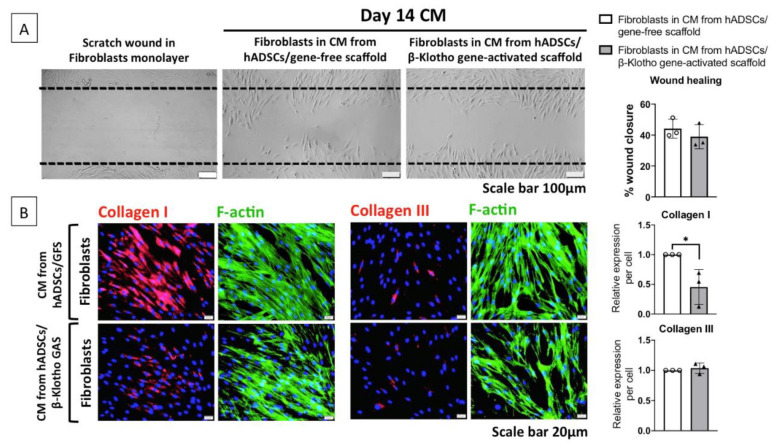
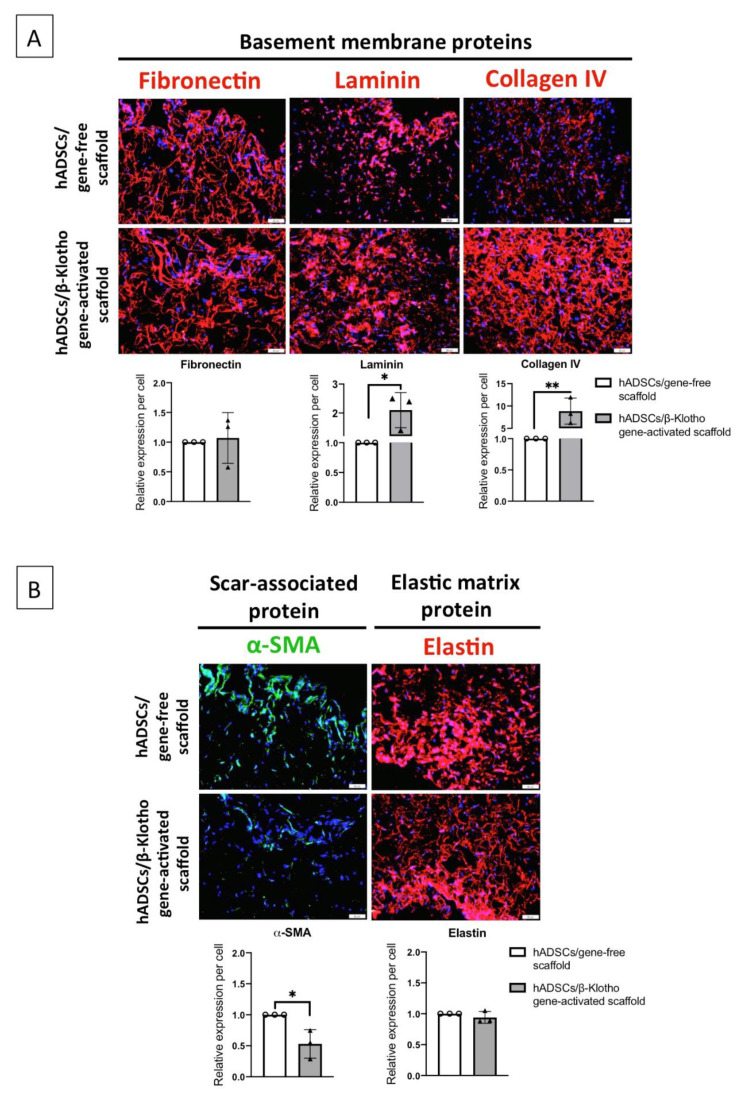
Wound healing requires a tight orchestration of complex cellular events. Disruption in the cell-signaling events can severely impair healing. The application of biomaterial scaffolds has shown healing potential; however, the potential is insufficient for optimal wound maturation. This study explored the functional impact of a collagen-chondroitin sulfate scaffold functionalized with nanoparticles carrying an anti-aging gene β-Klotho on human adipose-derived stem cells (ADSCs) for rejuvenative healing applications. We studied the response in the ADSCs in three phases: (1) transcriptional activities of pluripotency factors (Oct-4, Nanog and Sox-2), proliferation marker (Ki-67), wound healing regulators (TGF-β3 and TGF-β1); (2) paracrine bioactivity of the secretome generated by the ADSCs; and (3) regeneration of basement membrane (fibronectin, laminin, and collagen IV proteins) and expression of scar-associated proteins (α-SMA and elastin proteins) towards maturation. Overall, we found that the β-Klotho gene-activated scaffold offers controlled activation of ADSCs' regenerative abilities. On day 3, the ADSCs on the gene-activated scaffold showed enhanced (2.5-fold) activation of transcription factor Oct-4 that was regulated transiently. This response was accompanied by a 3.6-fold increase in the expression of the anti-fibrotic gene TGF-β3. Through paracrine signaling, the ADSCs-laden gene-activated scaffold also controlled human endothelial angiogenesis and pro-fibrotic response in dermal fibroblasts. Towards maturation, the ADSCs-laden gene-activated scaffold further showed an enhanced regeneration of the basement membrane through increases in laminin (2.1-fold) and collagen IV (8.8-fold) deposition. The ADSCs also expressed 2-fold lower amounts of the scar-associated α-SMA protein with improved qualitative elastin matrix deposition. Collectively, we determined that the β-Klotho gene-activated scaffold possesses tremendous potential for wound healing and could advance stem cell-based therapy for rejuvenative healing applications.
伤口愈合需要对复杂的细胞事件进行精确的协调。细胞信号转导事件的中断会严重损害愈合过程。生物材料支架的应用已显示出愈合潜力;然而,这种潜力不足以实现最佳的伤口成熟。本研究探讨了用携带抗衰老基因β-klotho的纳米颗粒功能化的硫酸软骨素胶原蛋白支架对人脂肪来源干细胞(ADSCs)在促进愈合的再生应用中的功能影响。我们分三个阶段研究了ADSCs的反应:(1)多能性因子(Oct-4、Nanog和Sox-2)、增殖标志物(Ki-67)、伤口愈合调节因子(TGF-β3和TGF-β1)的转录活性;(2)ADSCs产生的分泌组的旁分泌生物活性;(3)基底膜(纤连蛋白、层粘连蛋白和IV型胶原蛋白)的再生以及瘢痕相关蛋白(α-SMA和弹性蛋白)向成熟的表达。总体而言,我们发现β-klotho基因激活的支架能够可控地激活ADSCs的再生能力。在第3天,基因激活支架上的ADSCs显示转录因子Oct-4的激活增强(2.5倍),且这种激活是短暂调节的。这种反应伴随着抗纤维化基因TGF-β3表达增加3.6倍。通过旁分泌信号,负载ADSCs的基因激活支架还能控制人内皮细胞的血管生成和真皮成纤维细胞的促纤维化反应。在向成熟发展的过程中,负载ADSCs的基因激活支架通过层粘连蛋白(2.1倍)和IV型胶原蛋白(8.8倍)沉积的增加,进一步显示出基底膜再生增强。ADSCs还表达了数量减少2倍的瘢痕相关α-SMA蛋白,同时弹性蛋白基质沉积质量得到改善。我们共同确定,β-klotho基因激活的支架在伤口愈合方面具有巨大潜力,可推动基于干细胞的促进愈合的再生应用治疗发展。