Yang Chenlin, Hu Rui, Li Qian, Li Shuang, Xiang Junfeng, Guo Xudong, Wang Shuangqing, Zeng Yi, Li Yi, Yang Guoqiang
Key Laboratory of Photochemistry, Institute of Chemistry, Key Laboratory of Photochemical Conversion and Optoelectronic Materials, Technical Institute of Physics and Chemistry, and State Key Laboratory for Structural Chemistry of Unstable and Stable Species, Institute of Chemistry, Chinese Academy of Sciences, Beijing 100190, China.
University of Chinese Academy of Sciences, Beijing 100049, China.
ACS Omega. 2018 Sep 30;3(9):10487-10492. doi: 10.1021/acsomega.8b01190. Epub 2018 Sep 4.
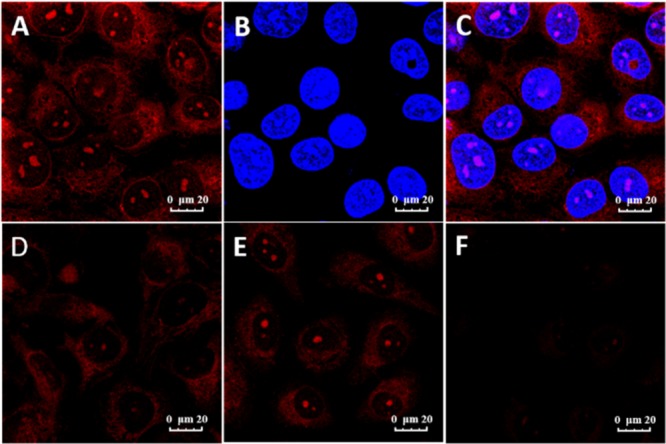
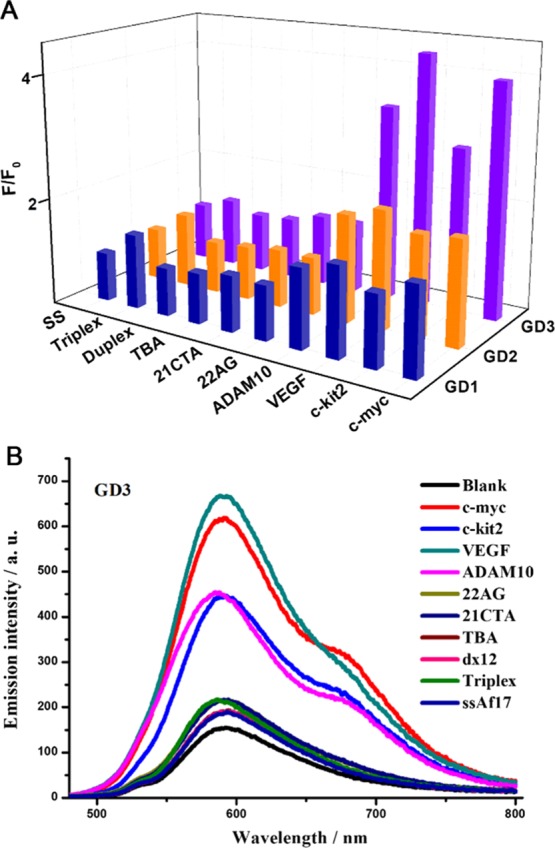
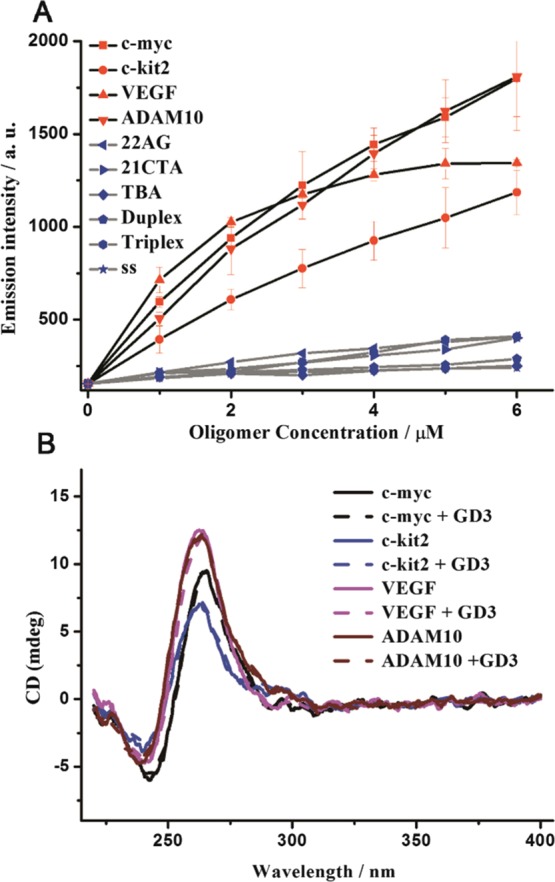
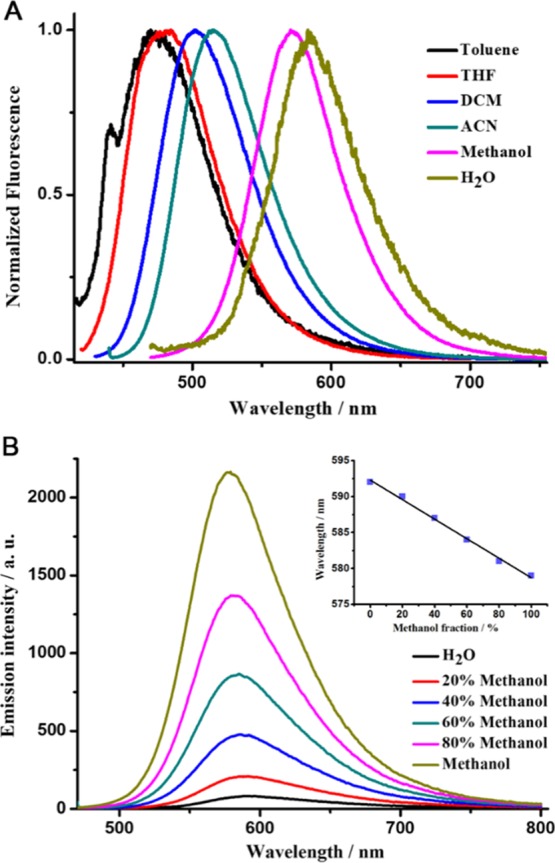
G-quadruplexes (G4s) are unique four-stranded nucleic acid secondary structures formed by G-rich nucleic acid sequences which are prevalent in gene promoter and telomere regions and deemed to play essential roles in many biological and pathological processes. Although attentions to G4s have been paid for nearly 40 years, G4 selectivity and its topology discrimination in cells is still pending. Small fluorescence molecules are emerging as a versatile tool of interrogation of cellular features in vivo. Herein, a new class of bis(4-aminobenzylidene)acetone derivatives GD1, GD2, and GD3 with excellent environment-sensitive emission properties were developed and used for fluorescent detection of G4s. Among them, compound GD3 owning four methoxy groups presented preferable capability of lighting up parallel G4s with a strong red-emission enhancement. The photophysical property of GD3 was systematically investigated to elucidate the turn-on mechanism of GD3 toward parallel G4 structures, which reveal that the binding-induced polarity change of the microenvironment around GD3 together with the fluorophore conformational confinement affected the molecular intramolecular charge-transfer state and resulted the enhanced emission. G4s staining with GD3 in fixed cells was further applied, demonstrating GD3 a promising probe with the ability to visualize the distribution of G4 structures in biological processes. In general, this study provides a new potential scaffold-bis(4-aminobenzylidene)acetone-for design of G4-selective fluorescence probes.
G-四链体(G4s)是由富含鸟嘌呤(G)的核酸序列形成的独特四链核酸二级结构,其在基因启动子和端粒区域普遍存在,并被认为在许多生物学和病理学过程中发挥重要作用。尽管对G4s的关注已有近40年,但细胞中G4s的选择性及其拓扑结构识别仍有待解决。小分子荧光分子正成为一种在体内研究细胞特征的通用工具。在此,开发了一类具有优异环境敏感发射特性的新型双(4-氨基亚苄基)丙酮衍生物GD1、GD2和GD3,并将其用于G4s的荧光检测。其中,含有四个甲氧基的化合物GD3具有较好的点亮平行G4s的能力,其红色发射显著增强。系统研究了GD3的光物理性质,以阐明其对平行G4结构的开启机制,结果表明,GD3周围微环境的结合诱导极性变化以及荧光团构象限制影响了分子内分子内电荷转移状态,从而导致发射增强。进一步应用GD3对固定细胞中的G4s进行染色,并证明GD3是一种有前景的探针,能够在生物学过程中可视化G4结构的分布。总的来说,本研究为设计G4选择性荧光探针提供了一种新的潜在支架——双(4-氨基亚苄基)丙酮。