Africa Health Research Institute, Durban, South Africa.
London School of Hygiene and Tropical Medicine, London, United Kingdom.
PLoS One. 2018 Oct 16;13(10):e0203193. doi: 10.1371/journal.pone.0203193. eCollection 2018.
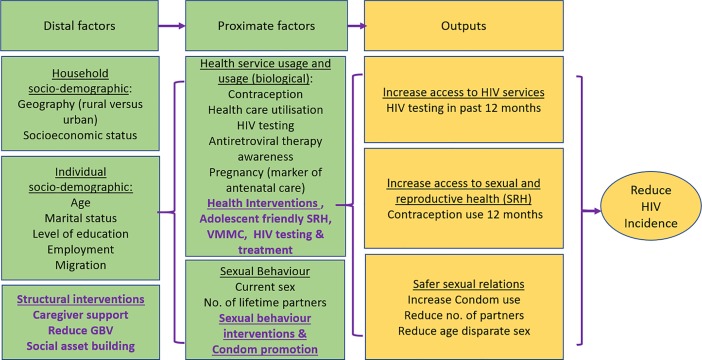
Adolescent girls and young women (AGYW) bear the brunt of the HIV epidemic in South Africa. 'DREAMS' aims to reduce HIV incidence through multi-level combination prevention. We describe HIV incidence and uptake of HIV and sexual reproductive health (SRH) by AGYW in KwaZulu-Natal (KZN), prior to DREAMS.
Longitudinal and cross-sectional analysis of women (15-24 year old) in a population-based HIV incidence cohort within a demographic surveillance site in KZN. Observation time for HIV incidence was person-years at risk while resident. "Current use of contraceptives" and "having an HIV test in the past 12 months" was compared between 2011 and 2015.
In 2015, HIV prevalence was 11.0% and 34.1% and HIV incidence (2011-2015) was 4.54% (95%CI:3.89-5.30) and 7.45% (95%CI:6.51-8.51) per year in 15-19 and 20-24 year olds respectively, with no significant decline compared to 2006-2010. In 2015, 90.7% of 20-24-year-olds were unemployed, 36.4% and 51.7% of 15-19 and 20-24 year olds reported recent migration; 20.9% and 72.6% of 15-19 and 20-24 year olds had ever been pregnant. In 2015, less than 50% reported condom-use at last sex, 15.0% of 15-19 year olds and 48.9% of 20-24 year olds were currently using contraception and 32.0% and 66.7% of 15-19 and 20-24 year olds had tested for HIV in the past 12 months. There had been no improvement compared to 2011. Factors associated with AGYW testing for HIV in the past 12 months were, survey year-2011 more likely than 2015 (aOR = 0.50), number of partners (aOR = 3.25), ever been pregnant (aOR = 2.47) and knowing where to find ART (aOR = 1.54). Factors associated with contraception use were being older (aOR = 4.83); ever been pregnant (aOR = 12.62); knowing where to get ART (aOR = 1.79) and having had an HIV test in past 12 months (aOR = 1.74).
Prior to DREAMS, HIV incidence in AGYW was high. HIV and SRH service uptake did not improve and was suboptimal. Findings highlight the need for combination HIV prevention programmes for AGYW in this economically vulnerable area.
青少年女孩和年轻妇女(AGYW)在南非艾滋病毒流行中首当其冲。“梦想”旨在通过多层次联合预防来降低艾滋病毒的发病率。我们描述了在 DREAMS 之前,夸祖鲁-纳塔尔省(KZN)的艾滋病毒发病率队列中 15-24 岁的女性(15-24 岁)的艾滋病毒发病率和艾滋病毒及性生殖健康(SRH)的采用情况。
对 KZN 人口监测点内基于人群的艾滋病毒发病率队列中女性(15-24 岁)进行纵向和横断面分析。艾滋病毒发病率的观察时间为居民风险的人年。比较了 2011 年至 2015 年期间“当前使用避孕药具”和“过去 12 个月内进行过艾滋病毒检测”的情况。
2015 年,艾滋病毒流行率分别为 11.0%和 34.1%,艾滋病毒发病率(2011-2015 年)分别为 4.54%(95%CI:3.89-5.30)和 7.45%(95%CI:6.51-8.51)/年,与 2006-2010 年相比,无显著下降。2015 年,20-24 岁的年轻人中,90.7%失业,15-19 岁和 20-24 岁的年轻人中,分别有 36.4%和 51.7%的人报告最近迁移;15-19 岁和 20-24 岁的年轻人中,分别有 20.9%和 72.6%的人曾经怀孕。2015 年,不到 50%的人报告上次性行为使用了安全套,15.0%的 15-19 岁年轻人和 48.9%的 20-24 岁年轻人目前正在使用避孕药具,15-19 岁和 20-24 岁的年轻人中,分别有 32.0%和 66.7%的人在过去 12 个月内进行了艾滋病毒检测。与 2011 年相比,没有任何改善。过去 12 个月内接受艾滋病毒检测的 AGYW 与调查年份有关(2011 年的可能性为 2015 年的 0.50 倍)、性伴侣数量(aOR=3.25)、是否怀孕(aOR=2.47)以及是否知道在哪里可以获得抗逆转录病毒治疗(aOR=1.54)。与使用避孕药具有关的因素是年龄较大(aOR=4.83);曾怀孕(aOR=12.62);知道在哪里可以获得艾滋病治疗(aOR=1.79)以及过去 12 个月内进行过艾滋病检测(aOR=1.74)。
在 DREAMS 之前,青少年女孩和年轻妇女的艾滋病毒发病率很高。艾滋病毒和性生殖健康服务的采用情况并没有改善,而且并不理想。研究结果强调,在这个经济脆弱的地区,需要为青少年女孩和年轻妇女制定艾滋病毒综合预防方案。