Samadian Mohammad, Bani Monireh Ahmadi, Golchin Navid, Mardani Mohammad Ali, Head John S, Arazpour Mokhtar
Skull Base Research Center, Loghman Hakim Hospital, Tehran, Iran.
Department of Neurosurgery, Loghman Hakim Hospital, Shahid Beheshti University of Medical Sciences, Tehran, Iran.
Asian Spine J. 2019 Feb;13(1):96-102. doi: 10.31616/asj.2017.0283. Epub 2018 Oct 18.
Pilot study.
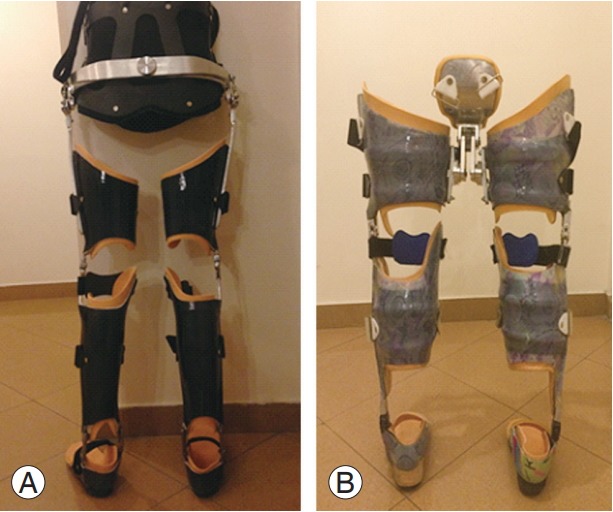
Evaluation of two different hip-knee-ankle-foot orthoses (HKAFOs; medial linkage reciprocating gait orthosis [MLRGO] and isocentric reciprocating gait orthosis [IRGO]) using gait and postural stability analysis in four subjects with spinal cord injury (SCI).
To the best of our knowledge, no study has evaluated postural stability in subjects with SCI when using MLRGO and IRGO.
The relative efficacy of each orthosis was evaluated with relevant gait parameters, and an assessment of postural stability and sway during usage was made. Each analysis was conducted following an appropriate period of training and acclimatization. The gait parameters employed in the study were walking speed, cadence, and endurance; these were recorded and analyzed using current, validated methods. Postural stability was assessed using a verified force plate measurement system, and a modified Falls Efficacy Scale (mFES) was used for the measurement of postural sway and the perceived fear of falling.
Walking speed, cadence, and endurance increased with the use of both HKAFOs. When the two types of HKAFOs were compared, all the parameters showed a slight (but not significant) increase with the use of MLRGO compared with the use of IRGO. In contrast, there were slight but insignificant improvements in postural sway with the use of IRGO. However, although there were no significant differences between the two sets of mFES scores, there was a slightly reduced fear of falling with the use of MLRGO compared with the use of IRGO in the static standing position.
It is noteworthy that meaningful interpretations of results can only be drawn if a larger sample is employed. This pilot study showed no significant data; however, the results indicate that the use of MLRGO is superior to that of IRGO in terms of potential improvement in the mobility and confidence levels of subjects with SCI.
试点研究。
对四名脊髓损伤(SCI)患者使用两种不同的髋-膝-踝-足矫形器(HKAFOs;内侧联动往复式步态矫形器[MLRGO]和等中心往复式步态矫形器[IRGO])进行步态和姿势稳定性分析评估。
据我们所知,尚无研究评估脊髓损伤患者使用MLRGO和IRGO时的姿势稳定性。
通过相关步态参数评估每种矫形器的相对疗效,并对使用过程中的姿势稳定性和摇摆进行评估。每项分析均在经过适当的训练和适应期后进行。本研究中使用的步态参数为步行速度、步频和耐力;采用当前经过验证的方法对这些参数进行记录和分析。使用经过验证的测力板测量系统评估姿势稳定性,并使用改良的跌倒效能量表(mFES)测量姿势摇摆和感知到的跌倒恐惧。
使用两种HKAFOs时,步行速度、步频和耐力均有所提高。比较两种类型的HKAFOs时,与使用IRGO相比,使用MLRGO时所有参数均有轻微(但不显著)提高。相比之下,使用IRGO时姿势摇摆有轻微但不显著的改善。然而,尽管两组mFES评分之间没有显著差异,但在静态站立姿势下,与使用IRGO相比,使用MLRGO时跌倒恐惧略有降低。
值得注意的是,只有采用更大的样本量才能得出有意义的结果解释。这项试点研究未显示出显著数据;然而,结果表明,就潜在改善脊髓损伤患者的活动能力和信心水平而言,使用MLRGO优于使用IRGO。