Huang Kuo-Chin, Su Yuan-Chih, Sun Mao-Feng, Huang Sheng-Teng
Department of Chinese Medicine, China Medical University Hospital, Taichung, Taiwan.
School of Chinese Medicine, China Medical University, Taichung, Taiwan.
Front Pharmacol. 2018 Oct 1;9:1117. doi: 10.3389/fphar.2018.01117. eCollection 2018.
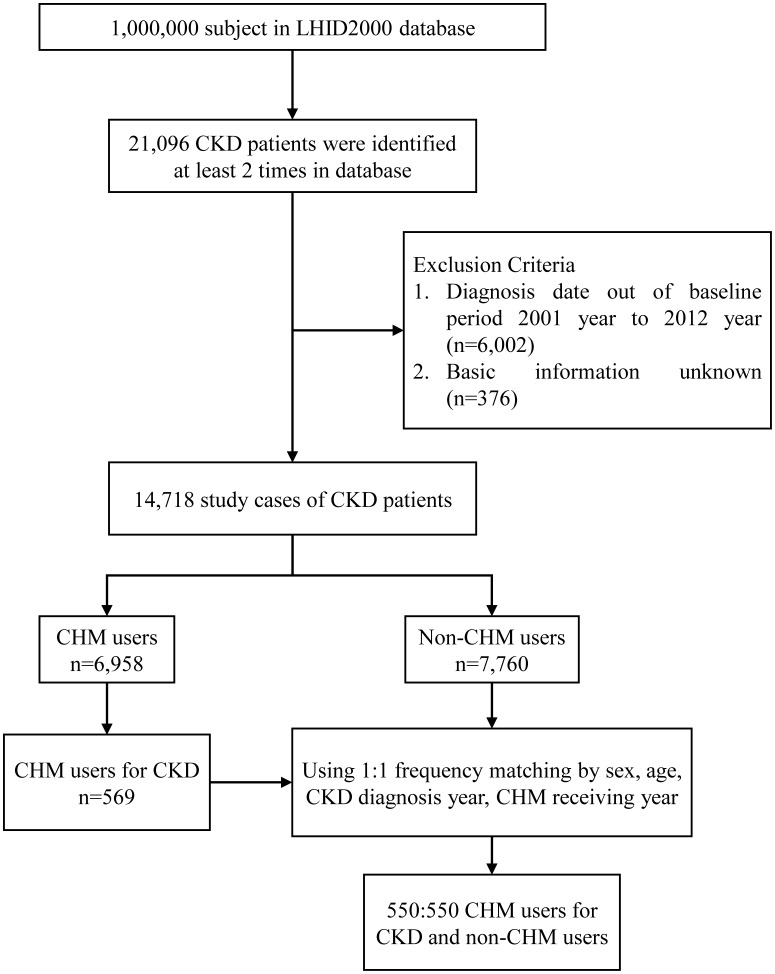
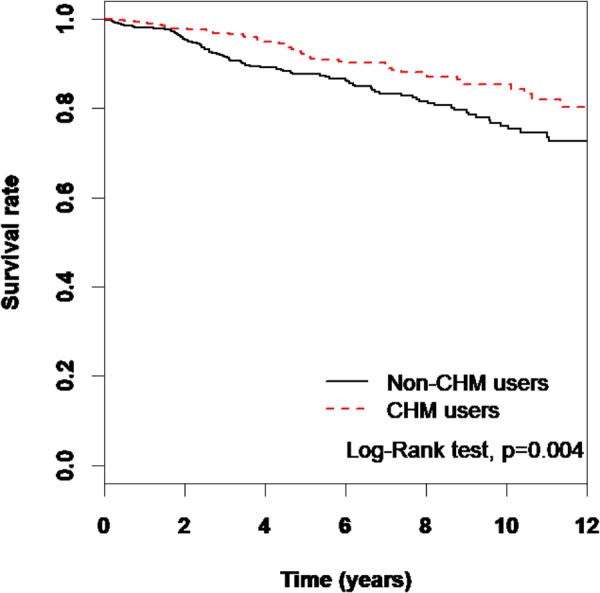
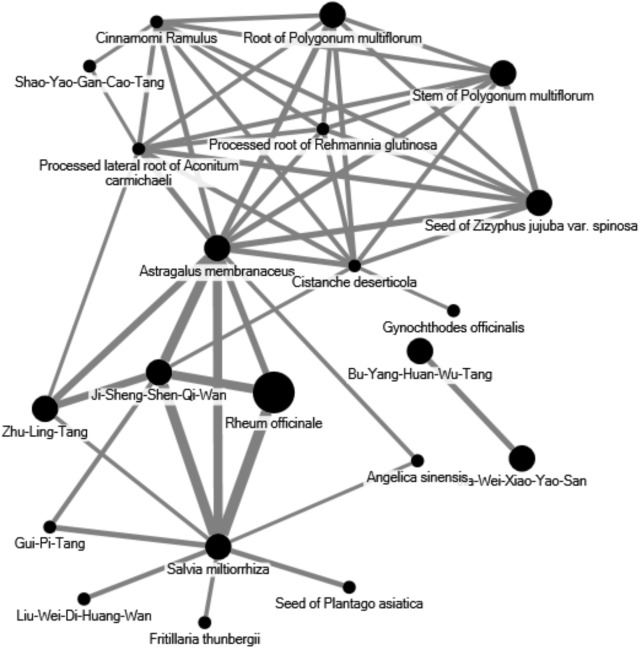
Chinese herbal medicine (CHM) is frequently applied in conjunction with western pharmacotherapy to relieve symptoms in patients with CKD. However, evidence-based research into the effectiveness of CHM use as applied to treat CKD is limited and warrants further investigation. The aim of this study is to assess whether adjunctive treatment with CHM affected survival rate of CKD patients undergoing conventional western medical management. A total of 14,718 CKD patients, including 6,958 CHM users and 7,760 non-CHM users, were recruited from the Longitudinal Health Insurance Database 2000, a sub-dataset of the National Health Insurance Research Database, to conduct this study. Demographic characteristics, including sex, age, job type, residential area, and comorbidity were considered as covariates to adjust the analysis. A network analysis of treatments, including with herbal formulas and single herbs, was performed to investigate the core patterns of CHM use for the treatment of CKD patients. The Kaplan-Meier method was used to determine the survival rate between CHM and non-CHM groups. After matching for sex and age, there were 550 subjects in both the CHM and non-CHM cohorts. Other than presence of diabetes (adjusted = 0.57, < 0.001) and urinary tract infection (adjusted OR = 0.69, < 0.05), sex, age, job type, area of residence, and other comorbidities indicated no special preference for CHM use among subjects. Bunge (SM) and Ji-Sheng-Shen-Qi-Wan (JSSQW) were the most frequent single herb and formula, respectively, prescribed for patients with CKD. The most frequent CHM combination between herbs and formulas was JSSQW, associated with Baill. (RO), SM and (Fisch.) Bunge (AM). The long-term survival rate demonstrated significant benefits for CHM users within a 12-year follow-up period ( < 0.004). This nationwide retrospective cohort study provides valuable insight into the characteristics and prescription patterns of CHM usage in CKD patients. JSSQW associated with RO, SM, and AM is the most common CHM prescription. CHM improves long-term survival in patients with CKD, suggesting that CHM is an effective adjuvant therapy for CKD.
中草药(CHM)常与西医药物疗法联合应用于慢性肾脏病(CKD)患者以缓解症状。然而,关于CHM用于治疗CKD有效性的循证研究有限,值得进一步探究。本研究旨在评估CHM辅助治疗是否会影响接受传统西医治疗的CKD患者的生存率。本研究从国民健康保险研究数据库的子数据集——2000年纵向健康保险数据库中招募了总共14718名CKD患者,其中包括6958名使用CHM的患者和7760名未使用CHM的患者。人口统计学特征,包括性别、年龄、职业类型、居住地区和合并症,被视为协变量以调整分析。对包括草药配方和单味草药在内的治疗方法进行网络分析,以探究CHM用于治疗CKD患者的核心模式。采用Kaplan-Meier方法确定CHM组和非CHM组之间的生存率。在匹配性别和年龄后,CHM组和非CHM组各有550名受试者。除了糖尿病(调整后比值比=0.57,P<0.001)和尿路感染(调整后比值比=0.69,P<0.05)外,性别、年龄、职业类型、居住地区和其他合并症表明受试者对使用CHM没有特殊偏好。对于CKD患者,最常开具的单味草药和配方分别是山茱萸(SM)和济生肾气丸(JSSQW)。草药与配方之间最常见的CHM组合是JSSQW,与川牛膝(RO)、山茱萸(SM)和麦冬(AM)相关。在12年的随访期内,长期生存率显示CHM使用者有显著益处(P<0.004)。这项全国性回顾性队列研究为CKD患者CHM使用的特征和处方模式提供了有价值的见解。与川牛膝、山茱萸和麦冬相关的济生肾气丸是最常见的CHM处方。CHM可提高CKD患者的长期生存率,表明CHM是CKD的一种有效辅助治疗方法。