Department of Diagnostic & Biomedical Sciences, The University of Texas Health Science Center at Houston School of Dentistry, Houston, TX 77054, USA.
Center for Craniofacial Research, The University of Texas Health Science Center at Houston School of Dentistry, Houston, TX 77054, USA.
Int J Mol Sci. 2018 Oct 17;19(10):3208. doi: 10.3390/ijms19103208.
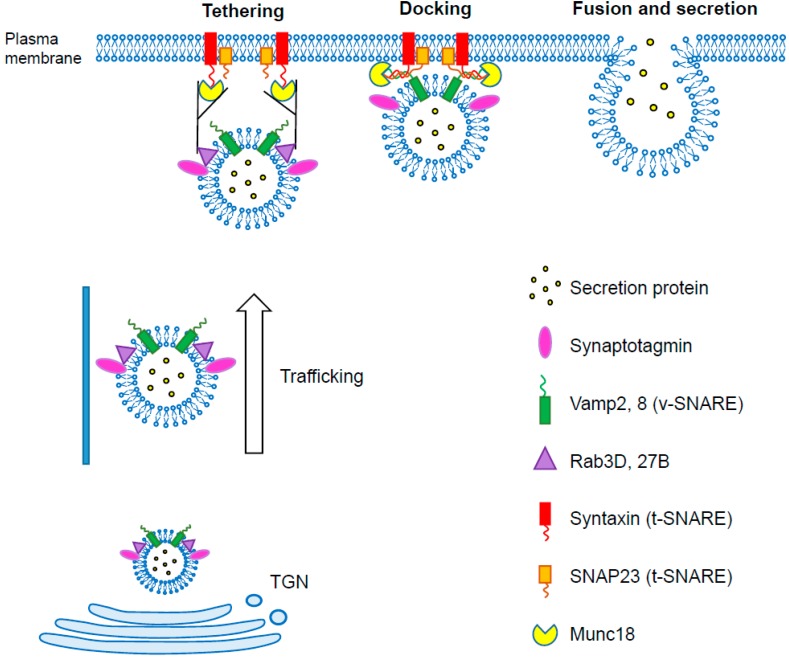
Every day, salivary glands produce about 0.5 to 1.5 L of saliva, which contains salivary proteins that are essential for oral health. The contents of saliva, 0.3% proteins (1.5 to 4.5 g) in fluid, help prevent oral infections, provide lubrication, aid digestion, and maintain oral health. Acinar cells in the lobular salivary glands secrete prepackaged secretory granules that contain salivary components such as amylase, mucins, and immunoglobulins. Despite the important physiological functions of salivary proteins, we know very little about the regulatory mechanisms of their secretion via exocytosis, which is a process essential for the secretion of functional proteins, not only in salivary glands, but also in other secretory organs, including lacrimal and mammary glands, the pancreas, and prostate. In this review, we discuss recent findings that elucidate exocytosis by exocrine glands, especially focusing on the salivary glands, in physiological and pathological conditions.
每天,唾液腺分泌约 0.5 至 1.5 升唾液,其中包含的唾液蛋白对口腔健康至关重要。唾液的成分,0.3%的蛋白质(1.5 至 4.5 克)在液体中,有助于预防口腔感染、提供润滑、辅助消化并维持口腔健康。小叶唾液腺中的腺泡细胞分泌预先包装的分泌颗粒,其中包含唾液成分,如淀粉酶、粘蛋白和免疫球蛋白。尽管唾液蛋白具有重要的生理功能,但我们对其通过胞吐作用分泌的调节机制知之甚少,胞吐作用是分泌功能性蛋白质的必要过程,不仅在唾液腺中,而且在其他分泌器官中也是如此,包括泪腺和乳腺、胰腺和前列腺。在这篇综述中,我们讨论了最近的发现,这些发现阐明了外分泌腺的胞吐作用,特别是在生理和病理条件下的唾液腺。