Department of Liver Disease, Shanghai Public Health Clinical Center, Fudan University, Shanghai, 201508, China.
Department of Infectious Disease, Ruian people's hospital, Wenzhou, Zhejiang, 325200, China.
Sci Rep. 2018 Oct 18;8(1):15449. doi: 10.1038/s41598-018-33412-z.
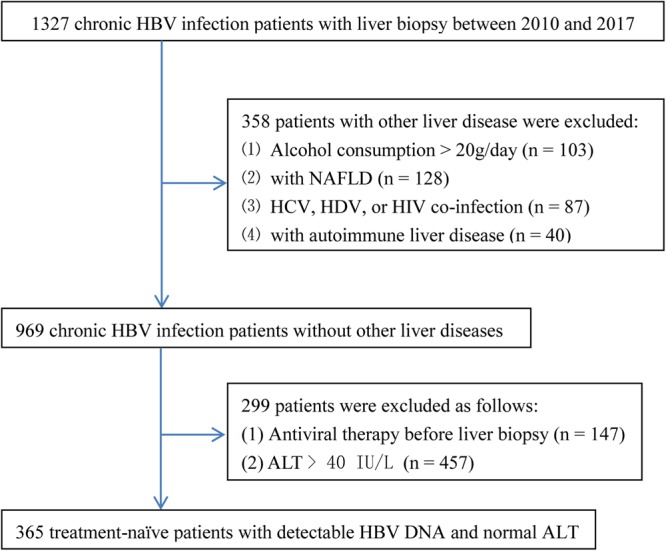
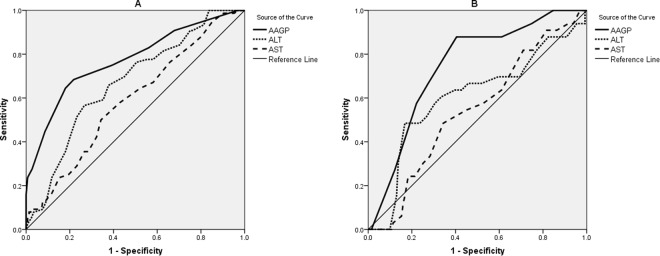
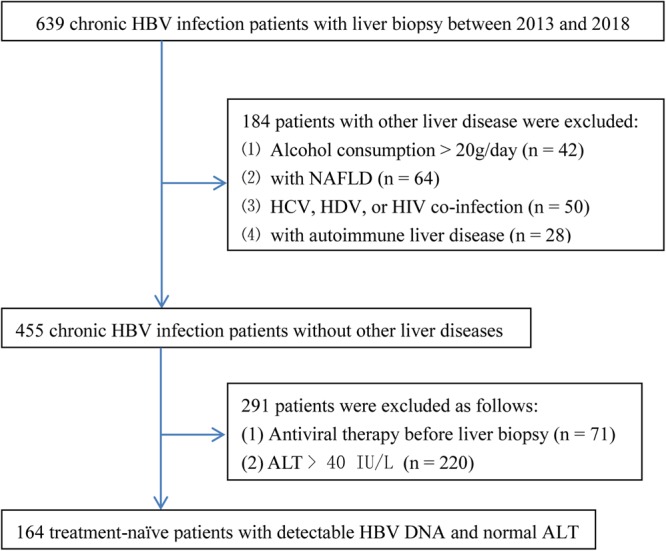
Significant liver inflammation might be found in 20-34% of chronic hepatitis B virus (HBV) infection patients with detectable HBV DNA and persistently normal alanine transaminase (ALT) (PNALT). We aimed to develop a diagnostic algorithm to predict significant liver inflammation in these specific patients. Using liver biopsy as the gold standard, we developed a novel, simple diagnostic algorithm to predict significant liver inflammation in a training set of 365 chronic HBV infection patients with detectable HBV DNA and PNALT, and validated the diagnostic accuracy in a validation set of 164 similar patients. The novel algorithm (AAGP) attributed to age, ALT, gamma-glutamyl transpeptidase (GGT), and platelet count was developed. In the training set, the area under the receiver operating characteristic curve (AUROC) of AAGP was higher than that of ALT and aspartate transaminase (AST), to diagnose significant liver inflammation (0.77, 0.67, and 0.59, respectively, p < 0.001). In the validation set, the AUROC of AAGP was also higher than ALT and AST (0.75, 0.61, and 0.54, respectively, p < 0.001). Using AAGP ≥2, the sensitivity and negative predictive value (NPV) was 91% and 93%, respectively, to diagnose significant liver inflammation. Using AAGP ≥8, the specificity and NPV was 91% and 86%, respectively, for significant liver inflammation. In conclusion, the AAGP algorithm is a novel, simple, user-friendly algorithm for the diagnosis of significant liver inflammation in chronic HBV infection patients with detectable HBV DNA and PNALT.
在乙型肝炎病毒 (HBV) 感染患者中,有 20-34%的患者乙型肝炎病毒 DNA 可检测到且丙氨酸氨基转移酶 (ALT) 持续正常 (PNALT),这些患者可能存在明显的肝脏炎症。我们旨在开发一种诊断算法来预测这些特定患者中是否存在显著的肝脏炎症。本研究以肝活检为金标准,在包含 365 例 HBV 感染患者的训练集中开发了一种新的简单诊断算法,以预测乙型肝炎病毒 DNA 可检测到且 ALT 持续正常患者的显著肝脏炎症,并在包含 164 例相似患者的验证集中验证了该诊断算法的准确性。该新算法(AAGP)与年龄、ALT、γ-谷氨酰转肽酶 (GGT) 和血小板计数有关。在训练集中,AAGP 的受试者工作特征曲线下面积(AUROC)高于 ALT 和天冬氨酸氨基转移酶(AST),以诊断显著的肝脏炎症(分别为 0.77、0.67 和 0.59,p < 0.001)。在验证集中,AAGP 的 AUROC 也高于 ALT 和 AST(分别为 0.75、0.61 和 0.54,p < 0.001)。使用 AAGP≥2 诊断显著肝脏炎症的敏感性和阴性预测值(NPV)分别为 91%和 93%。使用 AAGP≥8 诊断显著肝脏炎症的特异性和 NPV 分别为 91%和 86%。总之,AAGP 算法是一种用于诊断乙型肝炎病毒 DNA 可检测到且 ALT 持续正常的慢性 HBV 感染患者中显著肝脏炎症的新的简单、易用的算法。