Stromer Daniel, Christlein Vincent, Martindale Christine, Zippert Patrick, Haltenberger Eric, Hausotte Tino, Maier Andreas
Pattern Recognition Lab, Computer Science, Friedrich-Alexander-Universität Erlangen-Nürnberg, Erlangen, Germany.
Machine Learning and Data Analytics Lab, Computer Science, Friedrich-Alexander-Universität Erlangen-Nürnberg, Erlangen, Germany.
Sci Rep. 2018 Oct 18;8(1):15335. doi: 10.1038/s41598-018-33685-4.
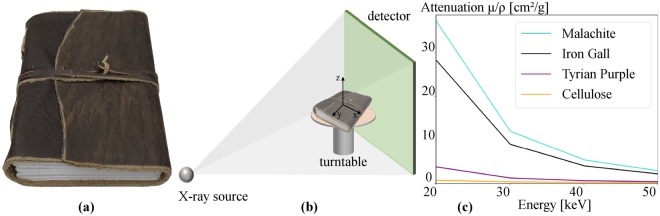
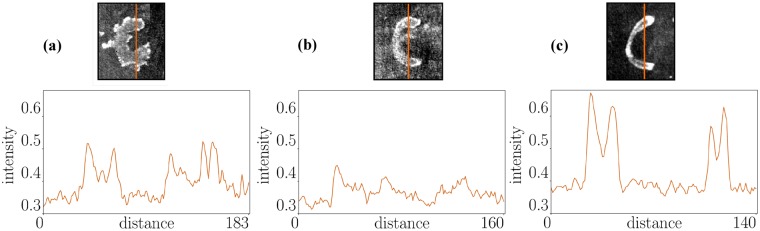
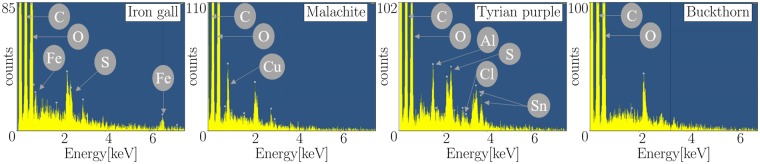
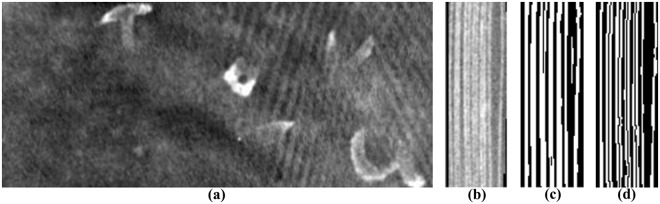
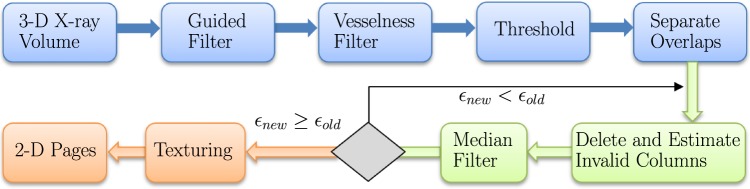
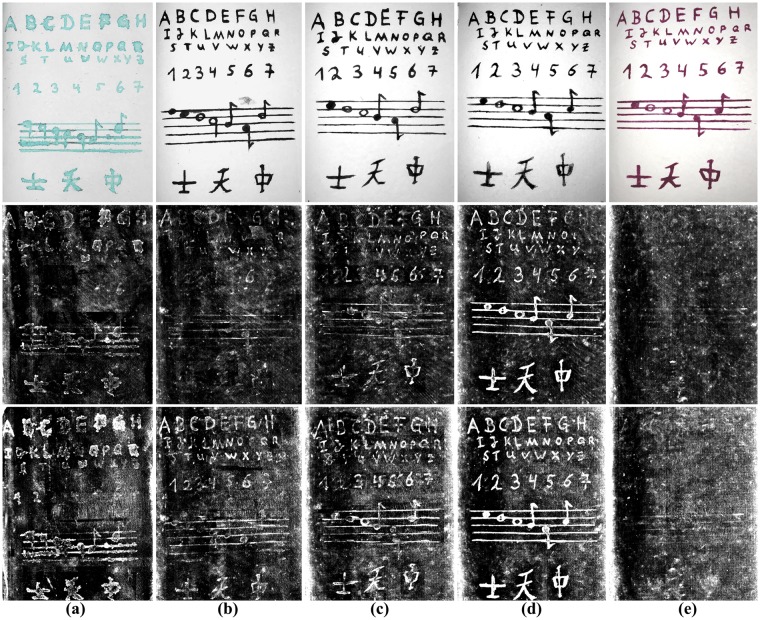
Severely damaged historical documents are extremely fragile. In many cases, their secrets remain concealed beneath their cover. Recently, non-invasive digitization approaches based on 3-D scanning have demonstrated the ability to recover single pages or letters without the need to open the manuscripts. This can even be achieved using conventional micro-CTs without the need for synchrotron hardware. However, not all manuscripts may be suited for such techniques due to their material and X-ray properties. In order to recommend which manuscripts and which inks are best suited for such a process, we investigate six inks that were commonly used in ancient times: malachite, three types of iron gall, Tyrian purple, and buckthorn. Image contrast is explored over the complete pipeline, from the X-ray CT scan and page extraction to the virtual flattening of the page image. We demonstrate, that all inks containing metallic particles are visible in the output, a decrease of the X-ray energy enhances the readability, and that the visibility highly depends on the X-ray attenuation of the ink's metallic ingredients and their concentration. Based on these observations, we give recommendations on how to select the appropriate imaging parameters.
严重受损的历史文献极其脆弱。在许多情况下,它们的秘密仍隐藏在封面之下。最近,基于三维扫描的非侵入式数字化方法已证明能够在不打开手稿的情况下恢复单页或信件内容。甚至使用传统的微型计算机断层扫描(micro-CT)就能做到这一点,而无需同步加速器硬件。然而,由于其材料和X射线特性,并非所有手稿都适合这种技术。为了推荐哪些手稿和哪些墨水最适合这一过程,我们研究了六种古代常用的墨水:孔雀石、三种铁胆墨水、泰尔紫和鼠李。从X射线计算机断层扫描、页面提取到页面图像的虚拟扁平化,在整个流程中探索图像对比度。我们证明,所有含金属颗粒的墨水在输出中都是可见的,降低X射线能量可提高可读性,并且可见性高度依赖于墨水金属成分的X射线衰减及其浓度。基于这些观察结果,我们给出了如何选择合适成像参数的建议。