Bar-On Lynn, Kalkman Barbara M, Cenni Francesco, Schless Simon-Henri, Molenaers Guy, Maganaris Constantinos N, Bass Alfie, Holmes Gill, Barton Gabor J, O'Brien Thomas D, Desloovere Kaat
Department of Rehabilitation Sciences, KU Leuven, Leuven, Belgium.
Amsterdam UMC, Vrije Universiteit Amsterdam, Department of Rehabilitation Medicine, Amsterdam Movement Sciences, Amsterdam, Netherlands.
Front Pediatr. 2018 Oct 4;6:259. doi: 10.3389/fped.2018.00259. eCollection 2018.
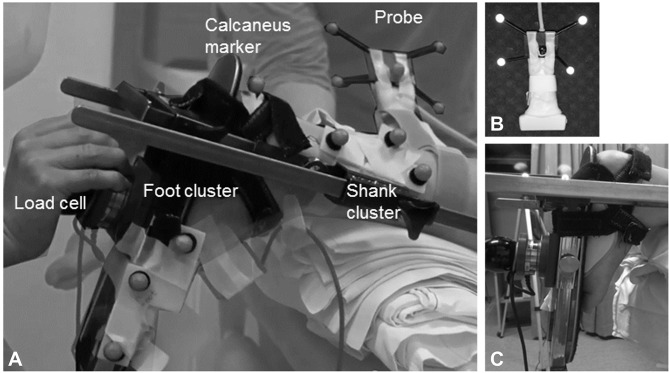
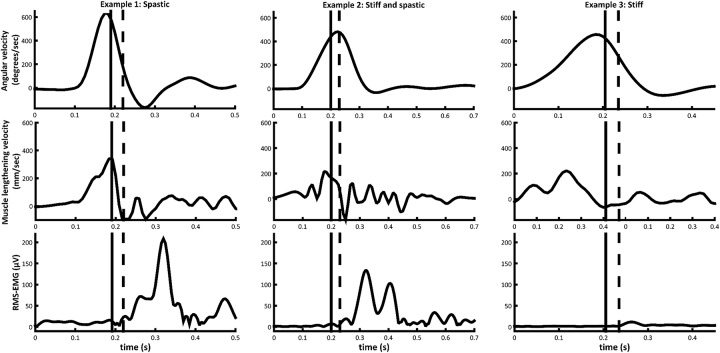
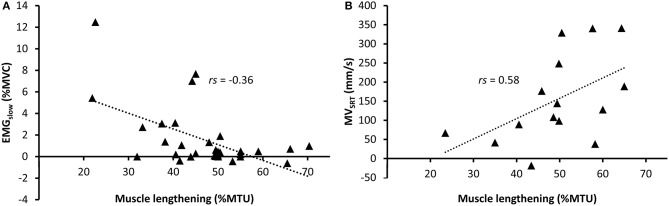
Stretch reflex hyperactivity in the gastrocnemius of children with spastic cerebral palsy (CP) is commonly evaluated by passively rotating the ankle joint into dorsiflexion at different velocities, such as applied in conventional clinical spasticity assessments. However, surface electromyography (sEMG) collected from the medial gastrocnemius (MG) during such examination reveals unexplained heterogeneity in muscle activation between patients. Recent literature also highlights altered muscle tensile behavior in children with spastic CP. We aimed to document MG muscle and tendon lengthening during passive ankle motion at slow and fast velocity and explore its interdependence with the elicited hyperactive stretch reflex. The ankle of 15 children with CP (11 ± 3 years, GMFCS 9I 6II, 8 bilateral, 7 unilateral) and 16 typically developing children (TDC) was passively rotated over its full range of motion at slow and fast velocity. Ultrasound, synchronized with motion-analysis, was used to track the movement of the MG muscle-tendon junction and extract the relative lengthening of muscle and tendon during joint rotation. Simultaneously, MG sEMG was measured. Outcome parameters included the angular and muscle lengthening velocities 30 ms before EMG onset and the gain in root mean square EMG during stretch, as a measure of stretch reflex activity. Compared to slow rotation, the muscle lengthened less and stretch reflex activity was higher during fast rotation. These velocity-induced changes were more marked in CP compared to TDC. In the CP group, muscle-lengthening velocity had higher correlation coefficients with stretch reflex hyperactivity than joint angular velocity. Muscles with greater relative muscle lengthening during slow rotation had earlier and stronger stretch reflexes during fast rotation. These initial results suggest that ankle angular velocity is not representative of MG muscle lengthening velocity and is less related to stretch reflex hyperactivity than MG muscle lengthening. In addition, muscles that lengthened more during slow joint rotation were more likely to show a velocity-dependent stretch reflex. This interdependence of muscle lengthening and stretch reflexes may be important to consider when administering treatment. However, muscle and tendon lengthening properties alone could not fully explain the variability in stretch reflexes, indicating that other factors should also be investigated.
痉挛型脑瘫(CP)患儿腓肠肌的牵张反射亢进通常是通过以不同速度被动将踝关节旋转至背屈来评估的,就像在传统临床痉挛评估中那样。然而,在此类检查过程中从内侧腓肠肌(MG)采集的表面肌电图(sEMG)显示,患者之间肌肉激活存在无法解释的异质性。近期文献还强调了痉挛型CP患儿肌肉拉伸行为的改变。我们旨在记录被动踝关节运动在慢速和快速时MG肌肉和肌腱的延长情况,并探讨其与引发的亢进牵张反射的相互依存关系。对15名CP患儿(11±3岁,GMFCS 9I 6II,8例双侧,7例单侧)和16名发育正常儿童(TDC)的踝关节在慢速和快速下进行全范围的被动旋转。超声与运动分析同步,用于追踪MG肌腱结合处的运动,并提取关节旋转过程中肌肉和肌腱的相对延长情况。同时,测量MG的sEMG。结果参数包括肌电图开始前30毫秒的角度和肌肉延长速度,以及拉伸过程中均方根肌电图的增益,作为牵张反射活动的指标。与慢速旋转相比,快速旋转时肌肉延长较少,牵张反射活动较高。与TDC相比,这些速度诱导的变化在CP中更为明显。在CP组中,肌肉延长速度与牵张反射亢进的相关系数高于关节角速度。在慢速旋转时相对肌肉延长较大的肌肉在快速旋转时有更早、更强的牵张反射。这些初步结果表明,踝关节角速度不能代表MG肌肉延长速度,与MG肌肉延长相比,与牵张反射亢进的相关性较小。此外,在关节慢速旋转时延长较多的肌肉更有可能表现出速度依赖性牵张反射。在进行治疗时,考虑肌肉延长和牵张反射之间的这种相互依存关系可能很重要。然而,仅肌肉和肌腱的延长特性不能完全解释牵张反射的变异性,这表明还应研究其他因素。