Martinez-Huenchullan Sergio F, Maharjan Babu R, Williams Paul F, Tam Charmaine S, Mclennan Susan V, Twigg Stephen M
Greg Brown Diabetes & Endocrinology Laboratory, Central Clinical School, Faculty of Medicine and Health, University of Sydney, Sydney, Australia.
School of Physical Therapy, Faculty of Medicine, Universidad Austral de Chile, Valdivia, Chile.
Physiol Rep. 2018 Oct;6(20):e13848. doi: 10.14814/phy2.13848.
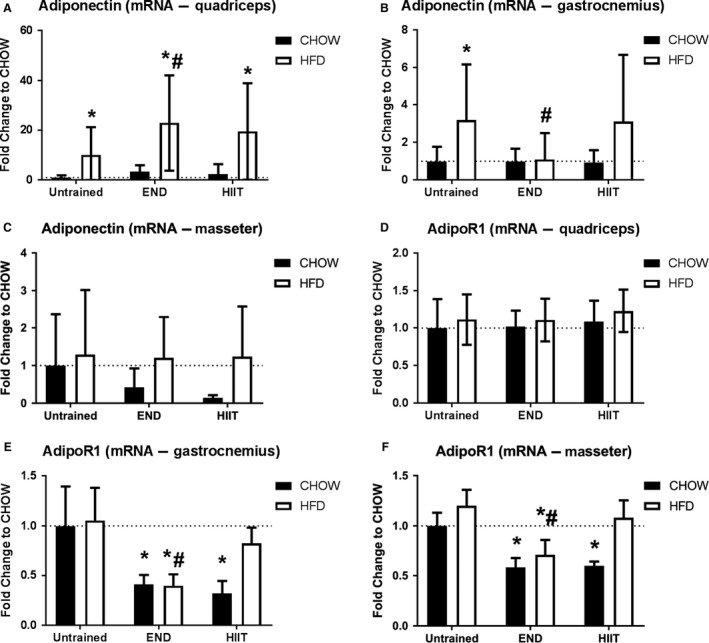
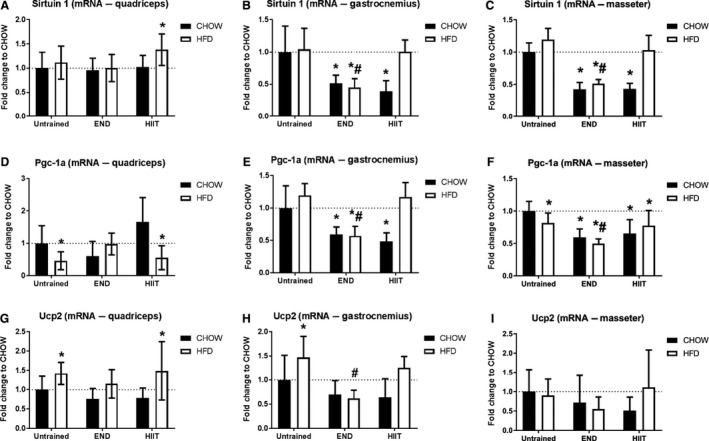
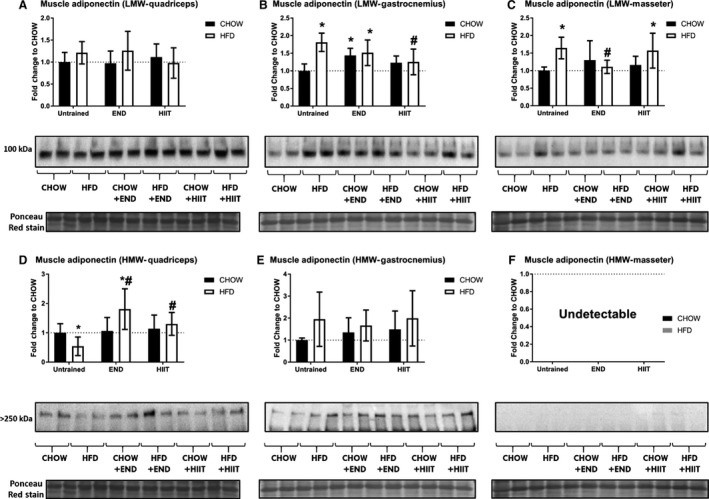
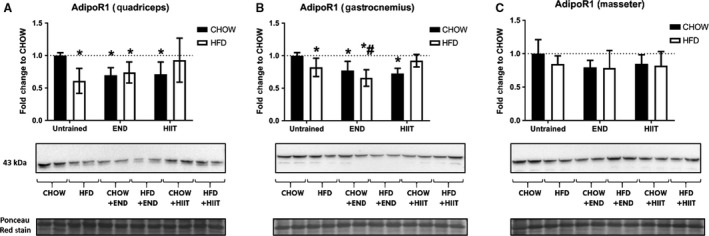
Changes in skeletal muscle adiponectin induction have been described in obesity and exercise. However, whether changes are consistent across muscle types and with different exercise modalities, remain unclear. This study compared the effects of diet and two isocaloric training programs on adiponectin induction and its regulators in three muscles: quadriceps (exercising/glycolytic-oxidative), gastrocnemius (exercising/glycolytic), and masseter (nonexercising/glycolytic). Ten-week-old male C57BL/6 mice were fed a high-fat diet (HFD) (45% fat) or standard CHOW diet (12% fat) ad libitum and underwent one of two training regimes: (1) constant-moderate training (END), or (2) high intensity interval training (HIIT) for 10 weeks (3 × 40 min sessions/week). Chow and HFD-fed untrained mice were used as control. Compared with Chow, HFD induced an increase in protein levels of low-molecular weight (LMW) adiponectin in gastrocnemius and masseter (2-fold; P < 0.05), and a decrease of high-molecular weight adiponectin (HMW-most bioactive form) in quadriceps (0.5-fold; P < 0.05). Only END prevented these changes (P < 0.05). HFD induced a decrease of adiponectin receptor 1 (AdipoR1) protein in exercising muscles of untrained mice (~0.5-0.8-fold; P < 0.05); notably, END also decreased AdipoR1 protein levels in lean and HFD mice. This type of training also normalized HFD-driven mRNA changes found in some adiponectin downstream factors (sirtuin 1, Pgc-1a, and Ucp2) in the three muscles tested. Our results indicate that diet, muscle type/activity, and exercise modality influences muscle adiponectin profile, and some of its mediators. These parameters should be taken into consideration when investigating this endocrine response of the skeletal muscle, particularly in the context of obesity and metabolic disorders.
肥胖和运动过程中骨骼肌脂联素诱导的变化已有相关描述。然而,这些变化在不同肌肉类型以及不同运动方式下是否一致仍不清楚。本研究比较了饮食和两种等热量训练方案对三种肌肉中脂联素诱导及其调节因子的影响,这三种肌肉分别是:股四头肌(运动型/糖酵解氧化型)、腓肠肌(运动型/糖酵解型)和咬肌(非运动型/糖酵解型)。给10周龄雄性C57BL/6小鼠随意喂食高脂饮食(HFD)(45%脂肪)或标准普通饮食(12%脂肪),并使其接受两种训练方案之一:(1)持续中等强度训练(END),或(2)高强度间歇训练(HIIT),为期10周(每周3次,每次40分钟)。喂食普通饮食和高脂饮食的未训练小鼠用作对照。与普通饮食相比,高脂饮食使腓肠肌和咬肌中低分子量(LMW)脂联素的蛋白水平升高(约2倍;P<0.05),而股四头肌中高分子量脂联素(HMW,最具生物活性的形式)降低(约0.5倍;P<0.05)。只有END能防止这些变化(P<0.05)。高脂饮食使未训练小鼠运动肌肉中脂联素受体1(AdipoR1)蛋白减少(约0.5 - 0.8倍;P<0.05);值得注意的是,END也降低了瘦小鼠和高脂饮食小鼠中AdipoR1蛋白水平。这种训练类型还使在测试的三种肌肉中一些脂联素下游因子(沉默调节蛋白1、Pgc - 1a和Ucp2)中发现的高脂饮食驱动的mRNA变化恢复正常。我们的结果表明,饮食、肌肉类型/活动和运动方式会影响肌肉脂联素谱及其一些介质。在研究骨骼肌的这种内分泌反应时,尤其是在肥胖和代谢紊乱的背景下,应考虑这些参数。