Martinez-Huenchullan Sergio F, Maharjan Babu Raja, Williams Paul F, Tam Charmaine S, Mclennan Susan V, Twigg Stephen M
Greg Brown Diabetes & Endocrinology Laboratory, Sydney Medical School, University of Sydney, Sydney, Australia.
Faculty of Medicine, School of Physical Therapy, Universidad Austral de Chile, Valdivia, Chile.
Physiol Rep. 2018 Feb;6(4). doi: 10.14814/phy2.13599.
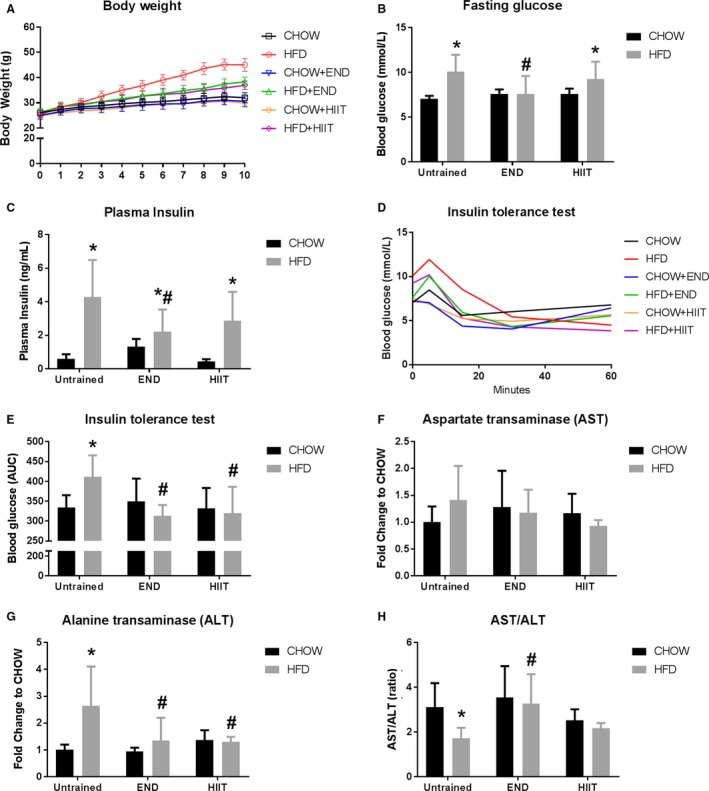
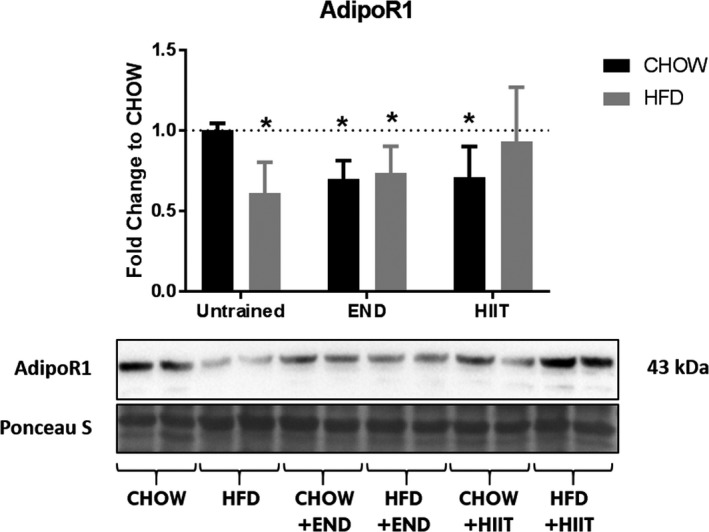
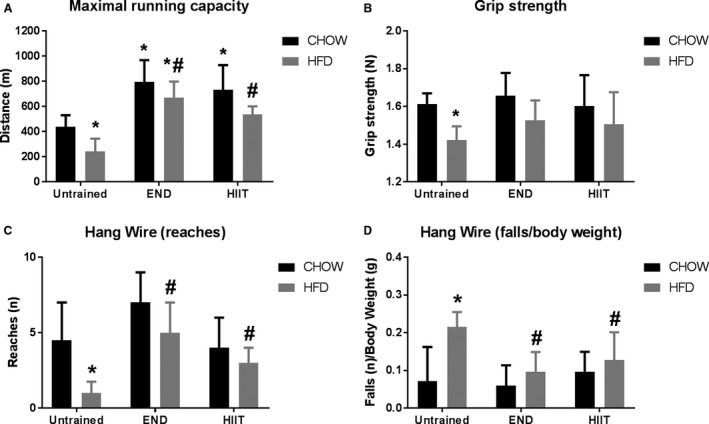
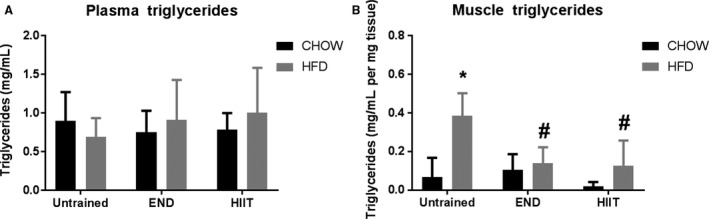
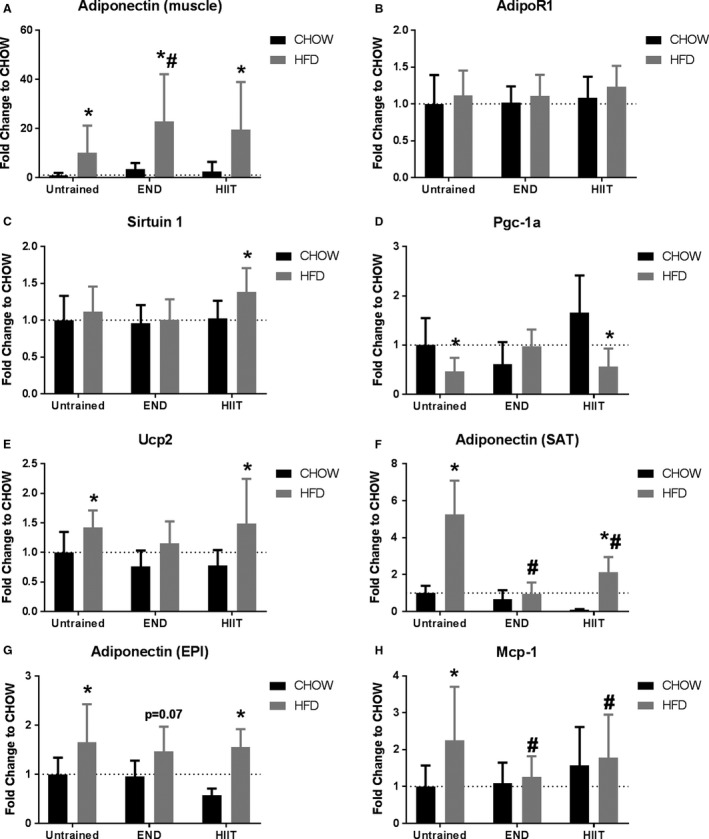
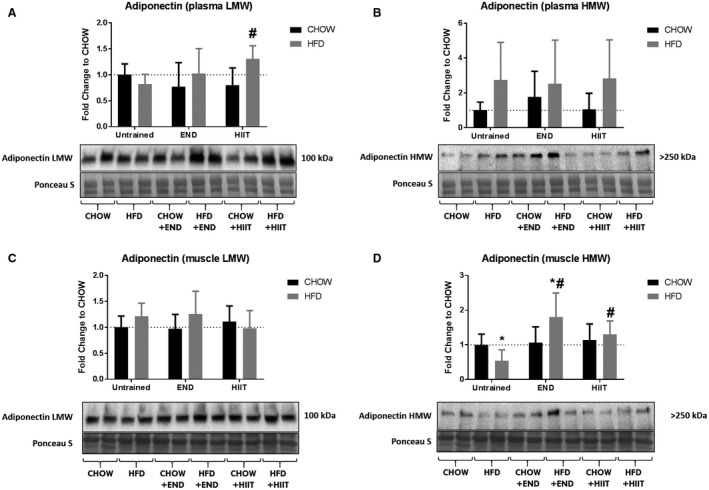
Exercise regimens may have differing effects in the presence of obesity. In addition to being fat derived, adiponectin has recently been described as a myokine that regulates insulin sensitivity, which may link to exercise-related metabolic benefits in obesity. Whether skeletal muscle adiponectin varies in different exercise modalities is unclear. This study investigated the comparative effects of 10 weeks of endurance constant-moderate intensity exercise (END) with high intensity interval training (HIIT), on metabolic outcomes, including muscle adiponectin in a mouse model of diet-induced obesity. Ten-week-old male C57BL/6 mice were fed a high-fat diet (HFD) (45% FAT) or standard CHOW diet ab libitum and underwent one of three training regimes: (1) no exercise, (2) END, or (3) HIIT (8 bouts of 2.5 min with eight periods of rest of 2.5 min) for 10 weeks (3 × 40 min sessions/week). Chow-fed mice acted as controls. Compared with HFD alone, both training programs similarly protected against body weight gain (HFD = 45 ± 2; END = 37 ± 2; HIIT = 36 ± 2 g), preserved lean/fat tissue mass ratio (HFD = 0.64 ± 0.09; END = 0.34 ± 0.13; HIIT = 0.33 ± 0.13), and improved blood glucose excursion during an insulin tolerance test (HFD = 411 ± 54; END = 350 ± 57; HIIT = 320 ± 66 arbitrary units [AU]). Alterations in fasting glycemia, insulinemia, and AST/ALT ratios were prevented only by END. END, but not HIIT increased skeletal muscle adiponectin mRNA (14-fold; P < 0.05) and increased protein content of high molecular weight (HMW) adiponectin (3.3-fold), whereas HIIT induced a milder increase (2.4-fold). Compared with HFD, neither END nor HIIT altered circulating low (LMW) or high (HMW) molecular weight adiponectin forms. Furthermore, only END prevented the HFD downregulation of PGC1α (P < 0.05) mRNA levels downstream of muscle adiponectin. These data show that different training programs affect muscle adiponectin to differing degrees. Together these results suggest that END is a more effective regimen to prevent HFD-induced metabolic disturbances in mice.
在肥胖情况下,运动方案可能会有不同的效果。脂联素除了源自脂肪外,最近还被描述为一种调节胰岛素敏感性的肌动蛋白,这可能与肥胖中运动相关的代谢益处有关。骨骼肌脂联素在不同运动方式下是否会发生变化尚不清楚。本研究调查了10周的耐力恒中强度运动(END)与高强度间歇训练(HIIT)对饮食诱导肥胖小鼠模型代谢结果的比较影响,包括肌肉脂联素。10周龄雄性C57BL/6小鼠随意喂食高脂饮食(HFD)(45%脂肪)或标准CHOW饮食,并接受三种训练方案之一:(1)不运动,(2)END,或(3)HIIT(8次2.5分钟,休息8次2.5分钟),持续10周(每周3次40分钟训练)。喂食CHOW饮食的小鼠作为对照。与单独的HFD相比,两种训练方案同样能防止体重增加(HFD = 45±2;END = 37±2;HIIT = 36±2克);保留瘦/胖组织质量比(HFD = 0.64±0.09;END = 0.34±0.13;HIIT = 0.33±0.13),并改善胰岛素耐量试验期间的血糖波动(HFD = 411±54;END = 350±57;HIIT = 320±66任意单位[AU])。仅END可预防空腹血糖、胰岛素血症和AST/ALT比值的改变。END增加了骨骼肌脂联素mRNA(14倍;P < 0.05)和高分子量(HMW)脂联素的蛋白质含量(3.3倍),而HIIT引起的增加较轻微(2.4倍),但HIIT未增加。与HFD相比,END和HIIT均未改变循环中的低(LMW)或高(HMW)分子量脂联素形式。此外,只有END可预防HFD对肌肉脂联素下游PGC1α(P < 0.05)mRNA水平的下调。这些数据表明不同的训练方案对肌肉脂联素的影响程度不同。这些结果共同表明,END是预防小鼠HFD诱导的代谢紊乱更有效的方案。