School of Automation and Electrical Engineering, University of Science and Technology Beijing, Beijing 100083, China.
Sensors (Basel). 2018 Oct 18;18(10):3528. doi: 10.3390/s18103528.
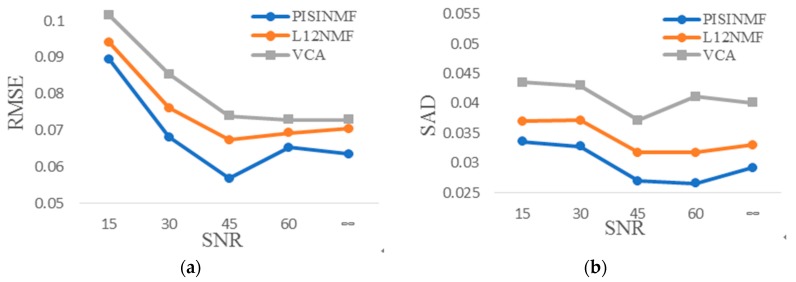
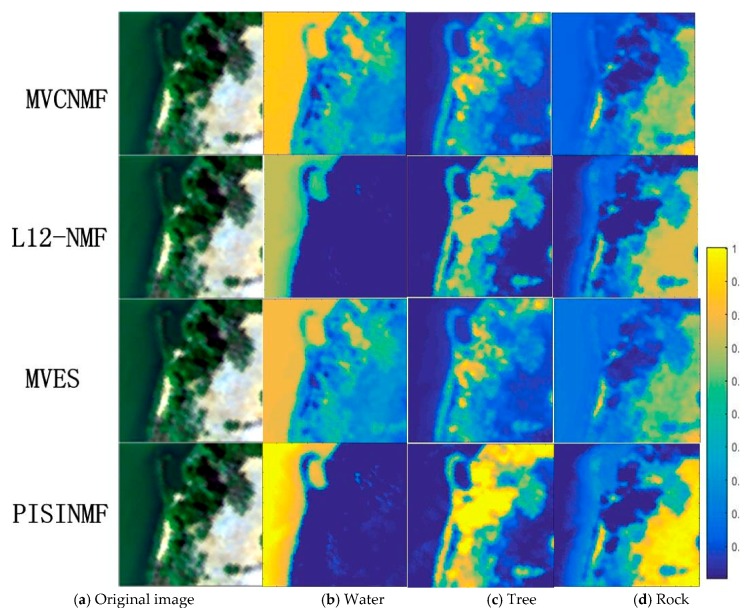
Hyperspectral unmixing, which decomposes mixed pixels into endmembers and corresponding abundance maps of endmembers, has obtained much attention in recent decades. Most spectral unmixing algorithms based on non-negative matrix factorization (NMF) do not explore the intrinsic manifold structure of hyperspectral data space. Studies have proven image data is smooth along the intrinsic manifold structure. Thus, this paper explores the intrinsic manifold structure of hyperspectral data space and introduces manifold learning into NMF for spectral unmixing. Firstly, a novel projection equation is employed to model the intrinsic structure of hyperspectral image preserving spectral information and spatial information of hyperspectral image. Then, a graph regularizer which establishes a close link between hyperspectral image and abundance matrix is introduced in the proposed method to keep intrinsic structure invariant in spectral unmixing. In this way, decomposed abundance matrix is able to preserve the true abundance intrinsic structure, which leads to a more desired spectral unmixing performance. At last, the experimental results including the spectral angle distance and the root mean square error on synthetic and real hyperspectral data prove the superiority of the proposed method over the previous methods.
高光谱解混,即将混合像素分解为端元和端元的相应丰度图,在最近几十年受到了广泛关注。大多数基于非负矩阵分解(NMF)的光谱解混算法都没有探索高光谱数据空间的内在流形结构。研究已经证明图像数据在内在流形结构上是平滑的。因此,本文探索了高光谱数据空间的内在流形结构,并将流形学习引入 NMF 进行光谱解混。首先,采用一种新的投影方程来模拟高光谱图像的内在结构,同时保留高光谱图像的光谱信息和空间信息。然后,在提出的方法中引入了一个图正则化项,它在光谱解混中建立了高光谱图像和丰度矩阵之间的紧密联系,以保持内在结构不变。这样,分解得到的丰度矩阵能够保留真实的丰度内在结构,从而获得更好的光谱解混性能。最后,包括合成和真实高光谱数据的光谱角距离和均方根误差在内的实验结果证明了该方法优于以前的方法。