Li Bassi Gianluigi, Prats Raquel Guillamat, Artigas Antonio, Xiol Eli Aguilera, Marti Joan-Daniel, Ranzani Otavio T, Rigol Montserrat, Fernandez Laia, Meli Andrea, Battaglini Denise, Luque Nestor, Ferrer Miguel, Martin-Loeches Ignacio, Póvoa Pedro, Chiumello Davide, Pelosi Paolo, Torres Antoni
Division of Animal Experimentation, Department of Pulmonary and Critical Care Medicine, Thorax Institute, Hospital Clinic, Calle Villarroel 170, Esc 6/8 Pl 2, Barcelona, Spain.
Institut d'Investigacions Biomèdiques August Pi i Sunyer (IDIBAPS), Barcelona, Spain.
Intensive Care Med Exp. 2018 Oct 20;6(1):42. doi: 10.1186/s40635-018-0206-1.
We previously evaluated the efficacy of a ventilatory strategy to achieve expiratory flow bias and positive end-expiratory pressure (EFB + PEEP) or the Trendelenburg position (TP) for the prevention of ventilator-associated pneumonia (VAP). These preventive measures were aimed at improving mucus clearance and reducing pulmonary aspiration of bacteria-laden oropharyngeal secretions. This secondary analysis is aimed at evaluating the effects of aforementioned interventions on systemic inflammation and to substantiate the value of clinical parameters and cytokines in the diagnosis of VAP.
Twenty female pigs were randomized to be positioned in the semirecumbent/prone position, and ventilated with duty cycle 0.33 and without PEEP (control); positioned as in the control group, PEEP 5 cmHO, and duty cycle to achieve expiratory flow bias (EFB+PEEP); ventilated as in the control group, but in the Trendelenburg position (Trendelenburg). Following randomization, P. aeruginosa was instilled into the oropharynx. Systemic cytokines and tracheal secretions P. aeruginosa concentration were quantified every 24h. Lung biopsies were collected for microbiological confirmation of VAP.
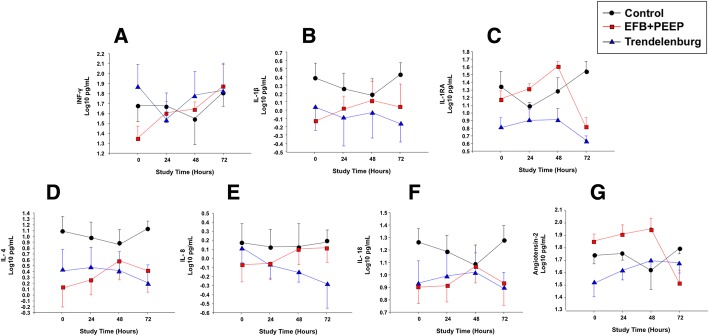
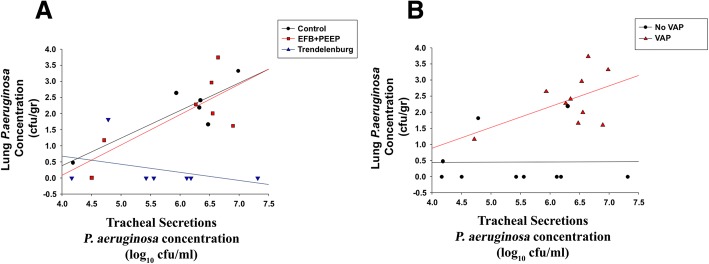
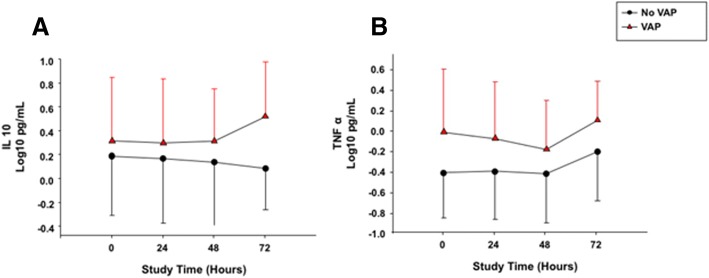
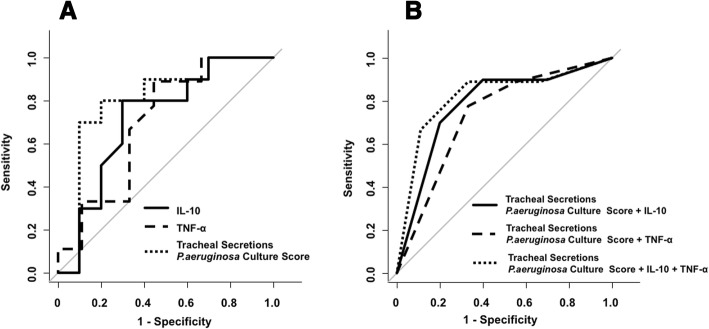
In the control, EFB + PEEP, and Trendelenburg groups, lung tissue Pseudomonas aeruginosa concentration was 2.4 ± 1.5, 1.9 ± 2.1, and 0.3 ± 0.6 log cfu/mL, respectively (p = 0.020). Whereas, it was 2.4 ± 1.9 and 0.6 ± 0.9 log cfu/mL in animals with or without VAP (p < 0.001). Lower levels of interleukin (IL)-1β (p = 0.021), IL-1RA (p < 0.001), IL-4 (p = 0.005), IL-8 (p = 0.008), and IL-18 (p = 0.050) were found in Trendelenburg animals. VAP increased IL-10 (p = 0.035), tumor necrosis factor-α (p = 0.041), and endotracheal aspirate (ETA) P. aeruginosa concentration (p = 0.024). A model comprising ETA bacterial burden, IL-10, and TNF-α yielded moderate discrimination for the diagnosis of VAP (area of the receiver operating curve 0.82, 95% CI 0.61-1.00).
Our findings demonstrate anti-inflammatory effects associated with the Trendelenburg position. In this reliable model of VAP, ETA culture showed good diagnostic accuracy, whereas systemic IL-10 and TNF-α marginally improved accuracy. Further clinical studies will be necessary to confirm clinical value of the Trendelenburg position as a measure to hinder inflammation during mechanical ventilation and significance of systemic IL-10 and TNF-α in the diagnosis of VAP.
我们之前评估了一种通气策略的疗效,该策略旨在实现呼气气流偏向和呼气末正压(EFB + PEEP)或头低脚高位(TP)以预防呼吸机相关性肺炎(VAP)。这些预防措施旨在改善黏液清除并减少携带细菌的口咽分泌物的肺内误吸。这项二次分析旨在评估上述干预措施对全身炎症的影响,并证实临床参数和细胞因子在VAP诊断中的价值。
将20只雌性猪随机分组,使其处于半卧位/俯卧位,采用占空比0.33且无PEEP的方式进行通气(对照组);如对照组一样摆放体位,给予5 cmH₂O的PEEP,并调整占空比以实现呼气气流偏向(EFB + PEEP);如对照组一样进行通气,但处于头低脚高位(头低脚高位组)。随机分组后,将铜绿假单胞菌注入口咽部。每24小时对全身细胞因子和气管分泌物中的铜绿假单胞菌浓度进行定量检测。采集肺组织活检样本以进行VAP的微生物学确认。
在对照组、EFB + PEEP组和头低脚高位组中,肺组织铜绿假单胞菌浓度分别为2.4±1.5、1.9±2.1和0.3±0.6 log cfu/mL(p = 0.020)。而在有或无VAP的动物中,该浓度分别为2.4±1.9和0.6±0.9 log cfu/mL(p < 0.001)。头低脚高位组动物的白细胞介素(IL)-1β(p = 0.021)、IL-1受体拮抗剂(IL-1RA)(p < 0.001)、IL-4(p = 0.005)、IL-8(p = 0.008)和IL-18(p = 0.050)水平较低。VAP会使IL-10(p = 0.035)、肿瘤坏死因子-α(TNF-α)(p = 0.041)和气管内吸出物(ETA)中的铜绿假单胞菌浓度升高(p = 0.024)。一个包含ETA细菌负荷、IL-10和TNF-α的模型对VAP诊断具有中等鉴别能力(受试者操作特征曲线面积为0.82,95%可信区间为0.61 - 1.00)。
我们的研究结果表明头低脚高位具有抗炎作用。在这个可靠的VAP模型中,ETA培养显示出良好的诊断准确性,而全身IL-1o和TNF-α仅略微提高了准确性。需要进一步的临床研究来证实头低脚高位作为机械通气期间抑制炎症的措施的临床价值以及全身IL-10和TNF-α在VAP诊断中的意义。