Institute of Sports of Lithuanian University of Health Sciences, LT-44307 Kaunas, Lithuania.
Sports Trauma and Arthroscopic Unit of Lithuanian University of Health Sciences, LT-44307 Kaunas, Lithuania.
Medicina (Kaunas). 2018 Apr 24;54(2):21. doi: 10.3390/medicina54020021.
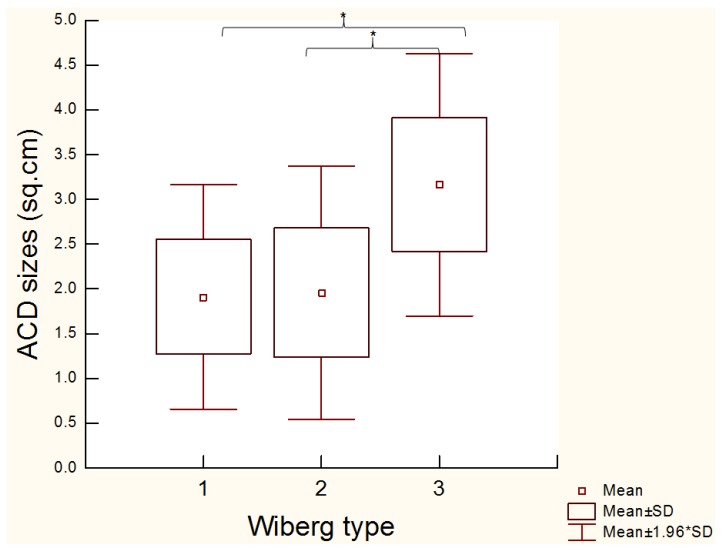
: the main goal of the study was to investigate the prevalence of the articular cartilage defects (ACD) in the patellofemoral (PF) region of the knee joint based on the anatomical shapes of patella and its impact on the level of physical activity in the population needing arthroscopic procedures for all types of pathologies in the knee. : The articular cartilage status of the PF region was obtained from 1098 arthroscopic procedures of the knee joint. The ACD were correlated to Wiberg's shape of the patella and classified according to the degree, size and depth of the ACD in the PF region using the ICRS (International Cartilage Repair Society) system: group I consisting of patients with Wiberg type I shape (W1), group II-patients with Wiberg type II shape (W2) and group III-patients with Wiberg type III shape (W3). The Tegner physical activity scale was used to evaluate the physical activity of the patients. : The mean of ACD size (PF region) in the W3 group was 3.10 ± 0.99 cm², which was a statistically significantly larger area in comparison with the W1 (1.90 ± 0.63 cm²; < 0.0000) and W2 (1.95 ± 0.71 cm²; < 0.0000). The patients from the W3 group (mean 3.10 ± 0.99) were less physically active (<4 Tegner) compared to the W2 group (mean of 4.48 ± 0.88; = 0.004) and W1 group (mean of 4.55 ± 0.72; = 0.002). : The patients with the Wiberg type III patella shape had a higher incidence and larger size of ACD in the PF of the knee compared to the groups of Wiberg type I and II. Wiberg III patients with a lower level of physical activity had a larger size of ACD in the PF joint.
研究的主要目的是基于髌骨的解剖形状及其对需要接受关节镜手术治疗各种膝关节疾病的人群的活动水平的影响,调查膝关节髌股(PF)区域的关节软骨缺损(ACD)的患病率。PF 区域的关节软骨状况是从 1098 例膝关节关节镜手术中获得的。ACD 与 Wiberg 髌骨形状相关,并根据 PF 区域 ACD 的程度、大小和深度使用 ICRS(国际软骨修复学会)系统进行分类:Wiberg Ⅰ型(W1)的患者为第 I 组,Wiberg Ⅱ型(W2)的患者为第 II 组,Wiberg Ⅲ型(W3)的患者为第 III 组。Tegner 身体活动量表用于评估患者的身体活动水平。W3 组的 ACD 大小(PF 区域)平均值为 3.10±0.99cm²,与 W1(1.90±0.63cm²;<0.0000)和 W2(1.95±0.71cm²;<0.0000)相比,这是一个统计学上显著更大的区域。与 W2 组(平均 4.48±0.88;=0.004)和 W1 组(平均 4.55±0.72;=0.002)相比,W3 组(平均 3.10±0.99)的患者身体活动水平较低(<4 级 Tegner)。与 Wiberg Ⅰ型和Ⅱ型相比,Wiberg Ⅲ型髌骨患者的 PF 关节 ACD 发生率更高,面积更大。活动水平较低的 Wiberg Ⅲ型患者的 PF 关节 ACD 面积更大。