Kleiter Ingo, Gahlen Anna, Borisow Nadja, Fischer Katrin, Wernecke Klaus-Dieter, Hellwig Kerstin, Pache Florence, Ruprecht Klemens, Havla Joachim, Kümpfel Tania, Aktas Orhan, Hartung Hans-Peter, Ringelstein Marius, Geis Christian, Kleinschnitz Christoph, Berthele Achim, Hemmer Bernhard, Angstwurm Klemens, Stellmann Jan-Patrick, Schuster Simon, Stangel Martin, Lauda Florian, Tumani Hayrettin, Mayer Christoph, Krumbholz Markus, Zeltner Lena, Ziemann Ulf, Linker Ralf, Schwab Matthias, Marziniak Martin, Then Bergh Florian, Hofstadt-van Oy Ulrich, Neuhaus Oliver, Zettl Uwe K, Faiss Jürgen, Wildemann Brigitte, Paul Friedemann, Jarius Sven, Trebst Corinna
Department of Neurology (I.K., A.G., K.H.), St. Josef Hospital, Ruhr University Bochum; Marianne-Strauß-Klinik (I.K.), Behandlungszentrum Kempfenhausen für Multiple Sklerose Kranke, Berg; NeuroCure Clinical Research Center and Experimental and Clinical Research Center (N.B., F. Pache), Charité Universitätsmedizin Berlin, and Max Delbrueck Center for Molecular Medicine, Berlin; Department of Neurology (K.F., J.F.), Asklepios Fachklinikum Teupitz; CRO Sostana GmbH and Charité Universitätsmedizin Berlin (K.-D.W.); Department of Neurology and Clinical and Experimental Multiple Sclerosis Research Center (F.Pache, K.R.), Charité Universitätsmedizin Berlin; Institute of Clinical Neuroimmunology (J.H., T.K.), Ludwig Maximilians University, Munich; Department of Neurology (O.A., H.-P.H., M.R.), Medical Faculty, Heinrich Heine University Düsseldorf; Department of Neurology (C.G., M. Schwab), Jena University Hospital; Department of Neurology (C.K.), University Hospital Essen; Department of Neurology (A.B.), Klinikum rechts der Isar, Technische Universität München, Munich; Department of Neurology (B.H.), Klinikum rechts der Isar, Technische Universität München and Munich Cluster for Systems Neurology (SyNergy); Department of Neurology (K.A.), University Hospital Regensburg; Institute of Neuroimmunology and MS (INIMS) and Department of Neurology (J.-P.S.), University Medical Centre Hamburg-Eppendorf, HamburgKlinik und Poliklinik für Neurologie (S.S.), Universitätsklinikum Hamburg-Eppendorf; Clinical Neuroimmunology and Neurochemistry (M. Stangel), Department of Neurology, Hannover Medical School; Department of Neurology (F.L., H.T.), University of Ulm; Fachklinik für Neurologie Dietenbronn (H.T.), Akademisches Krankenhaus der Universität Ulm, Schwendi; Department of Neurology (C.M.), Goethe University Frankfurt; Department of Neurology & Stroke (M.K., L.Z., U. Ziemann), and Hertie-Institute for Clinical Brain Research, University of Tübingen; Department of Neurology (R.L.), Friedrich-Alexander University Erlangen-Nuremberg; Department of Neurology and Neurological Intensive Care (M.M.), Isar-Amper-Clinic, Munich-East, Haar; Department of Neurology (F.T.B.), University of Leipzig; Department of Neurology (U. Hofstadt-van Oy), Klinikum Westfalen, Dortmund; Department of Neurology (O.N.), SRH Krankenhaus Sigmaringen; Neuroimmunological Section (U. Zettl), Department of Neurology, University of Rostock; Molecular Neuroimmunology Group (B.W., S.J.), Department of Neurology, University of Heidelberg; NeuroCure Clinical Research Center (F. Paul), Charité Universitätsmedizin Berlin, corporate member of Freie Universität Berlin, Humboldt-Universität zu Berlin, and Berlin Institute of Health, and Experimental and Clinical Research Center, Max Delbrück Center for Molecular Medicine and Charité-Universitätsmedizin Berlin; and Department of Neurology (C.T.), Hannover Medical School, Germany.
Neurol Neuroimmunol Neuroinflamm. 2018 Sep 26;5(6):e504. doi: 10.1212/NXI.0000000000000504. eCollection 2018 Nov.
To analyze whether 1 of the 2 apheresis techniques, therapeutic plasma exchange (PE) or immunoadsorption (IA), is superior in treating neuromyelitis optica spectrum disorder (NMOSD) attacks and to identify predictive factors for complete remission (CR).
This retrospective cohort study was based on the registry of the German Neuromyelitis Optica Study Group, a nationwide network established in 2008. It recruited patients with neuromyelitis optica diagnosed according to the 2006 Wingerchuk criteria or with aquaporin-4 (AQP4-ab)-antibody-seropositive NMOSD treated at 6 regional hospitals and 16 tertiary referral centers until March 2013. Besides descriptive data analysis of patient and attack characteristics, generalized estimation equation (GEE) analyses were applied to compare the effectiveness of the 2 apheresis techniques. A GEE model was generated to assess predictors of outcome.
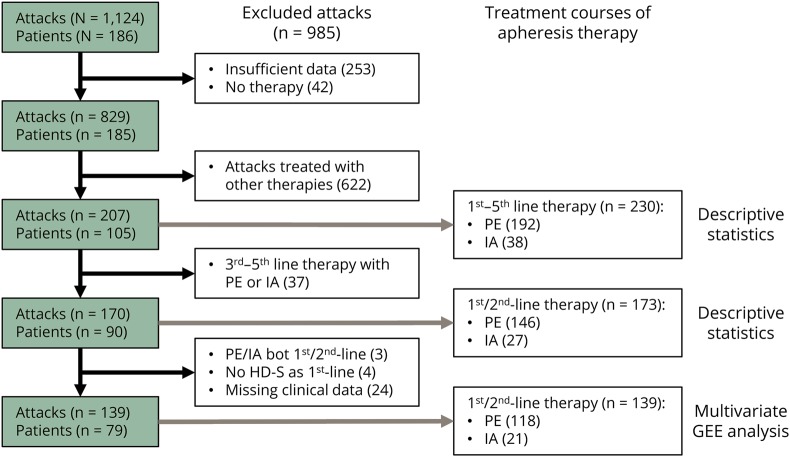
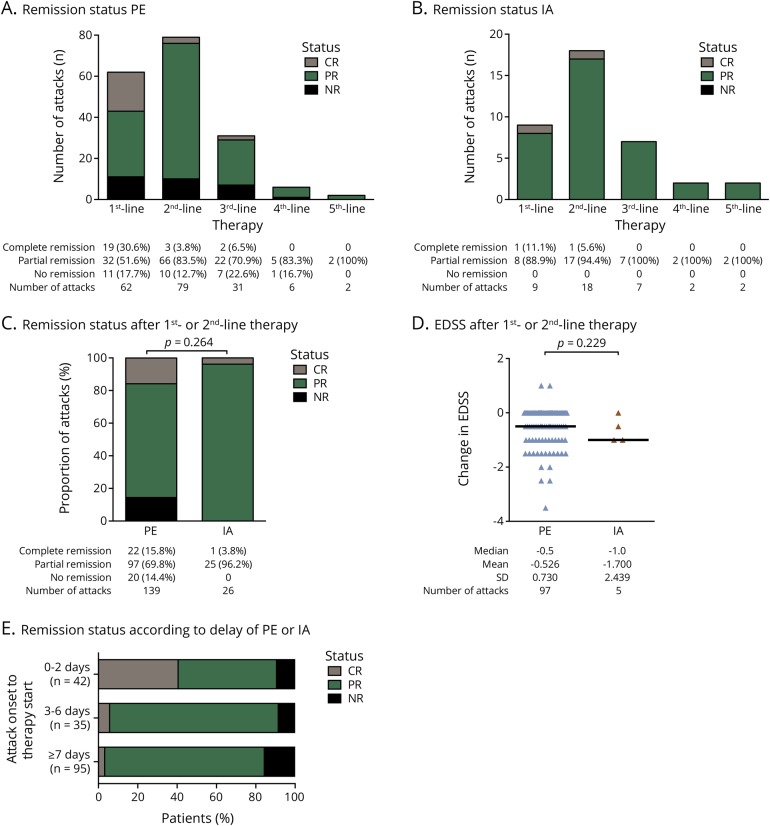
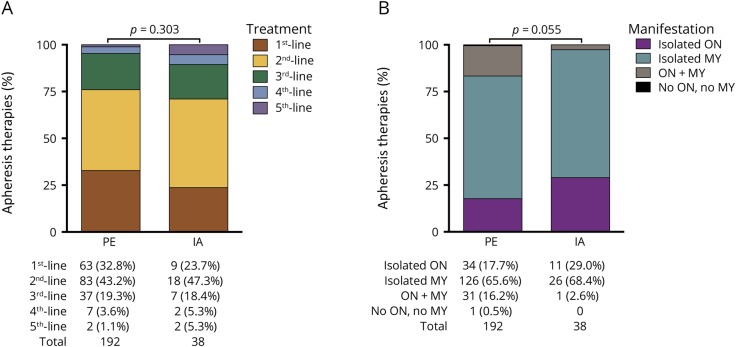
Two hundred and seven attacks in 105 patients (87% AQP4-ab-antibody seropositive) were treated with at least 1 apheresis therapy. Neither PE nor IA was proven superior in the therapy of NMOSD attacks. CR was only achieved with early apheresis therapy. Strong predictors for CR were the use of apheresis therapy as first-line therapy (OR 12.27, 95% CI: 1.04-144.91, = 0.047), time from onset of attack to start of therapy in days (OR 0.94, 95% CI: 0.89-0.99, = 0.014), the presence of AQP4-ab-antibodies (OR 33.34, 95% CI: 1.76-631.17, = 0.019), and monofocal attack manifestation (OR 4.71, 95% CI: 1.03-21.62, = 0.046).
Our findings suggest early use of an apheresis therapy in NMOSD attacks, particularly in AQP4-ab-seropositive patients. No superiority was shown for one of the 2 apheresis techniques.
This study provides Class IV evidence that for patients with NMOSD, neither PE nor IA is superior in the treatment of attacks.
分析两种单采技术(治疗性血浆置换(PE)或免疫吸附(IA))中的一种在治疗视神经脊髓炎谱系障碍(NMOSD)发作方面是否更具优势,并确定完全缓解(CR)的预测因素。
这项回顾性队列研究基于德国视神经脊髓炎研究组的登记数据,该研究组是2008年建立的一个全国性网络。研究纳入了根据2006年Wingerchuk标准诊断为视神经脊髓炎或在6家地区医院和16家三级转诊中心接受治疗的水通道蛋白4(AQP4-ab)抗体血清阳性的NMOSD患者,直至2013年3月。除了对患者和发作特征进行描述性数据分析外,还应用广义估计方程(GEE)分析来比较两种单采技术的有效性。生成一个GEE模型来评估预后的预测因素。
105例患者的207次发作(87%为AQP4-ab抗体血清阳性)接受了至少1次单采治疗。在NMOSD发作的治疗中,PE和IA均未被证明更具优势。只有早期单采治疗才能实现CR。CR的强预测因素包括将单采治疗作为一线治疗(比值比[OR]12.27,95%置信区间[CI]:1.04 - 144.91,P = 0.047)、从发作开始到治疗开始的天数(OR 0.94,95% CI:0.89 - 0.99,P = 0.014)、存在AQP4-ab抗体(OR 33.34,95% CI:1.76 - 631.17,P = 0.019)以及单灶性发作表现(OR 4.71,95% CI:1.03 - 21.62,P = 0.046)。
我们的研究结果表明,在NMOSD发作时应尽早使用单采治疗,尤其是在AQP4-ab血清阳性患者中。两种单采技术均未显示出优势。
本研究提供了IV级证据,表明对于NMOSD患者,PE和IA在治疗发作方面均无优势。