Department of Physiology, Faculty of Medicine, Khon Kaen University, Khon Kaen 40002, Thailand.
Cardiovascular Research Group, Khon Kaen University, Khon Kaen 40002, Thailand.
Nutrients. 2018 Oct 19;10(10):1549. doi: 10.3390/nu10101549.
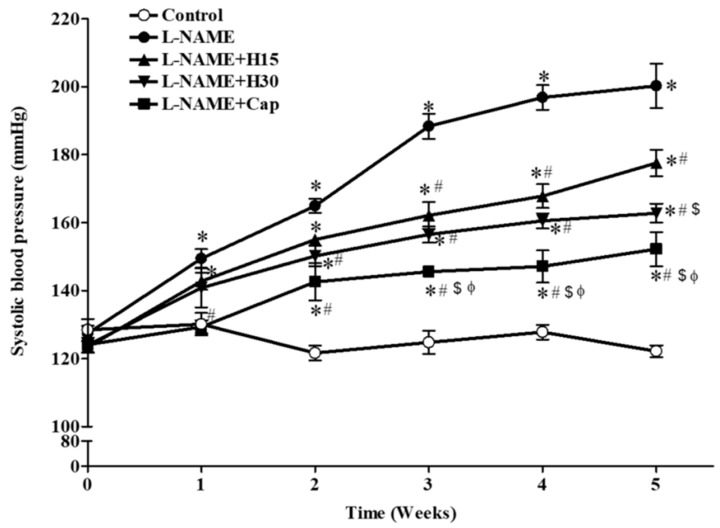
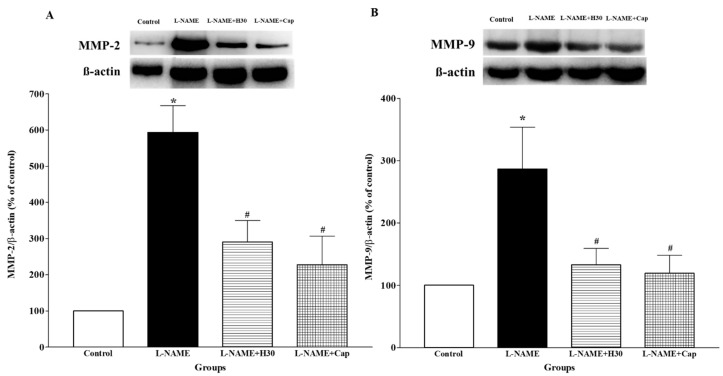
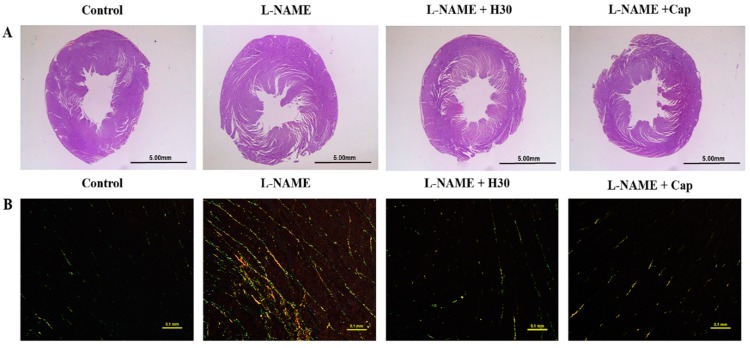
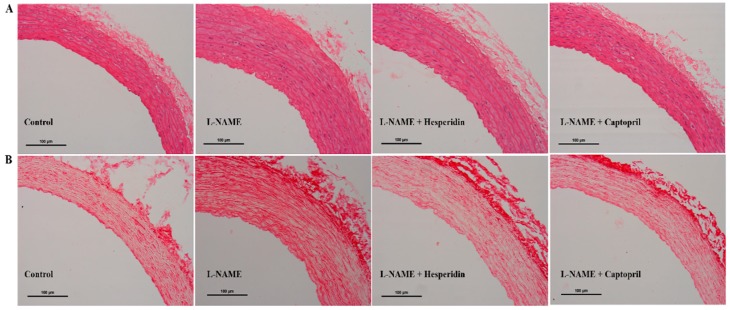
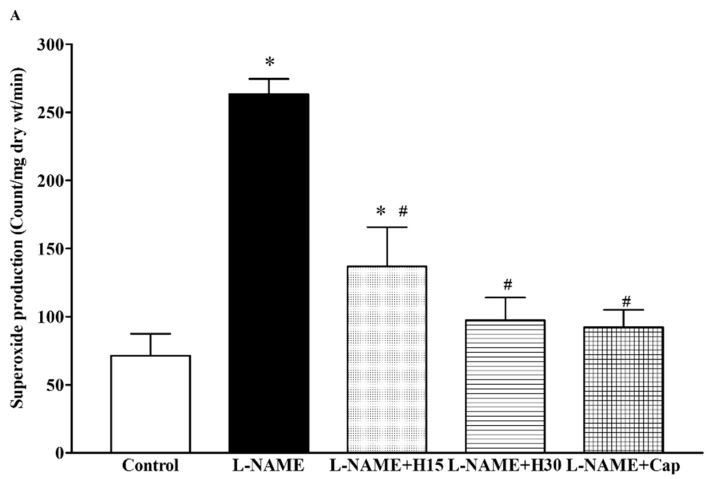
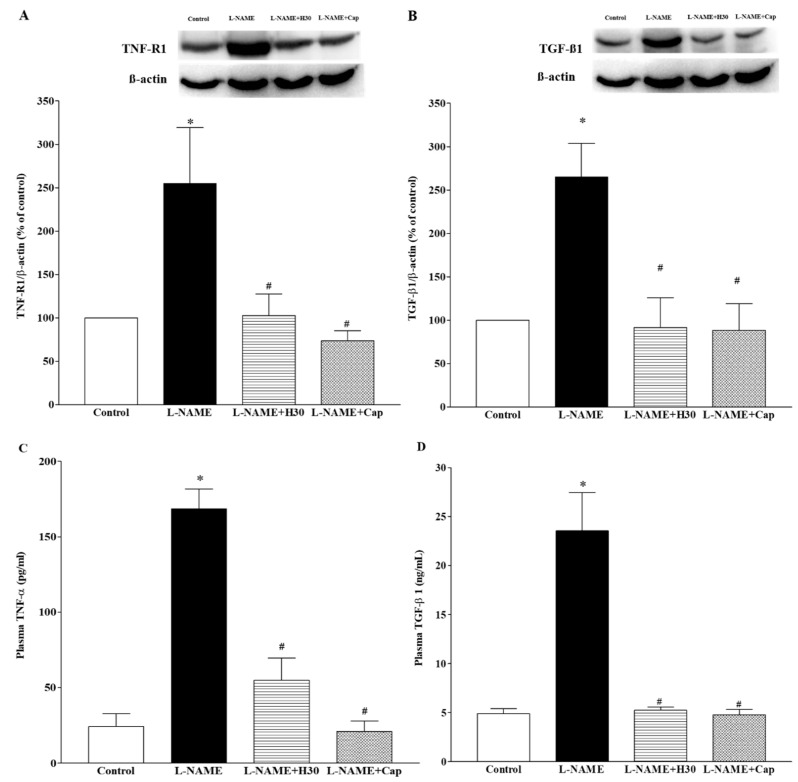
Hesperidin is a major flavonoid isolated from citrus fruits that exhibits several biological activities. This study aims to evaluate the effect of hesperidin on cardiovascular remodeling induced by n-nitro l-arginine methyl ester (l-NAME) in rats. Male Sprague-Dawley rats were treated with l-NAME (40 mg/kg), l-NAME plus hesperidin (15 mg/kg), hesperidin (30 mg/kg), or captopril (2.5 mg/kg) for five weeks ( = 8/group). Hesperidin or captopril significantly prevented the development of hypertension in l-NAME rats. l-NAME-induced cardiac remodeling, i.e., increases in wall thickness, cross-sectional area (CSA), and fibrosis in the left ventricular and vascular remodeling, i.e., increases in wall thickness, CSA, vascular smooth muscle cells, and collagen deposition in the aorta were attenuated by hesperidin or captopril. These were associated with reduced oxidative stress markers, tumor necrosis factor-alpha (TNF-α), transforming growth factor-beta 1 (TGF-β1), and enhancing plasma nitric oxide metabolite (NOx) in l-NAME treated groups. Furthermore, up-regulation of tumor necrosis factor receptor type 1 (TNF-R1) and TGF- β1 protein expression and the overexpression of matrix metalloproteinase-2 (MMP-2) and matrix metalloproteinase-9 (MMP-9) was suppressed in l-NAME rats treated with hesperidin or captopril. These data suggested that hesperidin had cardioprotective effects in l-NAME hypertensive rats. The possible mechanism may involve antioxidant and anti-inflammatory effects.
橙皮苷是从柑橘类水果中分离得到的一种主要类黄酮,具有多种生物学活性。本研究旨在评估橙皮苷对 n-硝基-l-精氨酸甲酯(l-NAME)诱导的大鼠心血管重构的影响。雄性 Sprague-Dawley 大鼠用 l-NAME(40mg/kg)、l-NAME 加橙皮苷(15mg/kg)、橙皮苷(30mg/kg)或卡托普利(2.5mg/kg)处理五周(每组 8 只)。橙皮苷或卡托普利显著预防了 l-NAME 大鼠的高血压发生。l-NAME 诱导的心脏重构,即左心室壁厚度、横截面积(CSA)和纤维化的增加,以及血管重构,即壁厚度、CSA、血管平滑肌细胞和主动脉胶原沉积的增加,均被橙皮苷或卡托普利减弱。这与降低氧化应激标志物、肿瘤坏死因子-α(TNF-α)、转化生长因子-β1(TGF-β1)和增强血浆一氧化氮代谢物(NOx)有关。此外,l-NAME 处理组中肿瘤坏死因子受体 1(TNF-R1)和 TGF-β1 蛋白表达上调,基质金属蛋白酶-2(MMP-2)和基质金属蛋白酶-9(MMP-9)过度表达被橙皮苷或卡托普利抑制。这些数据表明,橙皮苷对 l-NAME 高血压大鼠具有心脏保护作用。其可能的机制涉及抗氧化和抗炎作用。