Postdoctoral Fellow, New York University Rory Meyers College of Nursing, 433 First Avenue, 7th Floor, New York, NY, 10010, USA.
New York University Rory Meyers College of Nursing, 433 First Avenue, 7th Floor Room 737, New York, NY, 10010, USA.
Nutr Diabetes. 2018 Oct 22;8(1):56. doi: 10.1038/s41387-018-0064-7.
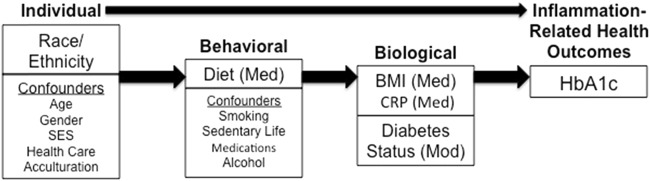
BACKGROUND/OBJECTIVE: Racial/ethnic disparities in type 2 diabetes (T2D) outcomes exist, and could be explained by nutrition- and inflammation-related differences. The objective of this study is to identify associations between race/ethnicity and glucose control among participants from NHANES 2007-2010, as influenced by diet quality, body mass, and inflammation and grouped by T2D status.
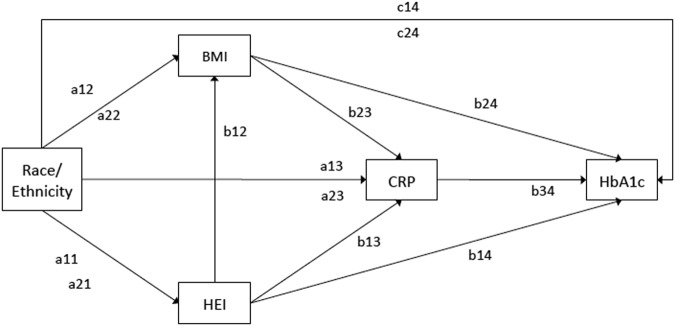
SUBJECTS/METHODS: The following is a cross-sectional, secondary data analysis of two NHANES data cycles spanning 2007-2010. The association between race/ethnicity and hemoglobin A1c (HbA1c) as mediated by dietary intake score, body mass index (BMI), and C-reactive protein (CRP) was assessed, as was the strength of the difference of that association, or moderation, by T2D status. The sample included n = 7850 non-pregnant adult participants ≥ 20 years of age who had two days of reliable dietary recall data, and no missing data on key variables included in the analysis. The primary outcome examined was HbA1c.
The model accurately explained the variation in HbA1c measures in participants without T2D, as mediated by diet quality, BMI, and CRP. However, significant variation in HbA1c remained after accounting for aforementioned mediators when contrasting non-Hispanic White to non-Hispanic Black participants without T2D. The model was not a good fit for explaining racial/ethnic disparities in HbA1c in participants with T2D. A test of the index of moderated mediation for this model was not significant for the differences in the effect of race/ethnicity on HbA1c by T2D status (moderator).
This study demonstrated that diet quality, BMI, and CRP mediated the effect of race/ethnicity on HbA1c in persons without T2D, but not in persons with T2D. Further research should include additional inflammatory markers, and other inflammation- and T2D-related health outcomes, and their association with racial/ethnic disparities in diabetes.
背景/目的:2 型糖尿病(T2D)的结果存在种族/民族差异,这些差异可能与营养和炎症相关的差异有关。本研究的目的是确定 2007-2010 年 NHANES 参与者中种族/民族与血糖控制之间的关联,同时考虑到饮食质量、体重和炎症,并根据 T2D 状况进行分组。
受试者/方法:这是一项对跨越 2007-2010 年的两个 NHANES 数据周期的横断面、二次数据分析。评估了种族/民族与糖化血红蛋白(HbA1c)之间的关联,该关联受饮食摄入评分、体重指数(BMI)和 C 反应蛋白(CRP)的影响,以及 T2D 状况对该关联的差异强度或调节作用的影响。该样本包括 n=7850 名≥20 岁的非孕妇成年参与者,他们有两天可靠的饮食记录数据,且分析中包含的关键变量无缺失数据。主要观察结果是 HbA1c。
该模型准确地解释了参与者中无 T2D 个体的 HbA1c 测量值的变化,这些变化受到饮食质量、BMI 和 CRP 的影响。然而,在考虑到上述中介因素后,当将非西班牙裔白人与非西班牙裔黑人参与者进行比较时,无 T2D 参与者的 HbA1c 仍存在显著差异。该模型无法很好地解释 T2D 参与者中 HbA1c 的种族/民族差异。对该模型的中介调节指数的检验对于 T2D 状态对 HbA1c 影响的种族/民族差异没有显著意义(调节因素)。
本研究表明,在无 T2D 个体中,饮食质量、BMI 和 CRP 调节了种族/民族对 HbA1c 的影响,但在 T2D 个体中则没有。进一步的研究应包括其他炎症标志物以及与炎症和 T2D 相关的其他健康结果,以及它们与糖尿病的种族/民族差异的关系。