Dai Cong, Zheng Yi, Li Yuanjie, Tian Tian, Wang Meng, Xu Peng, Deng Yujiao, Hao Qian, Wu Ying, Zhai Zhen, Dai Zhijun, Lyu Jun
Clinical Research Center, First Affiliated Hospital of Xi'an Jiaotong University, Xi'an, Shaanxi, 710061, People's Republic of China,
Department of Oncology, Second Affiliated Hospital of Xi'an Jiaotong University, Xi'an, Shaanxi, 710004, People's Republic of China,
Cancer Manag Res. 2018 Oct 10;10:4491-4500. doi: 10.2147/CMAR.S178345. eCollection 2018.
To evaluate the prognostic impact of HE4 expression in patients with cancer.
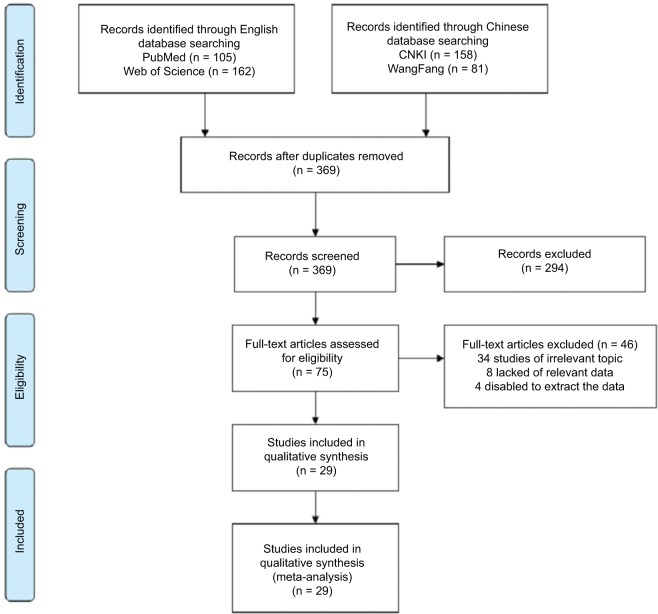
We searched the PubMed, Web of Science, Chinese National Knowledge Infrastructure and WangFang databases for publications concerning HE4 expression in patients with cancer. The correlation of HE4 expression level with overall survival (OS), disease-free survival (DFS), and progression-free survival (PFS) was analyzed.
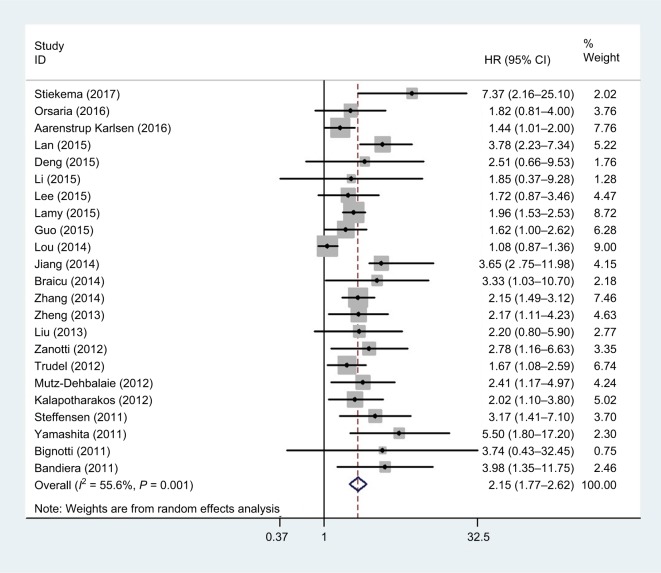
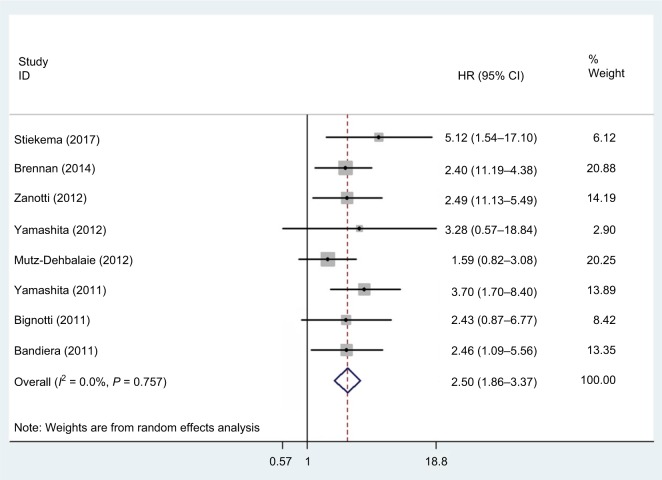
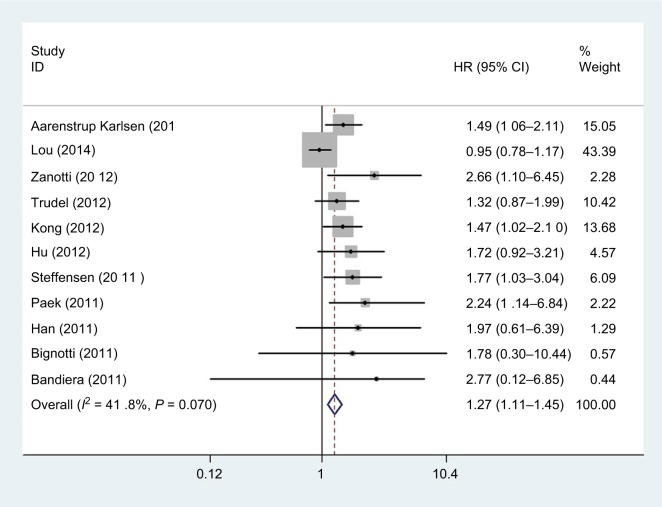
In this meta-analysis, 29 studies, with a total of 4,235 patients, were included. Our results showed that HE4 expression was significantly associated with poorer OS (hazard ratio [HR] =2.15, 95% confidence interval [CI] =1.77-2.62, <0.001). Further subgroup analysis found that this correlation was not affected by race (White: HR =1.92, 95% CI =1.53-2.39, <0.001; Asian: HR =2.62, 95% CI =2.06-3.35, <0.001) or tumor types (endometrial cancer: HR =2.91, 95% CI =1.86-4.53, <0.001; ovarian cancer: HR =1.82, 95% CI =1.50-2.22, <0.001; lung cancer: HR =2.31, 95% CI =1.54-3.47, <0.001). Our meta-analysis showed that HE4 overexpression was significantly associated with DFS (HR =2.50, 95% CI =1.86-3.37, <0.001) and PFS (HR =1.27, 95% CI =1.11-1.45, =0.001).
These results suggest that expression of HE4 was associated with a worse prognosis in patients with cancer. HE4 is a potential novel prognostic factor in patients with cancer.
评估癌胚抗原4(HE4)表达对癌症患者预后的影响。
我们检索了PubMed、科学网、中国知网和万方数据库,以查找有关癌症患者HE4表达的文献。分析了HE4表达水平与总生存期(OS)、无病生存期(DFS)和无进展生存期(PFS)的相关性。
在这项荟萃分析中,纳入了29项研究,共4235例患者。我们的结果显示,HE4表达与较差的总生存期显著相关(风险比[HR]=2.15,95%置信区间[CI]=1.77-2.62,P<0.001)。进一步的亚组分析发现,这种相关性不受种族(白人:HR=1.92,95%CI=1.53-2.39,P<0.001;亚洲人:HR=2.62,95%CI=2.06-3.35,P<0.001)或肿瘤类型(子宫内膜癌:HR=2.91,95%CI=1.86-4.53,P<0.001;卵巢癌:HR=1.82,95%CI=1.50-2.22,P<0.001;肺癌:HR=2.31,95%CI=1.54-3.47,P<0.001)的影响。我们的荟萃分析显示,HE4过表达与无病生存期(HR=2.50,95%CI=1.86-3.37,P<0.001)和无进展生存期(HR=1.27,95%CI=1.11-1.45,P=0.001)显著相关。
这些结果表明,HE4的表达与癌症患者较差的预后相关。HE4是癌症患者潜在的新型预后因素。