Lazarus Norman R, Harridge Stephen D R
Centre for Human & Applied Physiological Sciences, School of Basic & Medical Biosciences, Faculty of Life Sciences & Medicine, King's College London, London, United Kingdom.
Front Physiol. 2018 Oct 8;9:1135. doi: 10.3389/fphys.2018.01135. eCollection 2018.
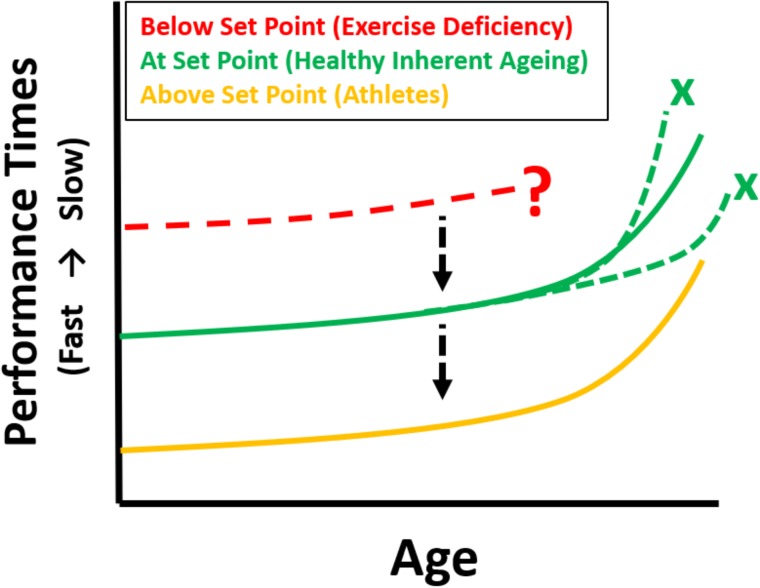
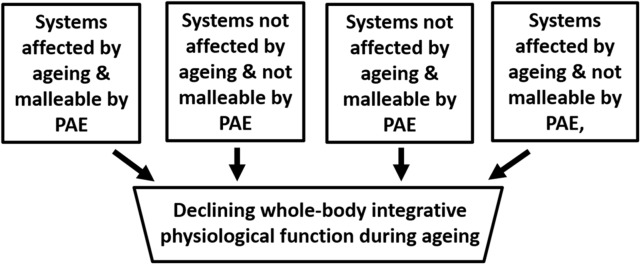
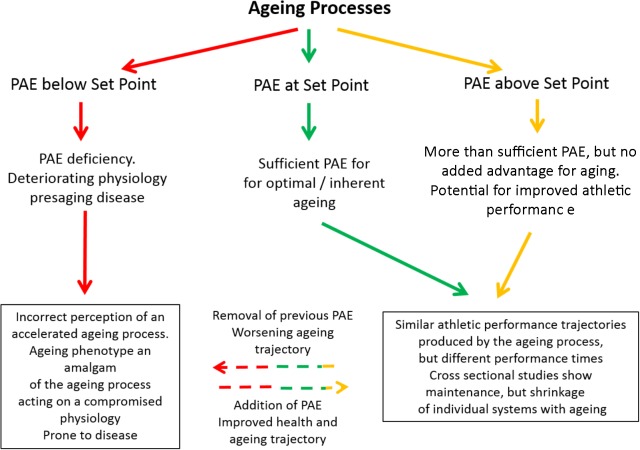
Arguably the best available depictions of the global physiological changes produced by age are the profiles of world record performance times in swimming, athletics, and cycling, depicting the trajectory of decline in maximal integrated physiological performance capability. The curves suggest that the aging process produces a synchronized, controlled decrease in physiological performance over the human lifespan. The shape of the performance profile by age is essentially independent of discipline, distance, or phenotype. Importantly, the specific times of performance are not the driving force in the production of the shape of the declining performance profile. We suggest that in these highly trained individuals the shape of the curve is generated by the aging process operating on a physiology optimized for any given age. We hypothesize that with adequate training this same profile and trajectory, but with lower performance times, would be generated by all individuals who engage in sufficient physical activity/exercise. Unlike performance, data obtained from examining individual physiological systems or tissues do not give information on the unceasing and changing global integrating functions of the aging process. However, these data do give valuable information about the integrity of physiological systems at a particular age and allow a direct comparison to be made between the effects of inactivity and physical activity/exercise. Being physically active has been shown to have global protective effects on physiological systems and thus facilitates the aging process by maintaining physiological integrity. There is emerging evidence which suggests that physiological regulation of aging may be multi-compartmentalized. We do not advocate exercise as a panacea, but all the evidence indicates that being physically active and exercising is far superior to any other alternative for achieving optimal aging.
可以说,关于年龄所带来的全球生理变化,现存最好的描述是游泳、田径和自行车项目世界纪录成绩的变化曲线,这些曲线描绘了最大综合生理机能下降的轨迹。这些曲线表明,衰老过程会在人类整个生命周期中使生理机能同步、可控地下降。按年龄划分的成绩曲线形状基本不受运动项目、距离或表型的影响。重要的是,具体的成绩时间并非成绩下降曲线形状产生的驱动因素。我们认为,在这些经过高度训练的个体中,曲线形状是由作用于针对任何给定年龄优化的生理机能的衰老过程所产生的。我们假设,通过充分的训练,所有进行足够身体活动/锻炼的个体都会产生相同的曲线形状和轨迹,只是成绩时间会更低。与成绩不同,从检查个体生理系统或组织获得的数据并不能提供关于衰老过程中持续且不断变化的整体整合功能的信息。然而,这些数据确实能提供关于特定年龄生理系统完整性的宝贵信息,并允许直接比较不活动和身体活动/锻炼的影响。已表明身体活动对生理系统具有全面的保护作用,从而通过维持生理完整性促进衰老过程。有新出现的证据表明,衰老的生理调节可能是多方面的。我们并不主张将运动视为万灵药,但所有证据都表明,为了实现最佳衰老,身体活动和锻炼远比其他任何方式都要好。