Faculty of Medicine, Center for Chronic Immunodeficiency, Medical Center - University of Freiburg, Freiburg, Germany.
Front Immunol. 2018 Oct 8;9:2285. doi: 10.3389/fimmu.2018.02285. eCollection 2018.
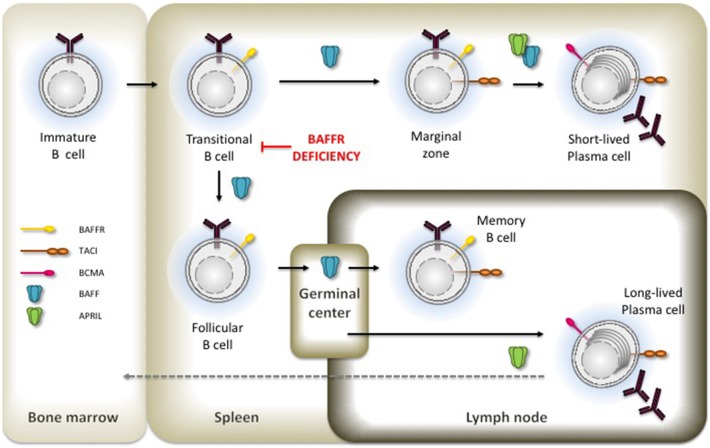
The BAFF-receptor (BAFFR) is encoded by the TNFRSF13C gene and is one of the main pro-survival receptors in B cells. Its function is impressively documented in humans by a homozygous deletion within exon 2, which leads to an almost complete block of B cell development at the stage of immature/transitional B cells. The resulting immunodeficiency is characterized by B-lymphopenia, agammaglobulinemia, and impaired humoral immune responses. However, different from mutations affecting pathway components coupled to B cell antigen receptor (BCR) signaling, BAFFR-deficient B cells can still develop into IgA-secreting plasma cells. Therefore, BAFFR deficiency in humans is characterized by very few circulating B cells, very low IgM and IgG serum concentrations but normal or high IgA levels.
BAFF 受体(BAFFR)由 TNFRSF13C 基因编码,是 B 细胞中主要的存活受体之一。在人类中,通过第 2 外显子内的纯合缺失,其功能得到了令人印象深刻的证明,这导致 B 细胞发育在未成熟/过渡 B 细胞阶段几乎完全受阻。由此产生的免疫缺陷的特征是 B 淋巴细胞减少、丙种球蛋白血症和体液免疫应答受损。然而,与影响与 B 细胞抗原受体(BCR)信号偶联的途径成分的突变不同,BAFFR 缺陷 B 细胞仍然可以发育成分泌 IgA 的浆细胞。因此,人类的 BAFFR 缺乏症的特征是循环 B 细胞非常少,IgM 和 IgG 血清浓度非常低,但 IgA 水平正常或升高。