Salta Stella, Papageorgiou Loula, Larsen Annette K, Van Dreden Patrick, Soulier Claire, Cokkinos Dennis V, Elalamy Ismail, Gerotziafas Grigoris T
Cancer Biology and Therapeutics Centre de Recherche Saint-Antoine Institut National de la Santé et de la Recherche Médicale (INSERM) U938 and Institut Universitaire de Cancérologie Faculté de Médecine, Sorbonne Université Paris France.
Service d'Hématologie Biologique Hôpital Tenon Hôpitaux Universitaires Est Parisien Assistance Publique Hôpitaux de Paris (AP-HP) Paris France.
Res Pract Thromb Haemost. 2018 Jul 17;2(4):696-707. doi: 10.1002/rth2.12120. eCollection 2018 Oct.
Venous thromboembolism (VTE) is associated with significant morbidity and mortality.
We investigated the impact of direct and AT-dependent FXa or thrombin inhibitors on thrombus formation.
Whole blood thromboelastometry and thrombin generation were assessed after triggering the TF pathway. Clinically relevant concentrations of rivaroxaban, fondaparinux, dabigatran or tinzaparin and an association of rivaroxaban and dabigatran were examined.
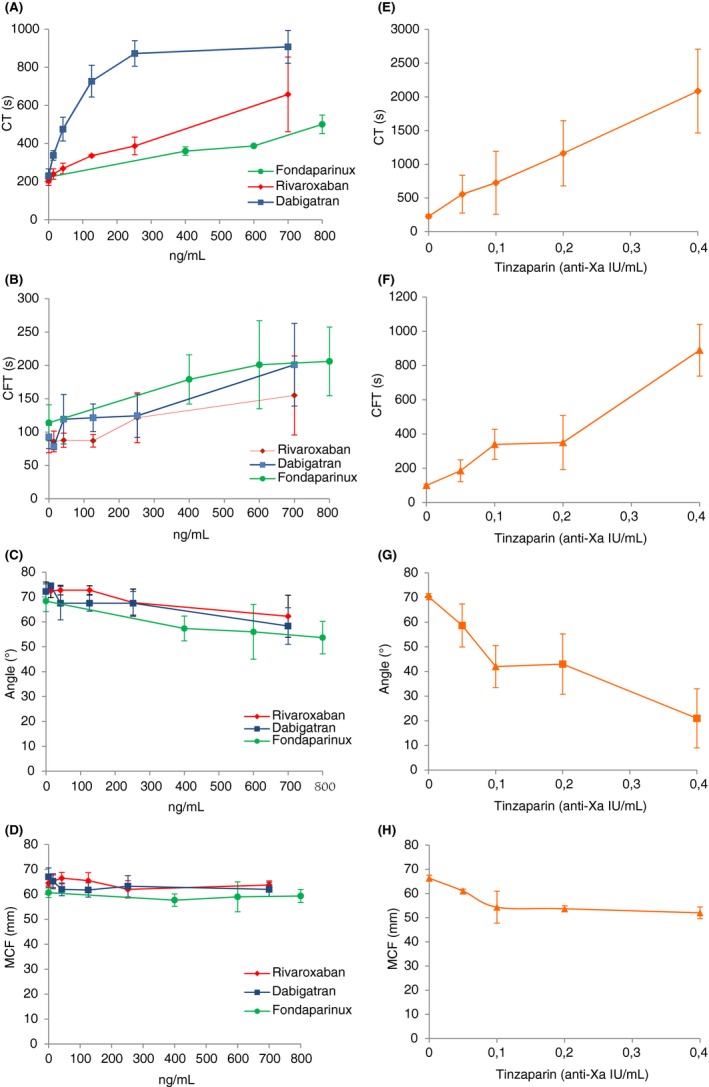
All agents delayed thrombus formation in a concentration-dependent manner, as documented by the prolongation of the clotting time (CT) and clot formation time (CFT). Rivaroxaban did not significantly alter the α-angle or maximum clot firmness (MCF). In contrast, dabigatran and fondaparinux altered the process of clot structure by decreasing the α-angle, but did not modify clot firmness. The later property was significantly affected only by tinzaparin that also reduced the MCF. The association of rivaroxaban and dabigatran did not affect the MCF, although it amplified the effect on CFT and α-angle.
All agents delayed thrombus formation. However, the compounds differed substantially with respect to fibrin polymerization rate and clot firmness. Comparison of the data obtained by thrombin generation assessment with those obtained by the thromboelastometric study shows that the delay in clot formation is principally associated with prolongation of the initiation phase of thrombin formation as well as a reduction of the propagation phase. Tinzaparin was much more potent than the other agents both with regard to suppression of thrombin generation and by delay in clot formation.
静脉血栓栓塞症(VTE)与显著的发病率和死亡率相关。
我们研究了直接和依赖抗凝血酶的因子Xa或凝血酶抑制剂对血栓形成的影响。
在触发组织因子(TF)途径后,评估全血血栓弹力图和凝血酶生成情况。检测了利伐沙班、磺达肝癸钠、达比加群或亭扎肝素的临床相关浓度,以及利伐沙班和达比加群的联合使用情况。
所有药物均以浓度依赖的方式延迟血栓形成,凝血时间(CT)和凝血形成时间(CFT)延长证明了这一点。利伐沙班未显著改变α角或最大血凝块硬度(MCF)。相比之下,达比加群和磺达肝癸钠通过降低α角改变了血凝块结构形成过程,但未改变血凝块硬度。只有亭扎肝素显著影响了后者的特性,它也降低了MCF。利伐沙班和达比加群的联合使用虽未影响MCF,但放大了对CFT和α角的作用。
所有药物均延迟血栓形成。然而,这些化合物在纤维蛋白聚合速率和血凝块硬度方面存在显著差异。凝血酶生成评估获得的数据与血栓弹力图研究获得的数据比较表明,血凝块形成延迟主要与凝血酶形成起始阶段的延长以及传播阶段的减少有关。在抑制凝血酶生成和延迟血凝块形成方面,亭扎肝素比其他药物更有效。