Department of Transplantation Surgery, Severance Hospital, Yonsei University Health System, Seoul, Republic of Korea.
Department of Surgery, Yonsei University College of Medicine, Seoul, Republic of Korea.
Sci Rep. 2018 Oct 23;8(1):15629. doi: 10.1038/s41598-018-34111-5.
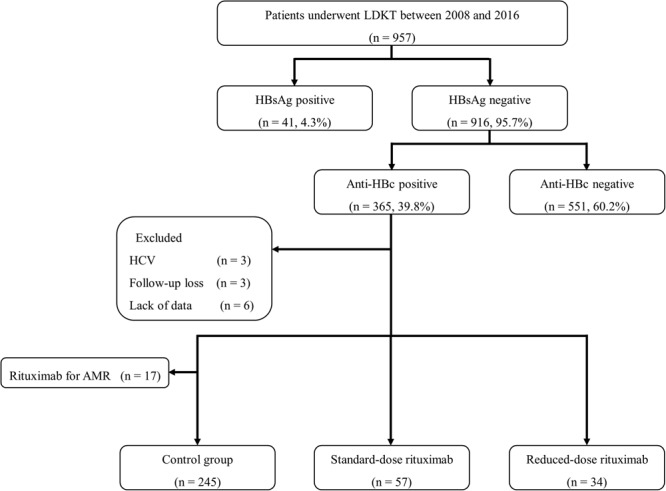
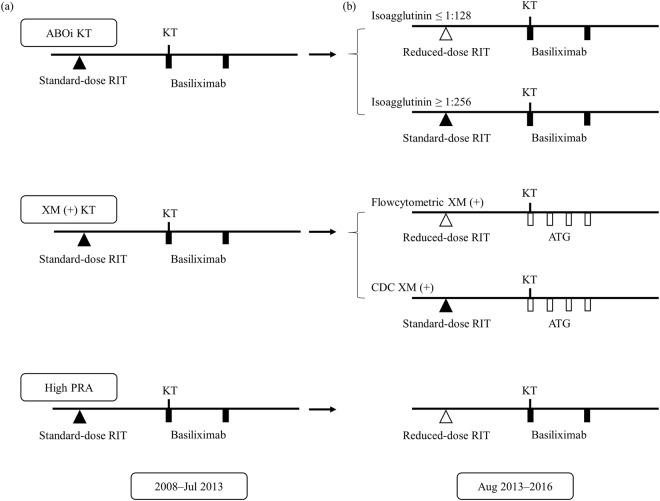
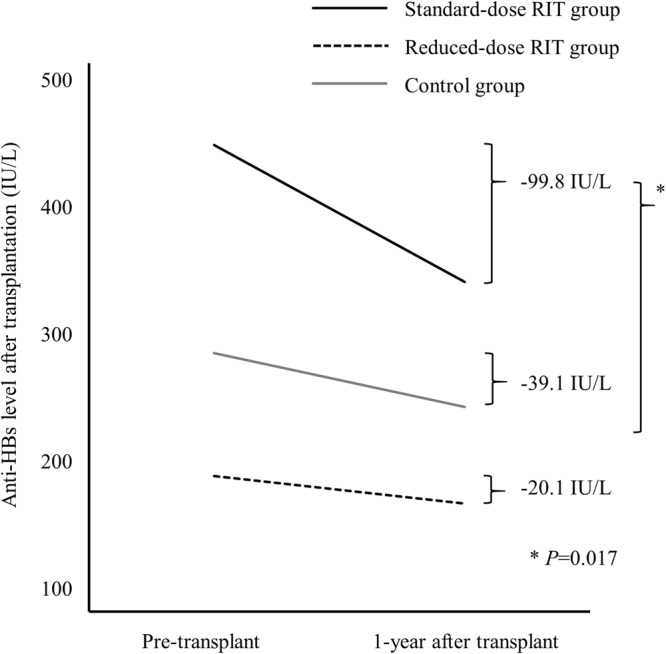
Sensitized patients received desensitization therapy with rituximab for kidney transplantation. However, the impact of rituximab dose on hepatitis B virus (HBV) reactivation is unknown. Patients who underwent living donor kidney transplantation between 2008 and 2016 were grouped according to rituximab dose (control vs. standard-dose rituximab [375 mg/m] vs. reduced-dose rituximab [200 mg/body]) for comparison of HBV reactivation. A total of 336 hepatitis B surface antigen (HBsAg)-negative/antibody to hepatitis B core antigen (anti-HBc)-positive patients underwent kidney transplantation, of whom 91 (27.1%) received rituximab for desensitization (57 standard-dose and 34 reduced-dose rituximab). During the study period, eight patients experienced HBV reactivation (three in the control group, five in the standard-dose group). In the standard-dose group, four patients experienced hepatitis flare, and one patient died due to hepatic failure. No HBV reactivation occurred in the reduced-dose group. Standard-dose rituximab significantly decreased hepatitis B surface antigen antibody titer (anti-HBs; -99.8 IU/L) at 12 months, compared with reduced-dose rituximab (-20.1 IU/L) and control (-39.1 IU/L, P = 0.017). Standard-dose rituximab (HR, 10.60; 95% CI, 2.52-44.60; P = 0.001) and anti-HBs < 100 IU/L at transplantation (HR, 9.06; 95% CI, 1.11-74.30; P = 0.04) were independent risk factors for HBV reactivation. Standard-dose rituximab significantly increased HBV reactivation risk for HBsAg-negative/anti-HBc-positive kidney transplant patients.
致敏患者接受利妥昔单抗脱敏治疗以进行肾移植。然而,利妥昔单抗剂量对乙型肝炎病毒(HBV)再激活的影响尚不清楚。根据利妥昔单抗剂量(对照组、标准剂量利妥昔单抗[375mg/m]、低剂量利妥昔单抗[200mg/体])将 2008 年至 2016 年间接受活体供肾移植的患者进行分组,以比较 HBV 再激活。共有 336 例乙型肝炎表面抗原(HBsAg)阴性/乙型肝炎核心抗体(抗-HBc)阳性患者接受了肾移植,其中 91 例(27.1%)接受了利妥昔单抗脱敏治疗(57 例标准剂量和 34 例低剂量利妥昔单抗)。在研究期间,有 8 例患者发生 HBV 再激活(对照组 3 例,标准剂量组 5 例)。在标准剂量组中,有 4 例患者出现肝炎发作,1 例患者因肝功能衰竭死亡。低剂量组未发生 HBV 再激活。与低剂量利妥昔单抗(-20.1IU/L)和对照组(-39.1IU/L,P=0.017)相比,标准剂量利妥昔单抗在 12 个月时显著降低了乙型肝炎表面抗原抗体滴度(抗-HBs;-99.8IU/L)。标准剂量利妥昔单抗(HR,10.60;95%CI,2.52-44.60;P=0.001)和移植时抗-HBs<100IU/L(HR,9.06;95%CI,1.11-74.30;P=0.04)是 HBV 再激活的独立危险因素。标准剂量利妥昔单抗显著增加了 HBsAg 阴性/抗-HBc 阳性肾移植患者的 HBV 再激活风险。