SYNMIKRO, LOEWE Center for Synthetic Microbiology, Marburg, Germany.
Department of Chemistry, Philipps Universität Marburg, Marburg, Germany.
Sci Rep. 2018 Oct 24;8(1):15747. doi: 10.1038/s41598-018-33842-9.
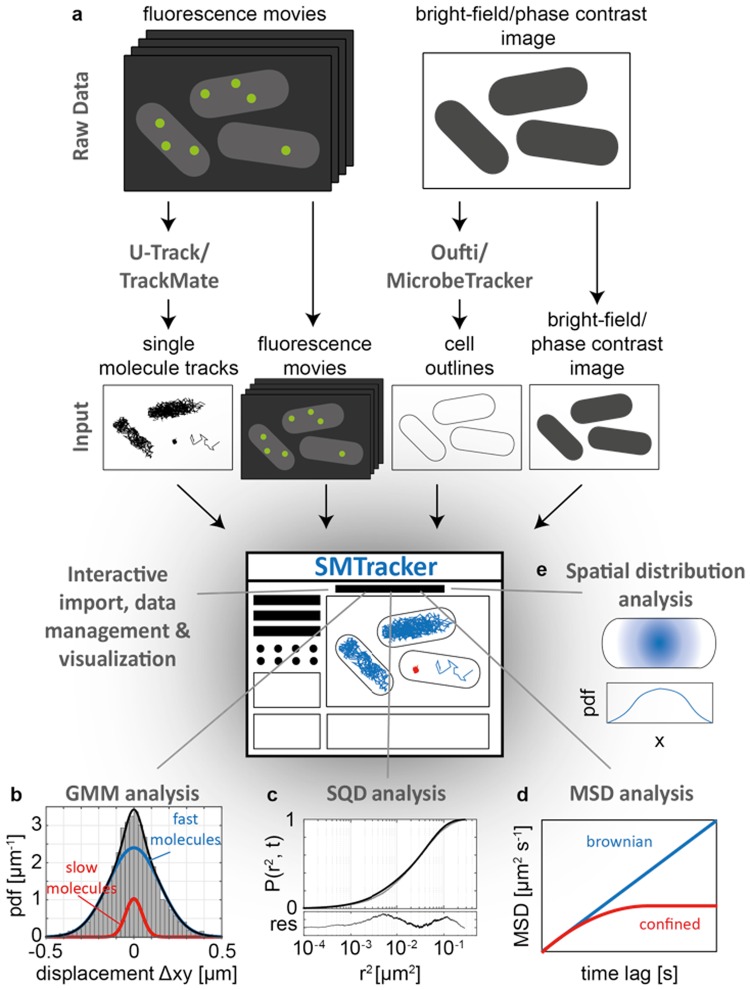
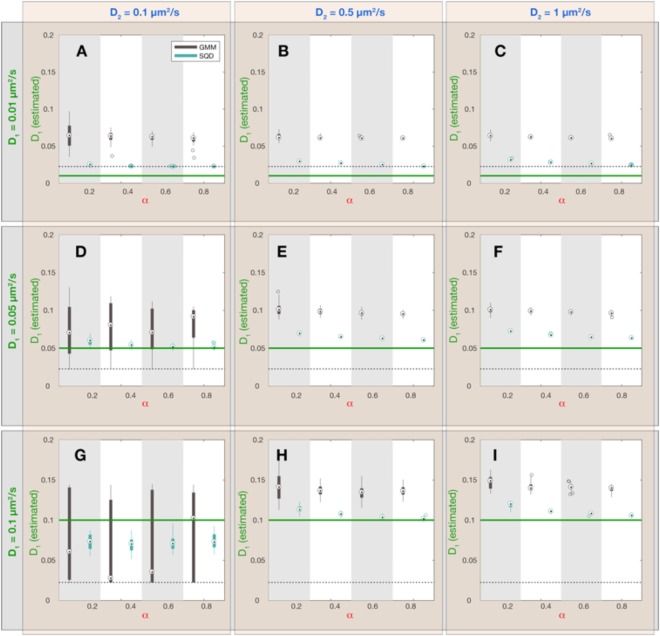
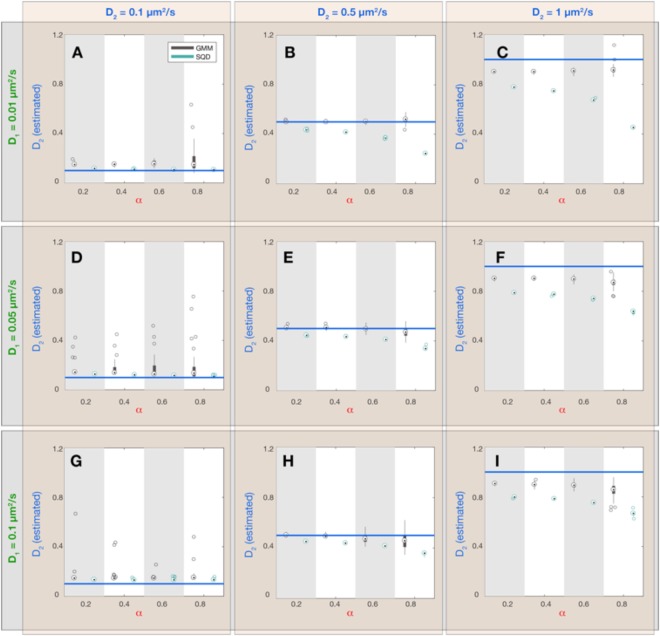
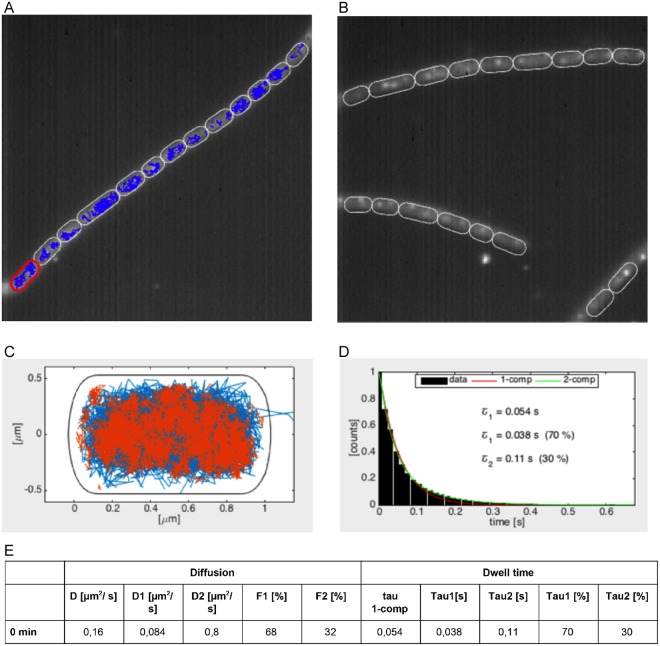
Single-particle (molecule) tracking (SPT/SMT) is a powerful method to study dynamic processes in living cells at high spatial and temporal resolution. Even though SMT is becoming a widely used method in bacterial cell biology, there is no program employing different analytical tools for the quantitative evaluation of tracking data. We developed SMTracker, a MATLAB-based graphical user interface (GUI) for automatically quantifying, visualizing and managing SMT data via five interactive panels, allowing the user to interactively explore tracking data from several conditions, movies and cells on a track-by-track basis. Diffusion constants are calculated a) by a Gaussian mixture model (GMM) panel, analyzing the distribution of positional displacements in x- and y-direction using a multi-state diffusion model (e.g. DNA-bound vs. freely diffusing molecules), and inferring the diffusion constants and relative fraction of molecules in each state, or b) by square displacement analysis (SQD), using the cumulative probability distribution of square displacements to estimate the diffusion constants and relative fractions of up to three diffusive states, or c) through mean-squared displacement (MSD) analyses, allowing the discrimination between Brownian, sub- or superdiffusive behavior. A spatial distribution analysis (SDA) panel analyzes the subcellular localization of molecules, summarizing the localization of trajectories in 2D- heat maps. Using SMTracker, we show that the global transcriptional repressor AbrB performs highly dynamic binding throughout the Bacillus subtilis genome, with short dwell times that indicate high on/off rates in vivo. While about a third of AbrB molecules are in a DNA-bound state, 40% diffuse through the chromosome, and the remaining molecules freely diffuse through the cells. AbrB also forms one or two regions of high intensity binding on the nucleoids, similar to the global gene silencer H-NS in Escherichia coli, indicating that AbrB may also confer a structural function in genome organization.
单粒子(分子)跟踪(SPT/SMT)是一种在高时空分辨率下研究活细胞中动态过程的强大方法。尽管 SMT 正在成为细菌细胞生物学中广泛使用的方法,但没有一个程序使用不同的分析工具来对跟踪数据进行定量评估。我们开发了 SMTracker,这是一个基于 MATLAB 的图形用户界面(GUI),通过五个交互面板自动量化、可视化和管理 SMT 数据,允许用户在逐个轨迹的基础上交互探索来自多个条件、电影和细胞的跟踪数据。扩散常数可以通过 a)高斯混合模型(GMM)面板来计算,该面板通过多态扩散模型(例如 DNA 结合分子与自由扩散分子)分析 x 和 y 方向的位置位移分布,并推断出扩散常数和每个状态下的分子相对分数,或 b)通过平方位移分析(SQD)来计算,使用平方位移的累积概率分布来估计扩散常数和多达三个扩散状态的相对分数,或 c)通过均方根位移(MSD)分析来计算,允许区分布朗运动、亚扩散或超扩散行为。一个空间分布分析(SDA)面板分析分子的亚细胞定位,将轨迹的定位概括为 2D-热图。使用 SMTracker,我们表明全局转录抑制剂 AbrB 在整个枯草芽孢杆菌基因组中表现出高度动态的结合,停留时间短,表明体内的开闭率很高。大约三分之一的 AbrB 分子处于 DNA 结合状态,40%扩散通过染色体,其余分子自由扩散通过细胞。AbrB 还在核体上形成一个或两个高强度结合区域,类似于大肠杆菌中的全局基因沉默因子 H-NS,这表明 AbrB 也可能在基因组组织中发挥结构功能。