Yang Feng, Chen Tai-Yen, Krzemiński Łukasz, Santiago Ace George, Jung Won, Chen Peng
Department of Chemistry and Chemical Biology, Cornell University, Ithaca, NY, 14853, USA.
Mol Microbiol. 2016 Dec;102(6):992-1003. doi: 10.1111/mmi.13529. Epub 2016 Sep 30.
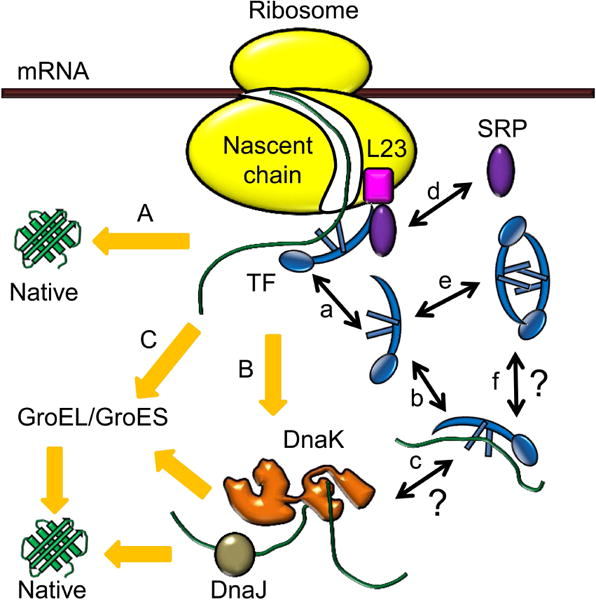
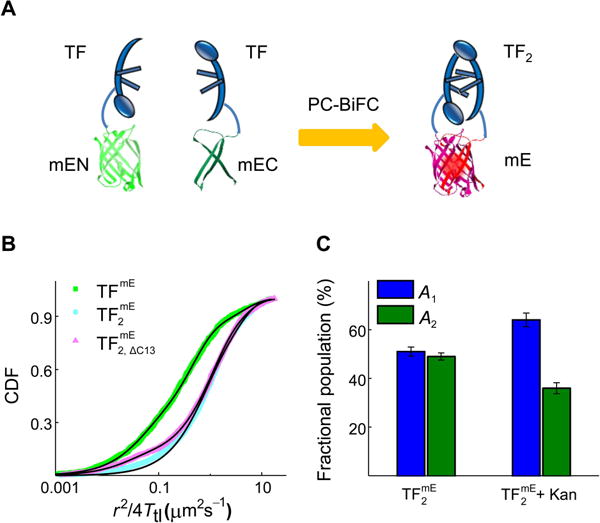
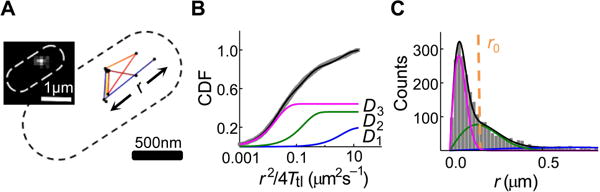
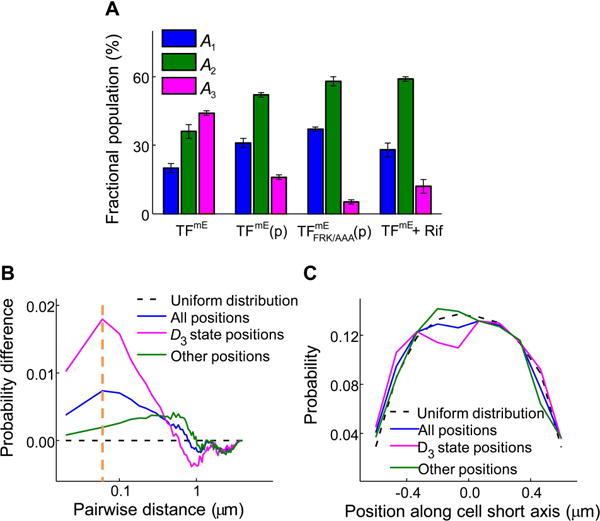
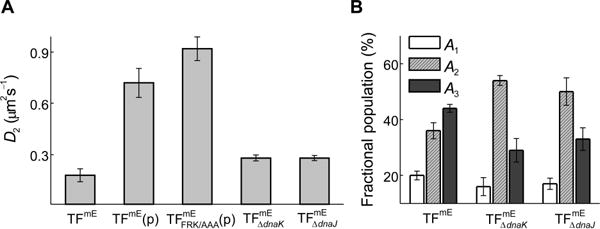
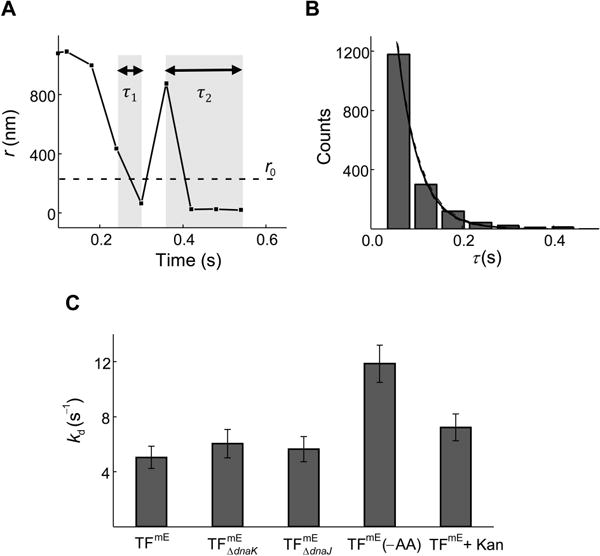
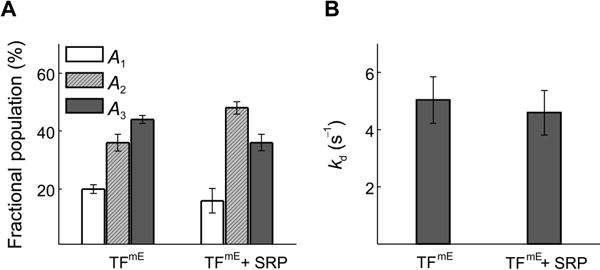
In bacteria, trigger factor (TF) is the molecular chaperone that interacts with the ribosome to assist the folding of nascent polypeptides. Studies in vitro have provided insights into the function and mechanism of TF. Much is to be elucidated, however, about how TF functions in vivo. Here, we use single-molecule tracking, in combination with genetic manipulations, to study the dynamics and function of TF in living E. coli cells. We find that TF, besides interacting with the 70S ribosome, may also bind to ribosomal subunits and form TF-polypeptide complexes that may include DnaK/DnaJ proteins. The TF-70S ribosome interactions are highly dynamic inside cells, with an average residence time of ∼0.2 s. Our results confirm that the signal recognition particle weakens TF's interaction with the 70S ribosome, and further identify that this weakening mainly results from a change in TF's binding to the 70S ribosome, rather than its unbinding. Moreover, using photoconvertible bimolecular fluorescence complementation, we selectively probe TF dimers in the cell and show that TF does not bind to the 70S ribosome but is involved in the post-translational interactions with polypeptides. These findings contribute to the fundamental understanding of molecular chaperones in assisting protein folding in living cells.
在细菌中,触发因子(TF)是一种分子伴侣,它与核糖体相互作用以协助新生多肽的折叠。体外研究为TF的功能和机制提供了见解。然而,关于TF在体内如何发挥作用仍有许多有待阐明的地方。在这里,我们结合基因操作,使用单分子追踪技术来研究TF在活的大肠杆菌细胞中的动态变化和功能。我们发现,TF除了与70S核糖体相互作用外,还可能与核糖体亚基结合,并形成可能包含DnaK/DnaJ蛋白的TF-多肽复合物。TF与70S核糖体的相互作用在细胞内高度动态,平均停留时间约为0.2秒。我们的结果证实信号识别颗粒会削弱TF与70S核糖体的相互作用,并进一步确定这种削弱主要是由于TF与70S核糖体结合的变化,而不是其解离。此外,我们使用光转换双分子荧光互补技术,在细胞中选择性地探测TF二聚体,并表明TF不与70S核糖体结合,而是参与与多肽的翻译后相互作用。这些发现有助于从根本上理解分子伴侣在活细胞中协助蛋白质折叠的过程。