Department of Biochemistry, Osaka International Cancer Institute, Osaka.
Department of Obstetrics and Gynecology, Osaka University Graduate School of Medicine.
Int J Gynecol Cancer. 2018 Nov;28(9):1751-1757. doi: 10.1097/IGC.0000000000001354.
The phenotypic and pathological features of small cell cervical carcinoma (SMCC) and small small cell lung cancer (SCLC) are very similar; thus, the chemotherapy regimens used for the rare SMCC have been routinely based on regimens used for common SCLC. We set out to explore the protein expression profile similarities between these 2 cancers to prove that linking their therapeutic regimens is justified, with a secondary aim of finding tumor-specific proteins to use as additional biomarkers for more accurate diagnosis of SMCC, and potentially to use as therapeutic targets.
Protein expression analysis was performed for 3 cases of SMCC and 1 example each of SCLC, mucinous adenocarcinoma of the cervix (MACC), lung mucinous adenocarcinoma (MACL), and squamous cell carcinoma of the cervix (SCC). We used cancer tissue-originated spheroids (CTOS) and isobaric tags for relative and absolute quantitation (iTRAQ)-based comprehensive and quantitative protein expression profile analysis. Expression in corresponding clinical samples was verified by immunohistochemistry.
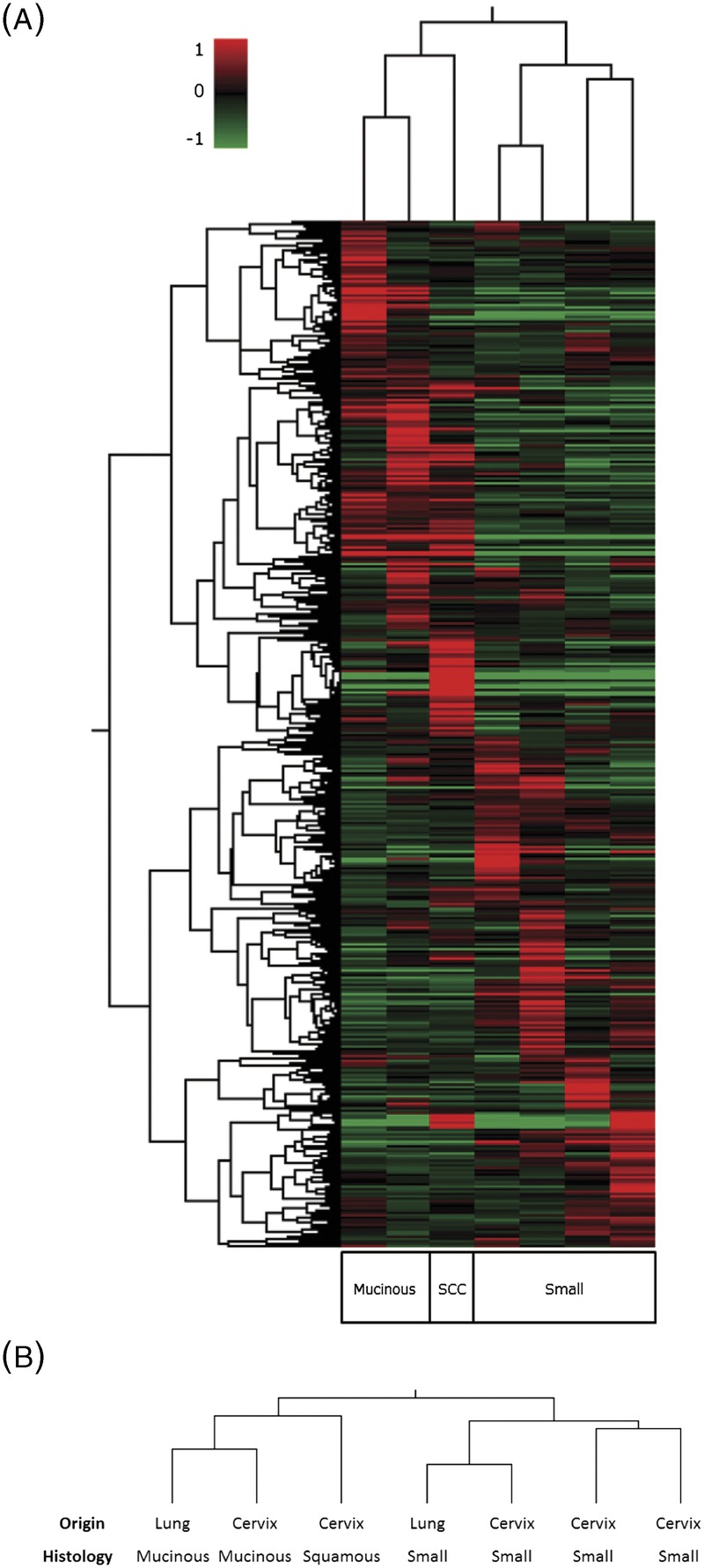
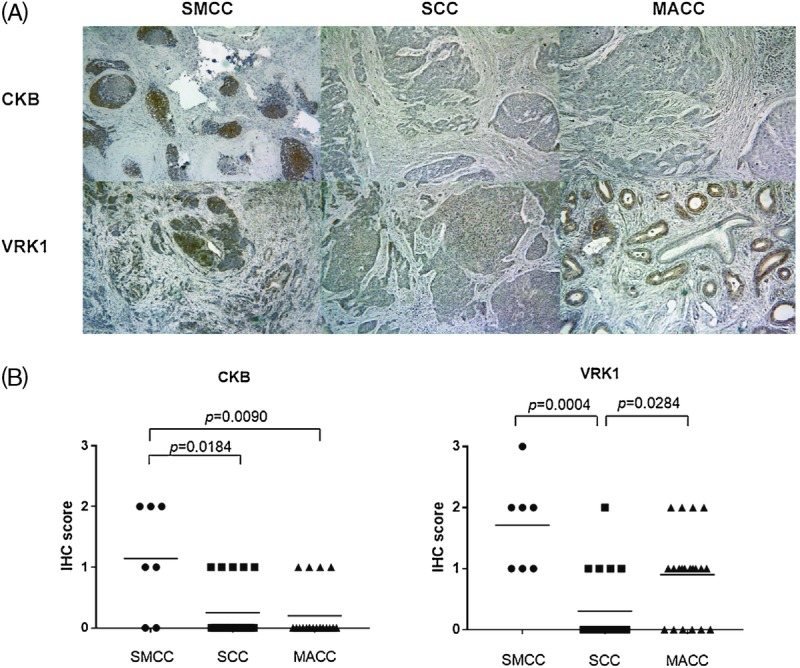
Rather than organ of origin-specific patterns, the SMCC and SCLC samples revealed remarkably similar protein expression profiles-in agreement with their matching tumor pathology phenotypes. Sixteen proteins were expressed at least 2-fold higher in both small cell carcinomas (SMCC and SCLC) than in MACC or SCC. Immunohistochemical analysis confirmed higher expression of creatine kinase B-type in SMCC, compared with MACC and SCC.
We demonstrate a significant overlapping similarity of protein expression profiles of lung and cervical small cell carcinomas despite the significant differences in their organs of origin.
小细胞宫颈癌(SMCC)和小细胞肺癌(SCLC)的表型和病理特征非常相似;因此,用于罕见 SMCC 的化疗方案通常基于用于常见 SCLC 的方案。我们旨在探讨这两种癌症之间的蛋白质表达谱相似性,以证明将它们的治疗方案联系起来是合理的,次要目的是找到肿瘤特异性蛋白,作为更准确诊断 SMCC 的额外生物标志物,并可能用作治疗靶点。
对 3 例 SMCC 和 1 例 SCLC、宫颈黏液腺癌(MACC)、肺黏液腺癌(MACL)和宫颈鳞状细胞癌(SCC)进行蛋白质表达分析。我们使用源自癌症组织的球体(CTOS)和基于等压标签的相对和绝对定量(iTRAQ)的全面和定量蛋白质表达谱分析。通过免疫组织化学验证相应临床样本中的表达。
SMCC 和 SCLC 样本显示出非常相似的蛋白质表达谱,而不是特定于器官起源的模式,这与它们匹配的肿瘤病理表型一致。在 SMCC 和 SCLC 中,有 16 种蛋白质的表达至少是 MACC 或 SCC 的 2 倍。免疫组织化学分析证实,与 MACC 和 SCC 相比,SMCC 中肌酸激酶 B 型表达更高。
尽管起源器官存在显著差异,但我们证明了肺和宫颈小细胞癌的蛋白质表达谱存在显著重叠的相似性。